





















 Saudi Arabia
 UAE
 Qatar
 Bahrain
 Kuwait
 Oman
 Lebanon
 Egypt
 Jordan
 Iraq
 India
 UK
 Ireland
 Germany
 USA
 Australia
 Singapore
 South Africa
 France
 Hungary
 Georgia
 Turkey
 Canada
 LagosNigeria




ERPNext for Manufacturing in Saudi Arabia
Saudi factories range from food plants in Riyadh to plastics converters in Jubail and metal shops in Dammam. ERPNext's Manufacturing module covers bills of materials, work orders, job cards and quality, and we configure it to match how your plant actually produces, costs and ships.
- Bills of materials
- Production planning
- Work orders and job cards
- Quality inspection
 ERPNext & FrappeImplementation · migration · AMC
Get a free quote
Reply within 24 hours with scope and a fixed quote.
ERPNext for Manufacturing in Saudi Arabia: the short answer
- Production styles
- Make to stock, make to order and batch process manufacturing, including multi-level bills of materials.
- Costing
- Material, labour and workstation costs captured per work order, with valuation in your stock ledger.
- Quality
- Inspection templates on receipt, in process and before dispatch, with results linked to batches.
- Compliance
- Cleared B2B invoices through a ZATCA app, 15% VAT and GOSI payroll for production staff.
- Delivered by
- Shyphan AI Solutions, an ERPNext implementation partner and Zoho Premium Partner, with 24/7 support. Call +966 54 176 1946.
- Last reviewed
- 27 November 2026
From raw material to cleared invoice in one system
Consider a plastics converter in Jubail buying polymer from a local petrochemical producer, turning it into film and packaging, and selling to food companies across the Kingdom. It needs to plan production against customer orders, consume resin by batch, record scrap, inspect rolls before dispatch, and know the real margin on each order. Before ERPNext, that knowledge is usually split between a production spreadsheet, a stores ledger and the accounting package.
ERPNext brings these together. A sales order can trigger a production plan, which raises work orders and purchase requests. Job cards record time on each operation and workstation. Materials are consumed from stock by batch, finished goods are received with their own batch numbers, and costs post to the ledger automatically. When the goods ship, the invoice goes to Fatoora for clearance through the ZATCA app without anyone re-keying data.
The same structure works for very different plants. A dates packer in Qassim, a furniture maker in Riyadh and a metal fabricator in Dammam all use bills of materials, work orders and quality checks, but with different emphasis. The packer cares about batches and shelf life, the furniture maker about made-to-order variants, the fabricator about drawings and job costing. We set ERPNext up around the emphasis that drives your margin, and leave out features that would only add clicks.
From first record to the finished report
One open-source system, so each step feeds the next without re-keying.
Manufacturing capabilities we configure
Bills of materials
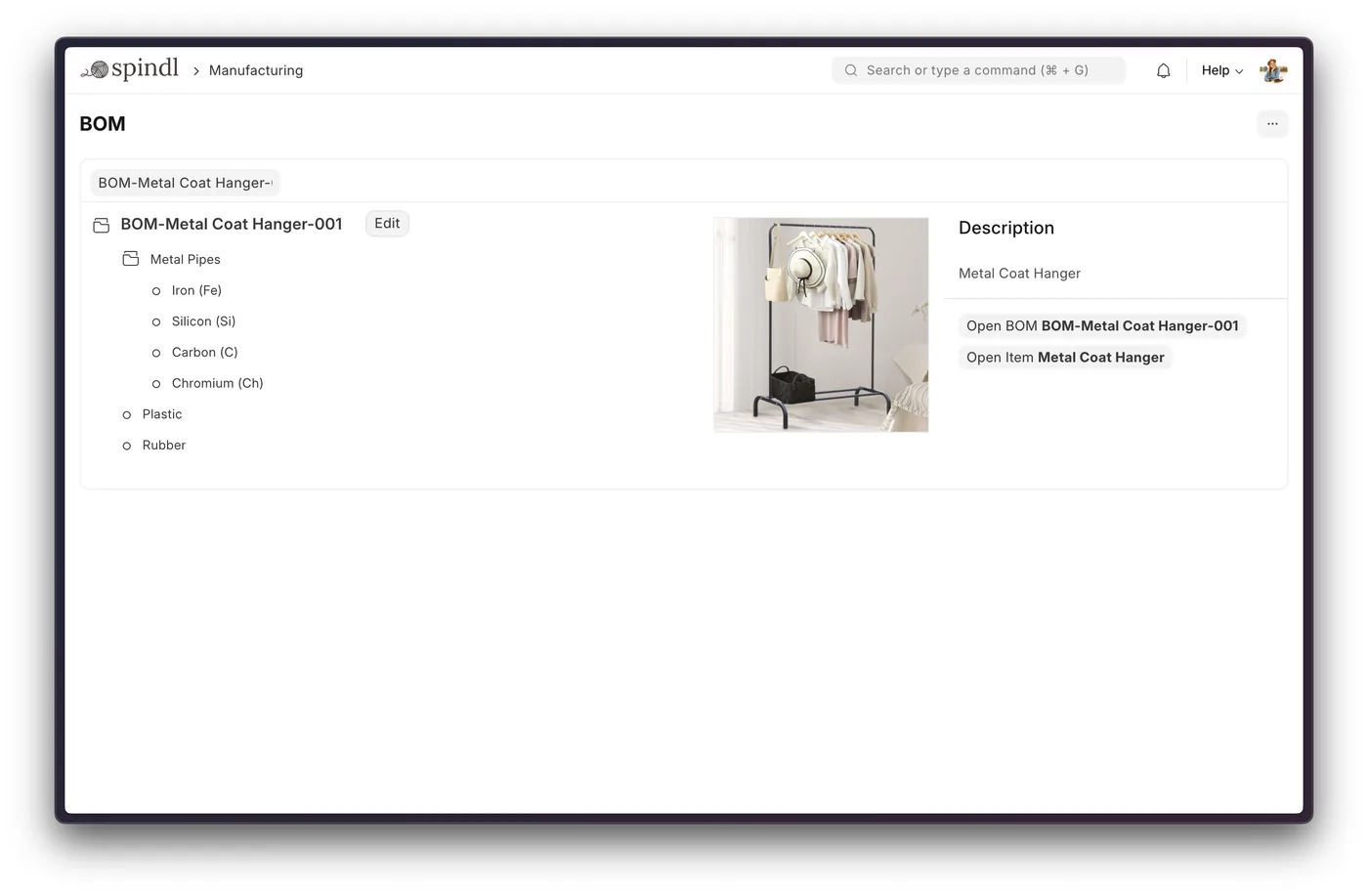
Multi-level BOMs with raw materials, sub-assemblies, operations and scrap, version-controlled so changes to a recipe or drawing are recorded.
Production planning
Production plans from sales orders or forecasts, with material requirements calculated against stock and open purchase orders.
Work orders and job cards
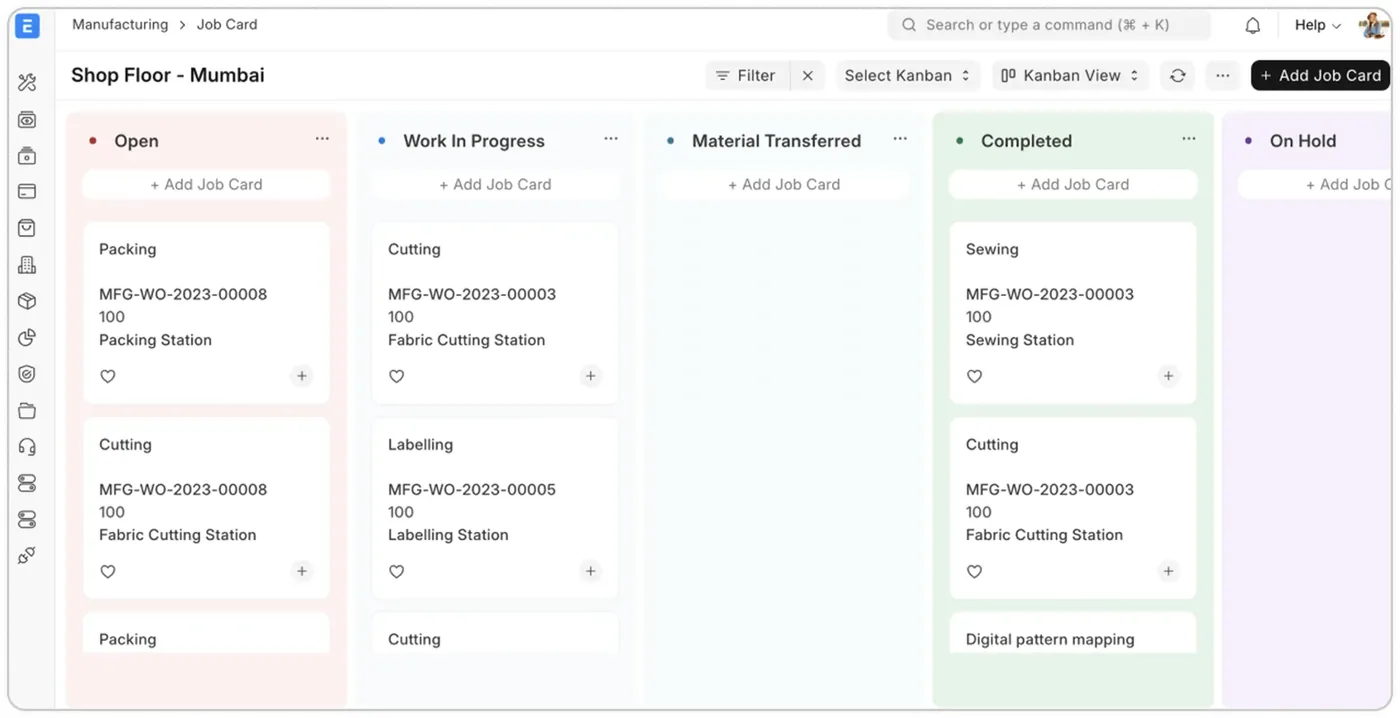
Work orders issue materials and track progress; job cards capture operator time and quantities on each operation and workstation.
Quality inspection
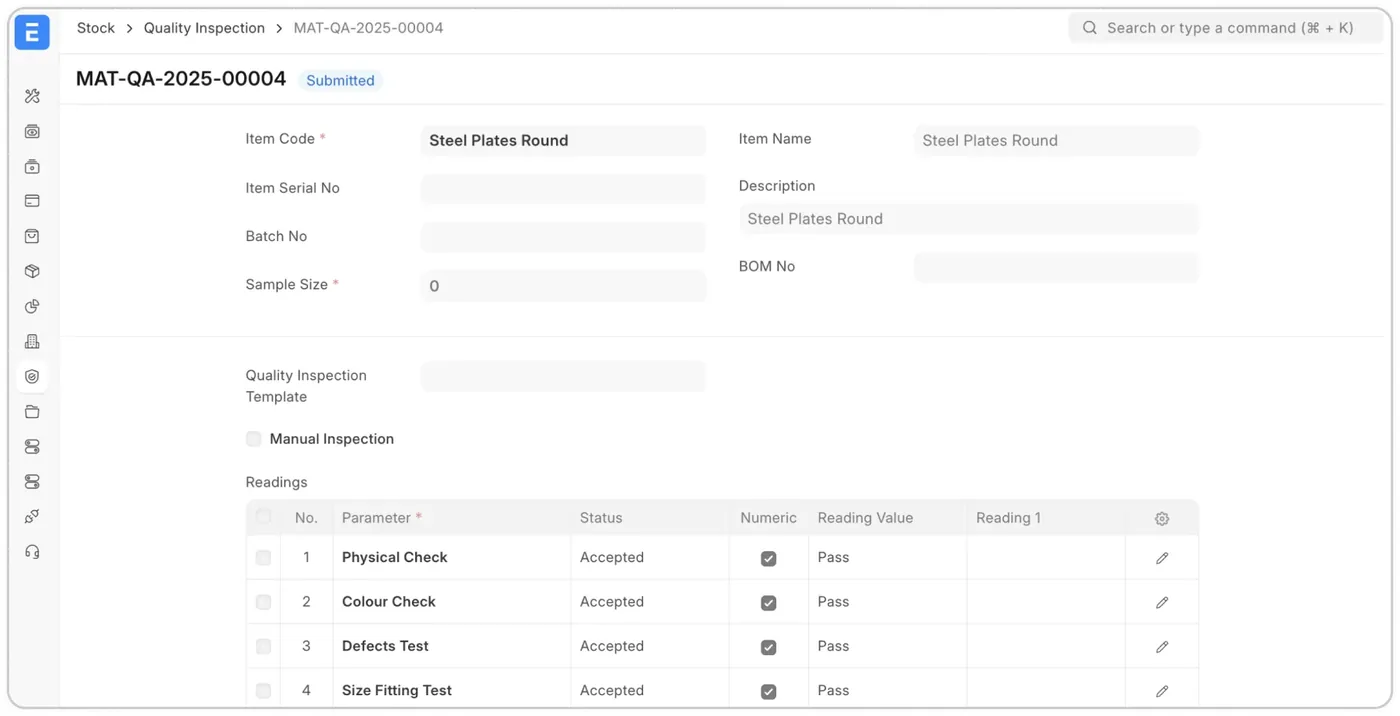
Inspection templates with parameters and acceptance ranges, required before stock moves on receipt, between operations or at dispatch.
Plant maintenance
Asset maintenance schedules for machines and moulds, with downtime logged so planners know real capacity and maintenance teams see which machines fail most often. Spare parts for each machine can be held as stock items linked to the asset.
Product costing
Standard and actual cost comparison per work order, including materials, labour, overheads and scrap, feeding margin reports by product and customer.
See it in ERPNext
Real ERPNext and Frappe screens for the work described on this page. We configure them for Saudi rules and your data.
ERPNext and the Frappe apps we implement
One open-source platform, one database, no per-user licence fees.







Saudi requirements for manufacturers
| Topic | The Saudi rule | What we set up |
|---|---|---|
| B2B invoices | Phase 2 standard tax invoices to business buyers must be cleared by Fatoora before reaching the buyer. | Sales invoices created from delivery notes are cleared on submit, and certificates of analysis print only with the cleared invoice. |
| Input VAT on imports | Imported raw materials and machinery carry VAT either paid at customs or accounted for under the reverse charge. | Purchase templates separate the two treatments, and landed cost vouchers add duty and freight to material valuation. |
| Production workforce | GOSI occupational hazards cover at 2% is paid by the employer for every worker, and end-of-service awards follow the Labour Law. | Frappe HR with shift types, overtime from attendance, GOSI components and gratuity provisions for factory staff. |
| Tamper-proof records | ZATCA requires e-invoice solutions to prevent undetected changes to issued invoices. | Corrections for price or quantity disputes go through credit and debit notes linked to the original invoice, never edits. |
| Fixed assets | Machinery and moulds are long-term assets whose cost and depreciation matter for financial statements and the data your zakat adviser uses. | ERPNext Assets records each machine with its cost, depreciation schedule and maintenance history, linked to the workstation it serves. |
We configure the system and check it against your accountant’s figures; we are not tax advisers, and your accountant files the returns. Last reviewed 27 November 2026.
How we implement ERPNext in a Saudi plant
Shop floor walkthrough
We follow materials from receiving to dispatch, list workstations and operations, and collect your current recipes, drawings and routings. Photos and short notes from the walkthrough become the reference for every later design decision.
Master data build
Items, BOMs, operations, workstations and inspection templates are set up and checked by your production and quality leads.
Costing agreement
Finance and production agree how labour and overheads are charged, so ERPNext costs match the way management wants to see margins. Hourly rates per workstation are documented and reviewed each year.
Pilot production run
One product line runs fully in ERPNext for a short period while the old method continues, so differences are found before they matter.
Plant-wide go-live
All lines move across, operators use job cards on shop floor terminals or tablets, and we stay close through the first month-end close.
Every ERPNext page for Saudi businesses
Services
Compliance
Industries
- ERPNext for Manufacturing in Saudi Arabia
- ERPNext for Trading Companies in Saudi Arabia
- ERPNext for Construction Companies in Saudi Arabia
- ERPNext for Retail in Saudi Arabia
Other countries
Worldwide

Written and reviewed by Vikas Saroj, Co-Founder, COO & Growth at Shyphan AI Solutions, who owns ERPNext, Odoo and Zoho delivery across Saudi Arabia and the wider region. Reviewed against current Saudi rules on 27 November 2026. Meet the team · LinkedIn
ERPNext for Manufacturing in Saudi Arabia: questions answered
Can ERPNext handle process manufacturing such as food or chemicals?
Can operators record work on the shop floor?
Does ERPNext support subcontracted manufacturing?
Is Shyphan an official Frappe partner?
How do we handle ZATCA invoicing for exports?
What does ERPNext cost for a factory?
Request your free quote
Tell us about your project and a senior ERPNext consultant - not a bot - replies within 24 hours with scope, timeline and a fixed quote. The first 30-minute discovery call is free, with no obligation.
- Free 30-minute discovery call
- Fixed-quote SOW - no surprises
- Arabic · English delivery
- VAT 15%, ZATCA, GOSI & mada ready