





















 Saudi Arabia
 UAE
 Qatar
 Bahrain
 Kuwait
 Oman
 Lebanon
 Egypt
 Jordan
 Iraq
 India
 UK
 Ireland
 Germany
 USA
 Australia
 Singapore
 South Africa
 France
 Hungary
 Georgia
 Turkey
 Canada
 LagosNigeria




Tally to ERPNext Migration in India
Moving from Tally Prime or Tally ERP 9 to ERPNext is mostly a data question: which ledgers, parties, stock items and balances come across, and how you prove nothing was lost. Shyphan plans the mapping, runs trial imports and reconciles trial balance, receivables, payables, stock and GST figures before you stop entering vouchers in Tally.
- Chart of accounts
- Customers and suppliers
- Stock items and godowns
- Opening balances
 ERPNext & FrappeImplementation · migration · AMC
Get a free quote
Reply within 24 hours with scope and a fixed quote.
Tally to ERPNext Migration in India: the short answer
- What moves
- Groups and ledgers, customers and suppliers with GSTINs, stock items with HSN codes and units, godowns, cost centres and opening balances.
- Source versions
- Tally Prime and Tally ERP 9 data exported as XML or Excel, from one company or several.
- How we check
- Trial balance, party-wise outstanding, stock quantity and value by godown, and GST ledger balances matched at the cut-over date.
- Best timing
- 1 April or the first day of a quarter, so returns for earlier periods stay in Tally and new periods start clean.
- Delivered by
- Shyphan AI Solutions, an ERPNext implementation partner and Zoho Premium Partner, with 24/7 support. Call +91 95651 53545.
- Last reviewed
- 27 November 2026
Why Tally migrations need a plan, not just an export
Tally is excellent at vouchers, and many Indian accountants know it by heart. Its structure is different from ERPNext, though. Tally files ledgers under fixed primary groups and lets one ledger behave as customer, supplier and expense at once, whereas ERPNext separates the chart of accounts from customer and supplier masters and links them through receivable and payable accounts.
That difference is where migrations go wrong. A sundry debtor ledger in Tally becomes a customer record in ERPNext plus an opening invoice against Debtors. Stock items need item groups, valuation rules and warehouse mapping. GST registration details stored on Tally ledgers must land on addresses, because India Compliance reads GSTIN and state from the address.
ERPNext's old built-in Tally Migration tool is no longer part of the core product. We now combine three methods: the open-source Tally Migration app published by Greycube Technologies on the Frappe Cloud Marketplace where its version fits, ERPNext's Data Import tool with templates we prepare, and scripts for unusual cases. The method matters less than the reconciliation at the end.
From first record to the finished report
One open-source system, so each step feeds the next without re-keying.
What we migrate from Tally
Chart of accounts
Tally groups and ledgers are mapped onto an ERPNext account tree. We merge duplicate ledgers, retire unused ones and agree the mapping with your accountant before any import runs.
Customers and suppliers
Sundry debtors and creditors become customer and supplier records with billing and shipping addresses, GSTIN, state, PAN, credit limits and payment terms. Parties that act as both customer and supplier in Tally are created as linked records, so balances can be netted.
Stock items and godowns
Stock items, stock groups, units of measure, HSN codes and batches move across, godowns become ERPNext warehouses, and valuation is set to match your policy.
Opening balances
Ledger balances post through an opening journal, party balances as opening invoices so ageing works from day one, and stock through a stock reconciliation at Tally's closing rate.
GST details
GSTIN on every party address, HSN and tax rate on items, and GST ledger balances carried as opening entries. Earlier returns stay in Tally; data for new periods comes from ERPNext.
Historic vouchers when needed
If past years must be searchable in ERPNext, Day Book vouchers can come across as journal entries. We suggest it only when auditors or owners truly need it, since it adds checking time.
See it in ERPNext
Real ERPNext and Frappe screens for the work described on this page. We configure them for Indian rules and your data.
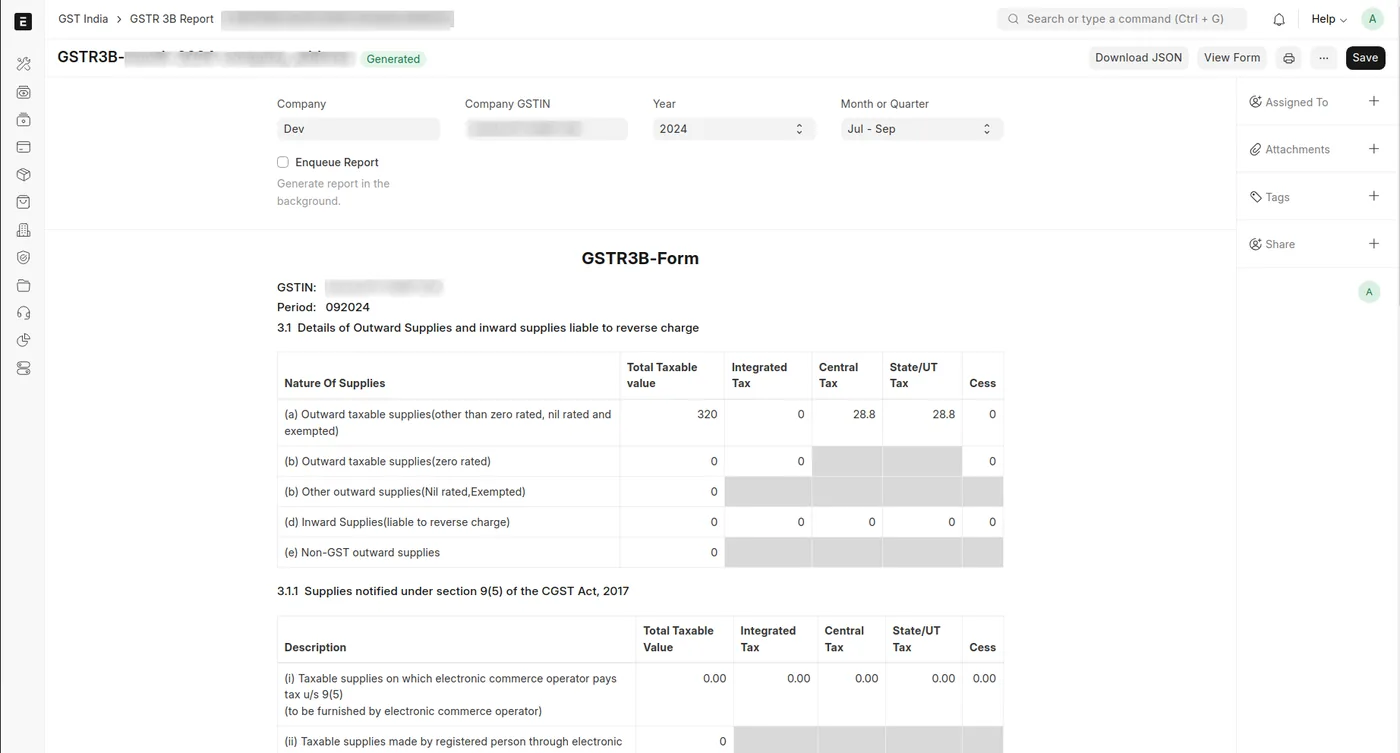
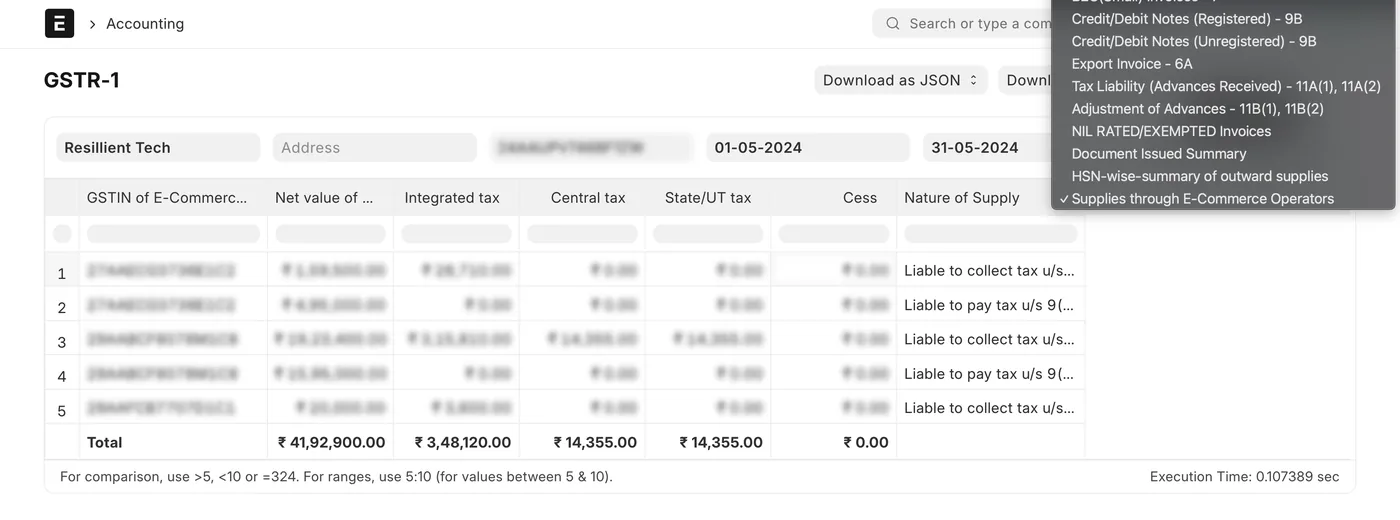
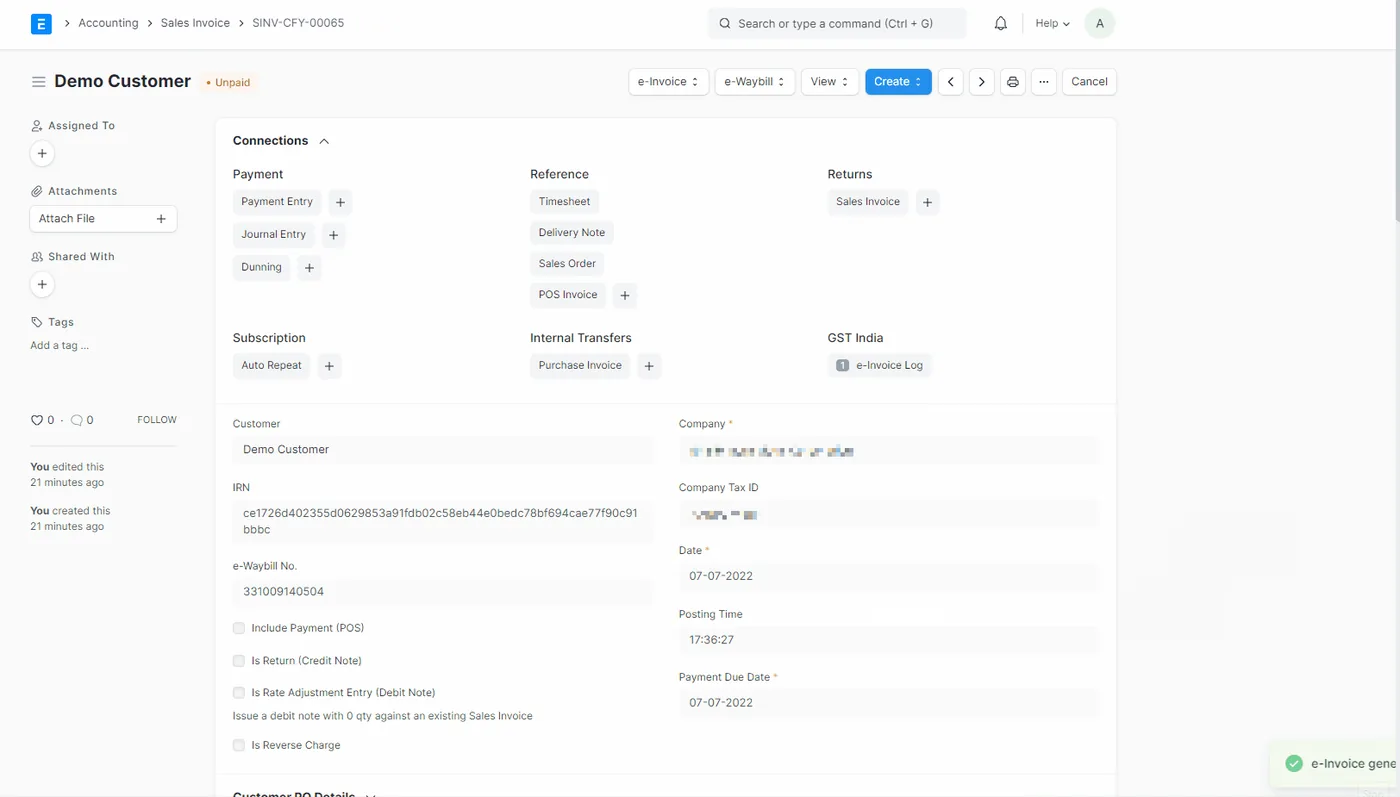
ERPNext and the Frappe apps we implement
One open-source platform, one database, no per-user licence fees.







GST and statutory points in a Tally move
| Topic | The Indian rule | What we set up |
|---|---|---|
| Place of supply | Whether CGST and SGST or IGST applies depends on whether the supplier's state and the place of supply are the same. | We carry the state and GSTIN from each Tally ledger to the ERPNext address, so India Compliance can choose intra-state or inter-state templates by itself. |
| HSN codes and rates | Since 22 September 2025, most items sit at 5% or 18% GST with 40% for specified goods, so rates stored in older Tally masters may be out of date. | We export item-wise HSN and rate from Tally, flag any rate set before the September 2025 changes for your accountant to confirm, then load item tax templates. |
| E-invoicing continuity | Above Rs 5 crore aggregate turnover, B2B invoices need an IRN from the IRP, and at Rs 10 crore or more each must be reported within 30 days of its date. | Invoices raised in Tally before cut-over keep their existing IRNs. From the first ERPNext invoice, India Compliance generates IRNs, using an API user registered for ERPNext ahead of time. |
| TDS balances | Tax deducted at source on supplier payments continues to be reported in quarterly returns, so amounts deducted but not yet deposited must carry across. | TDS payable ledgers and pending deductions come over as opening entries, and Tax Withholding Categories are attached to suppliers for future invoices. |
| Financial year boundary | Indian books close on 31 March and, from 1 April 2026, the Income-tax Act, 2025 uses a single tax year. | We prefer a 1 April cut-over: Tally holds the closed year, and ERPNext opens the new one with provisional balances that are adjusted by journal after audit. |
| Personal data | Customer and employee contact details moved from Tally are personal data under the DPDP Act, 2023, with duties phased in by the 2025 Rules. | Exports pass through restricted folders, are deleted after import, and migrated records inherit ERPNext role permissions from day one. |
We configure the system and check it against your accountant’s figures; we are not tax advisers, and your accountant files the returns. Last reviewed 27 November 2026.
Our five-stage Tally migration method
Audit the Tally data
We review groups, ledgers, stock items, godowns and cost centres, count records and list problems such as duplicate parties, missing GSTINs or negative stock. We also check whether inventory is kept with batches or by godown only, since that changes the stock design.
Agree the mapping
A spreadsheet maps every Tally group and ledger to its ERPNext destination. Your accountant signs it off, because it decides how reports will look.
Trial import
Masters and balances go into a staging site first. We compare trial balance, debtors, creditors and stock reports with Tally and fix differences at the source.
Final import at cut-over
After the last Tally entry for the period, we export again, load final balances into production and lock the old company against further posting.
Post-migration checks
During the first weeks we review new invoices, GST figures and bank reconciliation daily and correct any mapping issue before the first return is prepared.
Every ERPNext page for Indian businesses
Services
Compliance
Locations
Industries
Other countries
Worldwide

Written and reviewed by Vikas Saroj, Co-Founder, COO & Growth at Shyphan AI Solutions, who owns ERPNext, Odoo and Zoho delivery across India and the wider region. Reviewed against current Indian rules on 27 November 2026. Meet the team · LinkedIn
Tally to ERPNext Migration in India: questions answered
Can ERPNext import Tally data directly?
Will our historic Tally vouchers come across?
What about inventory vouchers?
How do we handle a mid-year switch?
Do we still need Tally afterwards?
Is Shyphan an official Frappe partner?
Request your free quote
Tell us about your project and a senior ERPNext consultant - not a bot - replies within 24 hours with scope, timeline and a fixed quote. The first 30-minute discovery call is free, with no obligation.
- Free 30-minute discovery call
- Fixed-quote SOW - no surprises
- English · Hindi delivery
- GST, e-invoicing & EPF/ESI ready