





















 Saudi Arabia
 UAE
 Qatar
 Bahrain
 Kuwait
 Oman
 Lebanon
 Egypt
 Jordan
 Iraq
 India
 UK
 Ireland
 Germany
 USA
 Australia
 Singapore
 South Africa
 France
 Hungary
 Georgia
 Turkey
 Canada
 LagosNigeria




ERPNext E-Invoice and E-Way Bill in India
If your turnover has crossed the e-invoicing threshold, every B2B invoice needs an IRN and QR code before it reaches the customer, and most goods movements need an e-way bill. Shyphan configures India Compliance so ERPNext generates both on submission, prints them correctly and handles cancellations.
- IRN and signed QR
- Cancellation handling
- E-way bill generation
- Vehicle updates and extensions
 ERPNext & FrappeImplementation · migration · AMC
Get a free quote
Reply within 24 hours with scope and a fixed quote.
ERPNext E-Invoice and E-Way Bill in India: the short answer
- E-invoice threshold
- Aggregate turnover above Rs 5 crore in any financial year from 2017-18, applicable since 1 August 2023.
- 30-day rule
- From 1 April 2025, taxpayers at Rs 10 crore aggregate turnover or more must report documents to the IRP within 30 days of their date.
- E-way bill trigger
- Movement of goods with consignment value above Rs 50,000, under Rule 138 of the CGST Rules.
- How ERPNext does it
- The India Compliance app by Resilient Tech connects to the government e-invoice and e-way bill systems.
- Delivered by
- Shyphan AI Solutions, an ERPNext implementation partner and Zoho Premium Partner, with 24/7 support. Call +91 95651 53545.
- Last reviewed
- 27 November 2026
From submit button to IRN without leaving ERPNext
E-invoicing in India does not mean emailing a PDF. The supplier reports invoice data in a set JSON format to the Invoice Registration Portal, which validates it and returns a signed invoice carrying an Invoice Reference Number and a QR code. Only that signed version counts as a valid e-invoice.
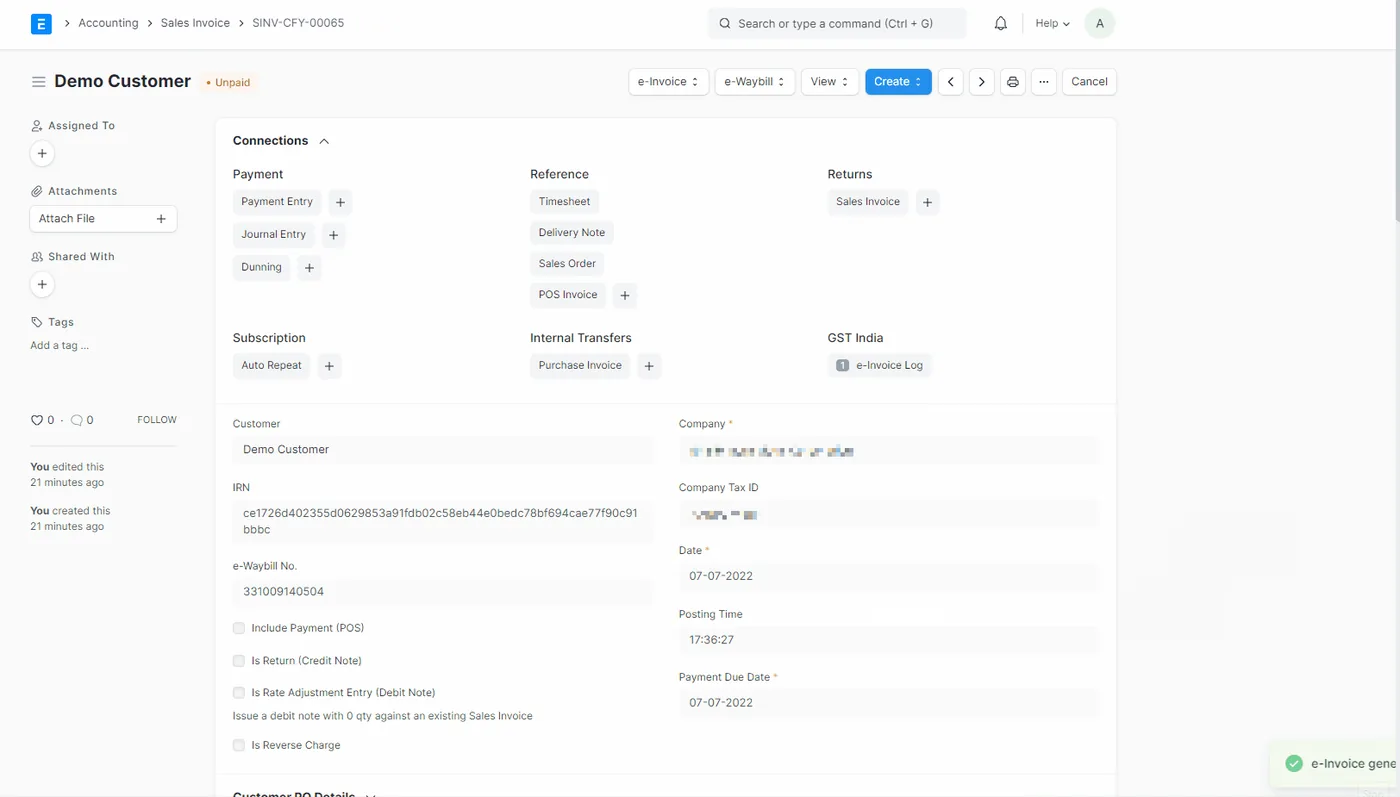
India Compliance handles the exchange inside ERPNext. When a sales invoice is submitted, the app can send it to the IRP, save the IRN, acknowledgement number and signed QR against the invoice and show them on the print format. Credit notes and debit notes follow the same route. If the goods also need an e-way bill, it can be generated along with the e-invoice or later from the delivery note.
Consider a typical auto components maker in Pune shipping to assemblers in Chennai. Each invoice needs an IRN, and each truckload needs an e-way bill with vehicle number and distance. Set up well, the dispatch clerk enters transporter details once, submits, and prints an invoice already showing its QR code and e-way bill number.
From first record to the finished report
One open-source system, so each step feeds the next without re-keying.
E-invoice and e-way bill features we set up
IRN and signed QR
Invoices go to the IRP on submission or on demand, and the returned IRN and QR code print on your tax invoice layout.
Cancellation handling
IRN cancellation within the 24-hour window, cancelling any active linked e-way bill first, and credit notes for corrections once that window has passed.
E-way bill generation
Consignment data comes from the invoice or delivery note, with transporter ID or vehicle number added by dispatch staff, and the bill is generated without visiting the portal.
Vehicle updates and extensions
Vehicle changes in transit, transporter updates and validity extensions are handled from the e-way bill actions on the ERPNext document.
Missing IRN alerts
A report and notification list submitted invoices without an IRN, so they are fixed well inside the 30-day reporting window.
Portal credentials
API users created on the e-invoice and e-way bill portals are stored per GSTIN in GST Settings and tested before go-live.
See it in ERPNext
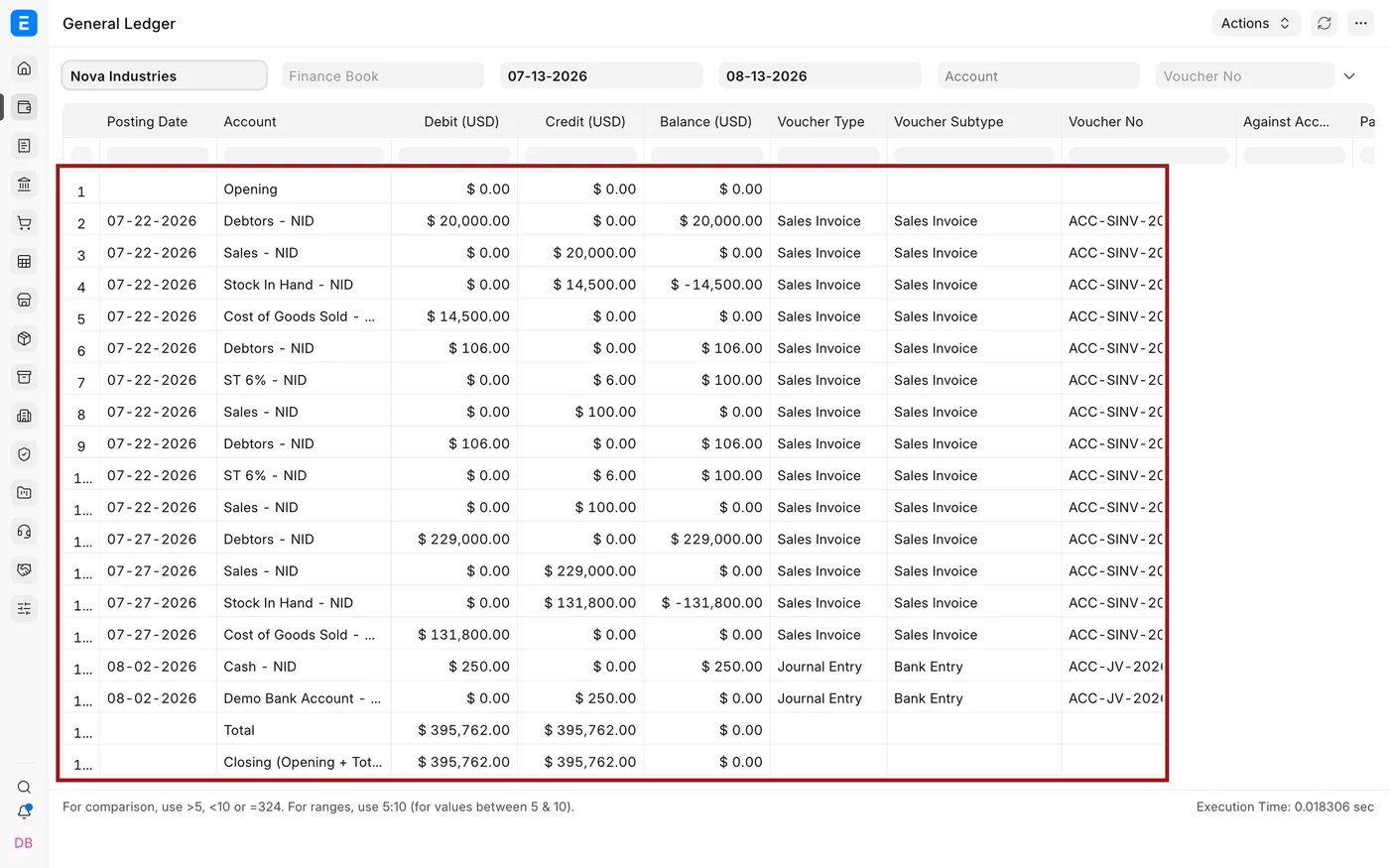
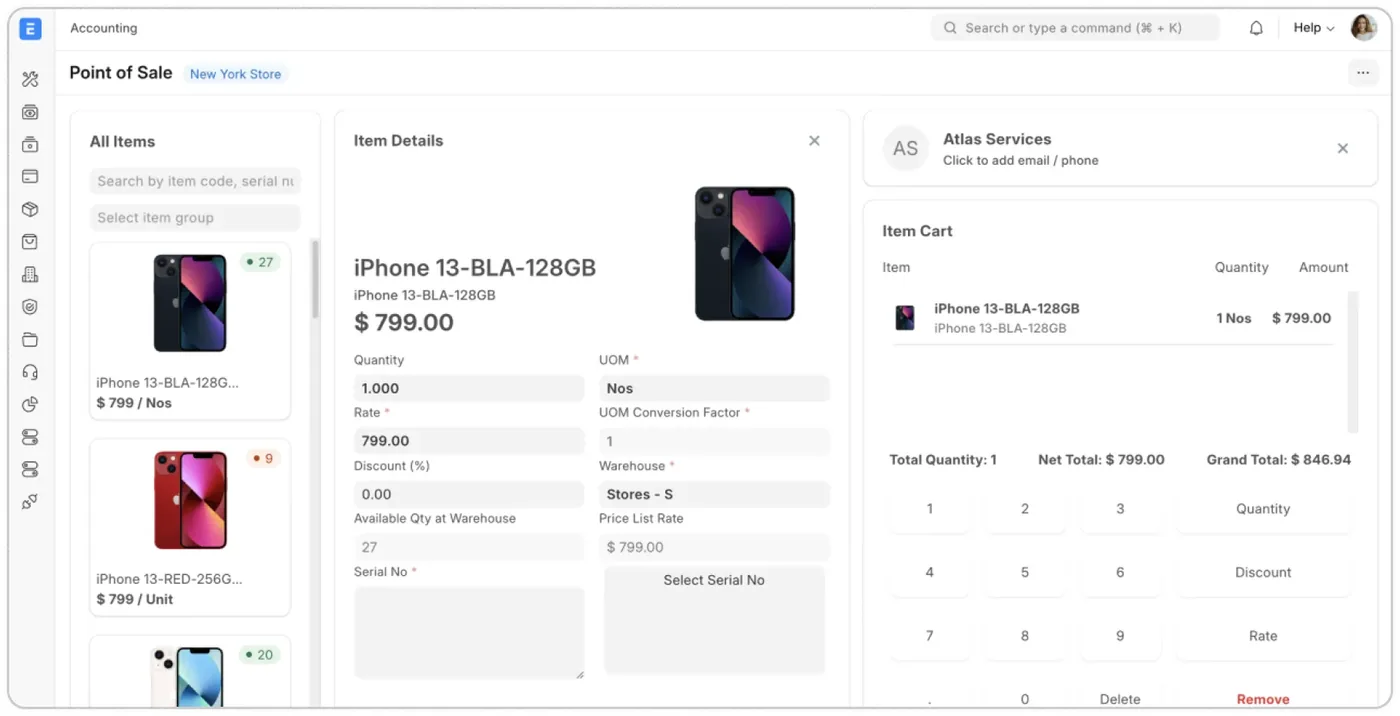
Real ERPNext and Frappe screens for the work described on this page. We configure them for Indian rules and your data.
ERPNext and the Frappe apps we implement
One open-source platform, one database, no per-user licence fees.







E-invoice and e-way bill rules we configure for
| Topic | The Indian rule | What we set up |
|---|---|---|
| Applicability | Notification 10/2023-Central Tax extended e-invoicing from 1 August 2023 to registered persons whose aggregate turnover exceeded Rs 5 crore in any financial year from 2017-18. | We enable e-invoicing for the GSTINs concerned and set an applicable-from date so older invoices are never sent. |
| 30-day window | From 1 April 2025, taxpayers with aggregate turnover of Rs 10 crore or more cannot report invoices, credit notes or debit notes to the IRP after 30 days from the document date. An invoice dated 1 April 2025 had to be reported by 30 April 2025. | Missing-IRN reports and alerts flag any submitted document still unreported, and auto-generation on submit keeps the gap small. |
| QR and verification | The IRP returns a signed e-invoice with IRN and QR code, which can be verified on the government e-invoice portal. | Print formats show the QR and IRN in a fixed position, and we test them with a phone scan before go-live. |
| IRN cancellation | An IRN can be cancelled only within 24 hours of generation, and partial cancellation is not allowed. | Cancellation is triggered from the invoice in ERPNext, and users are trained to raise credit notes after the window closes. |
| E-way bill threshold | Rule 138 requires an e-way bill for movement of goods with consignment value above Rs 50,000, counting tax but excluding exempt goods on the same invoice. | Consignment value is taken from the invoice, and the app asks for transport details whenever an e-way bill is needed. |
| E-way bill validity | For normal cargo, validity is one day up to 200 km and one more day for every further 200 km or part of it. | Distance is recorded on the document so the portal computes validity correctly, and extensions can be requested from ERPNext. |
We configure the system and check it against your accountant’s figures; we are not tax advisers, and your accountant files the returns. Last reviewed 27 November 2026.
How we switch on e-invoicing and e-way bills
Confirm applicability
Your accountant confirms which GSTINs fall under e-invoicing and the 30-day rule, based on aggregate turnover.
Create portal API users
API users are created on the e-invoice and e-way bill portals for each GSTIN, with access granted for the ERPNext integration.
Configure India Compliance
GST Settings, the e-invoice applicable date, auto-generation choices and print formats are set and reviewed with you.
Check master data
Addresses, PIN codes, GSTINs and HSN codes are validated before the first live submission, since most IRP rejections come from master data.
Go live and monitor
In the first days we watch every submission, fix rejected payloads and confirm IRNs and e-way bills print correctly.
Every ERPNext page for Indian businesses
Services
Compliance
- ERPNext GST Setup in India
- ERPNext E-Invoice and E-Way Bill in India
- Frappe HR Payroll in India
Locations
Industries
Other countries
Worldwide

Written and reviewed by Vikas Saroj, Co-Founder, COO & Growth at Shyphan AI Solutions, who owns ERPNext, Odoo and Zoho delivery across India and the wider region. Reviewed against current Indian rules on 27 November 2026. Meet the team · LinkedIn
ERPNext E-Invoice and E-Way Bill in India: questions answered
Is e-invoicing mandatory for my business?
What is the 30-day rule?
Can ERPNext generate the e-way bill automatically?
What if the IRP is down?
Do we pay for API calls?
Is Shyphan an official Frappe partner?
Request your free quote
Tell us about your project and a senior ERPNext consultant - not a bot - replies within 24 hours with scope, timeline and a fixed quote. The first 30-minute discovery call is free, with no obligation.
- Free 30-minute discovery call
- Fixed-quote SOW - no surprises
- English · Hindi delivery
- GST, e-invoicing & EPF/ESI ready