





















 Saudi Arabia
 UAE
 Qatar
 Bahrain
 Kuwait
 Oman
 Lebanon
 Egypt
 Jordan
 Iraq
 India
 UK
 Ireland
 Germany
 USA
 Australia
 Singapore
 South Africa
 France
 Hungary
 Georgia
 Turkey
 Canada
 LagosNigeria




ERPNext Customization in India
Most Indian businesses need ERPNext to fit a few habits it lacks out of the box: a delivery challan layout the transporter expects, a dealer scheme, an approval chain. Shyphan builds those changes the upgrade-safe way, configuration first and a separate Frappe app only when code is genuinely needed.
- Indian print formats
- Custom fields and forms
- Approval workflows
- Reports and dashboards
 ERPNext & FrappeImplementation · migration · AMC
Get a free quote
Reply within 24 hours with scope and a fixed quote.
ERPNext Customization in India: the short answer
- Typical requests
- Invoice and challan print formats, custom fields, approval workflows, dashboards and integrations with banks, portals or online stores.
- How we build
- No edits to ERPNext core. Code lives in a custom app under version control, so upgrades remain possible.
- Who builds it
- Python and JavaScript developers working on the Frappe Framework from our Noida office.
- Testing
- Each change is code-reviewed and tried on a staging site with your data before it reaches production.
- Delivered by
- Shyphan AI Solutions, an ERPNext implementation partner and Zoho Premium Partner, with 24/7 support. Call +91 95651 53545.
- Last reviewed
- 27 November 2026
Customising ERPNext without breaking future upgrades
ERPNext is unusually flexible because it sits on the Frappe Framework, where forms, fields, reports and permissions are all metadata. Much of what people call customisation needs no code at all: Customize Form adds fields, property setters change labels and defaults, the Print Format Builder rearranges layouts, and Workflow adds approval states.
Trouble starts when someone edits ERPNext's own files on the server. It works until the next update overwrites the change or refuses to apply. We avoid that entirely. Anything beyond configuration goes into a custom app with its own doctypes, hooks, server scripts and client scripts, kept in a Git repository you control. Because the app is separate, it can be switched off, tested on its own and moved to a new ERPNext version without untangling core changes.
Picture a textile trader in Surat that sells by the metre, buys by the bale and wants commission tracked for each broker. Unit conversion is standard ERPNext. Broker commission on every sales invoice is a small custom app with one new doctype and a report.
From first record to the finished report
One open-source system, so each step feeds the next without re-keying.
Changes we build most often for Indian companies
Indian print formats
Tax invoices with HSN-wise tax summaries, amount in words in rupees, bank details, e-invoice QR and IRN, plus delivery challans and job work challans laid out the way transporters and job workers expect.
Custom fields and forms
Extra fields such as transporter GSTIN, vehicle type, dealer code or batch expiry, placed where users need them and carried from order to delivery to invoice.
Approval workflows
Multi-level approval for purchase orders, price changes, credit limit overrides and payment requests, with email or in-app alerts at each state.
Reports and dashboards
Query and script reports for receivables by salesperson, stock ageing by godown or margin by customer, plus number cards on the workspace for owners.
Integrations
Connections to banks, payment gateways, Shopify or WooCommerce stores, courier services and attendance devices through the Frappe REST API and webhooks.
Custom Frappe apps
New doctypes and logic for processes ERPNext lacks, such as dealer schemes, warranty claims or broker commission, packaged as an installable app with tests.
See it in ERPNext
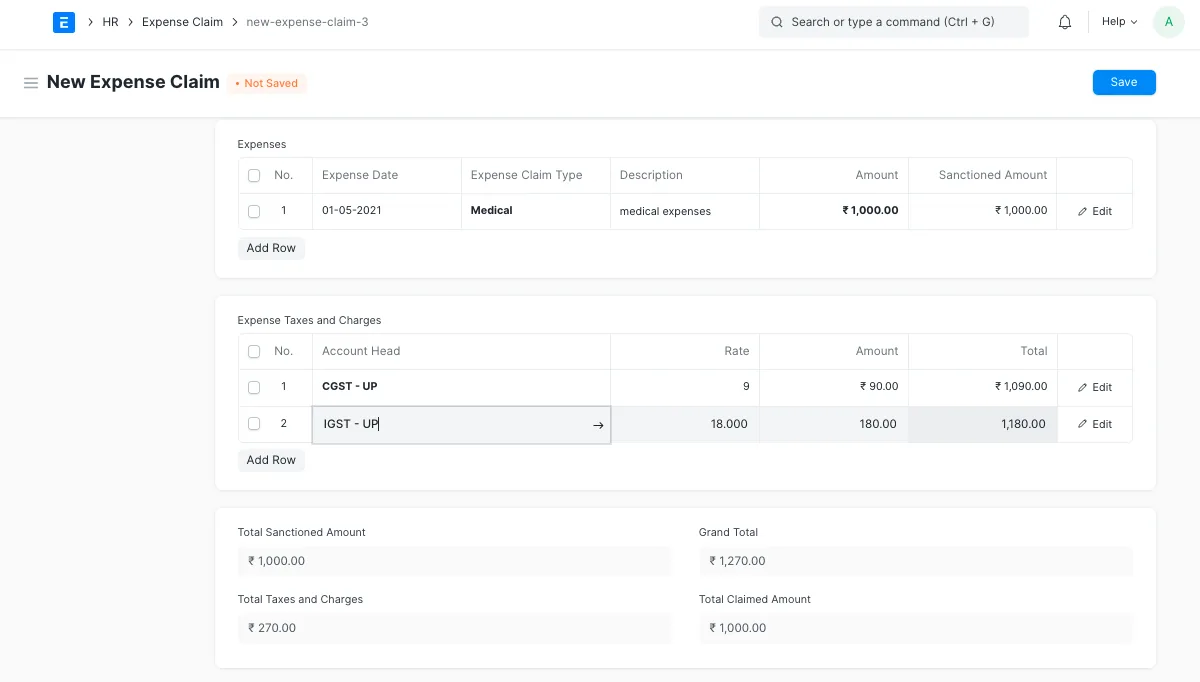
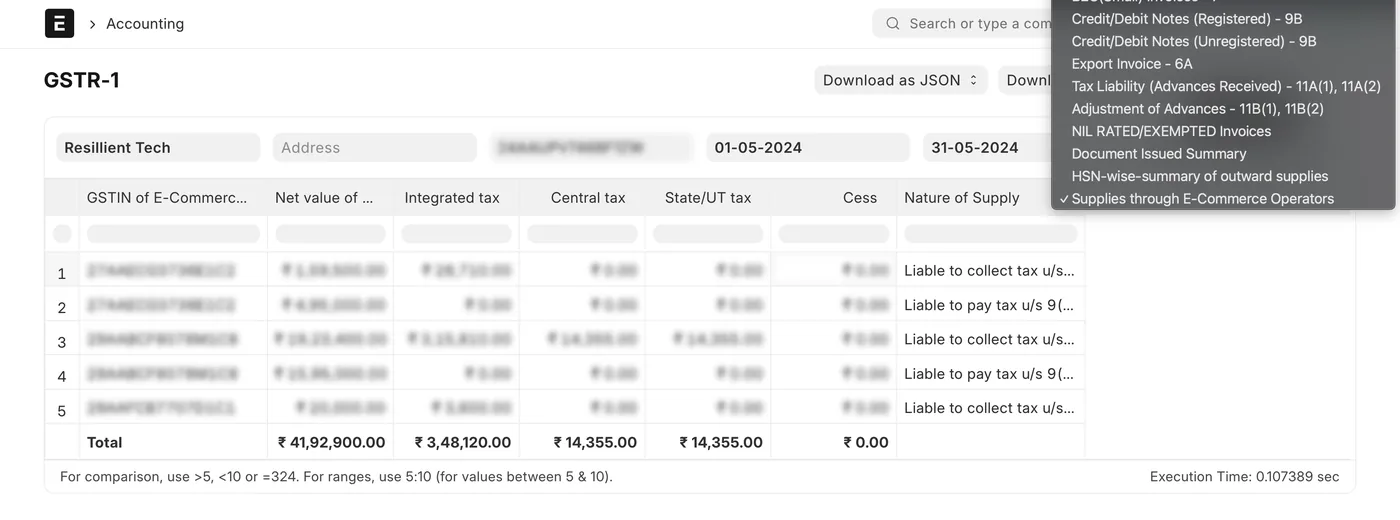
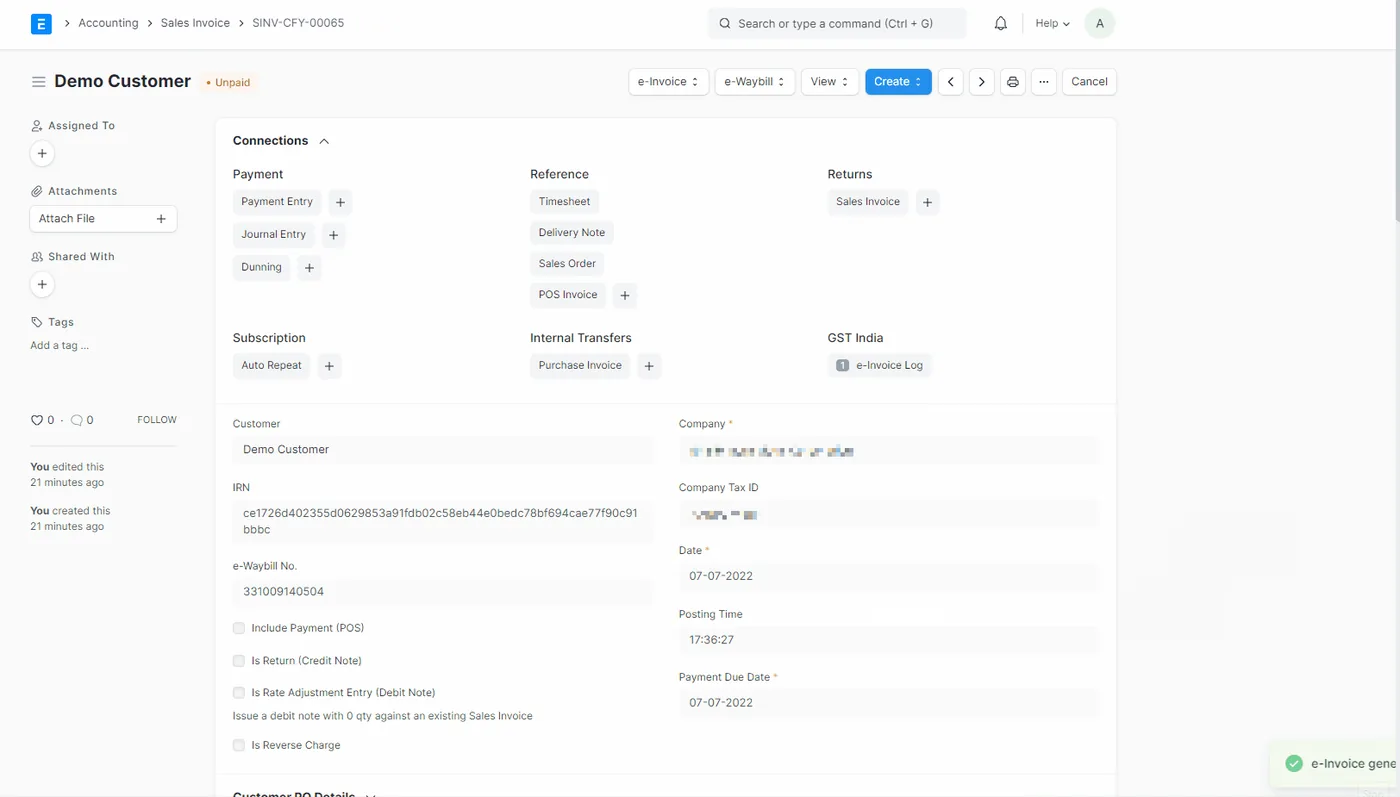
Real ERPNext and Frappe screens for the work described on this page. We configure them for Indian rules and your data.
ERPNext and the Frappe apps we implement
One open-source platform, one database, no per-user licence fees.







Indian requirements that drive customisation
| Topic | The Indian rule | What we set up |
|---|---|---|
| E-invoice print | E-invoiced documents must carry the IRN and the signed QR code returned by the Invoice Registration Portal. | Print formats pull the IRN, acknowledgement and QR stored by India Compliance into a fixed block, checked against samples your accountant approves. |
| E-way bill data | Consignments above Rs 50,000 need an e-way bill, which in turn needs transporter and vehicle details when the goods move. | We add transporter, vehicle number and distance fields to delivery notes where your process captures them, so dispatch staff fill them only once. |
| Payroll components | PF, ESI, professional tax and income tax deductions apply to Indian salaries, and professional tax slabs differ by state. | Where a salary policy needs more than India Payroll offers, such as a site allowance rule, we add component formulas rather than altering the app. |
| Personal data | The DPDP Act, 2023 requires reasonable security safeguards for personal data, and the DPDP Rules, 2025 add consent notices and breach reporting. | Custom doctypes holding personal data get role-based permissions, field-level restrictions and change tracking from the start. |
| E-invoice 30-day window | From 1 April 2025, businesses with aggregate turnover of Rs 10 crore or more must report each invoice to the IRP within 30 days of its date. | Custom validations we add never hold an invoice back from IRN generation, and any custom submit logic is tested against the e-invoice flow. |
We configure the system and check it against your accountant’s figures; we are not tax advisers, and your accountant files the returns. Last reviewed 27 November 2026.
How a customisation request is handled
Write the requirement
You describe the problem in business terms, ideally with an example document. We restate it, list the affected doctypes and confirm what done looks like.
Choose the lightest fix
We check whether settings, a property change or a print format solves it before proposing code. Smaller changes cost less to maintain.
Estimate and approve
Code changes get an effort estimate and either a fixed price or a fixed block of hours. Work begins only once you approve.
Build and review
One developer builds in the custom app, a second reviews the code, and your key user tests on staging.
Release and document
We deploy in a quiet window, record the change in a change log and update the user guide wherever screens have changed. If something misbehaves, the previous version of the app can be restored quickly.
Every ERPNext page for Indian businesses
Services
Compliance
Locations
Industries
Other countries
Worldwide

Written and reviewed by Vikas Saroj, Co-Founder, COO & Growth at Shyphan AI Solutions, who owns ERPNext, Odoo and Zoho delivery across India and the wider region. Reviewed against current Indian rules on 27 November 2026. Meet the team · LinkedIn
ERPNext Customization in India: questions answered
Will customisation stop us upgrading ERPNext?
Who owns the custom code?
Can you change a customisation someone else built?
Do you use Client Scripts and Server Scripts in the browser?
Is there a licence fee for customised ERPNext?
Is Shyphan a Frappe certified partner?
Request your free quote
Tell us about your project and a senior ERPNext consultant - not a bot - replies within 24 hours with scope, timeline and a fixed quote. The first 30-minute discovery call is free, with no obligation.
- Free 30-minute discovery call
- Fixed-quote SOW - no surprises
- English · Hindi delivery
- GST, e-invoicing & EPF/ESI ready