





















 Saudi Arabia
 UAE
 Qatar
 Bahrain
 Kuwait
 Oman
 Lebanon
 Egypt
 Jordan
 Iraq
 India
 UK
 Ireland
 Germany
 USA
 Australia
 Singapore
 South Africa
 France
 Hungary
 Georgia
 Turkey
 Canada
 LagosNigeria




ERPNext Implementation in Oman
A good rollout is mostly decisions made early: which modules go live first, how items are coded and who approves what. We run ERPNext implementations in Oman as phased projects with a written scope, a test site from week one and a go-live date your team agrees to.
- Company and account structure
- Item and warehouse design
- Manufacturing set up properly
- Quality and approvals
 ERPNext & FrappeImplementation · migration · AMC
Get a free quote
Reply within 24 hours with scope and a fixed quote.
ERPNext Implementation in Oman: the short answer
- Approach
- Phased delivery: finance and stock first, then manufacturing, projects or HR once the core is stable.
- Where it fits
- Factories in Rusayl or Sohar, contractors with site stores, and distributors running several warehouses.
- Your team's time
- A named project owner, plus a few hours a week from each department lead during build and testing.
- Delivery
- Remote configuration with on-site workshops in Oman for process mapping, training and cut-over when needed.
- Delivered by
- Shyphan AI Solutions, an ERPNext implementation partner and Zoho Premium Partner, with 24/7 support. Call +91 95651 53545.
- Last reviewed
- 27 November 2026
Why implementation method matters more than software
Most failed ERP projects in the region did not fail because of the software. They failed because item masters were copied across unchecked, approval rules were never written down and nobody owned the cut-over weekend. Our method puts those decisions on paper before configuration starts.
Consider a typical food manufacturer in Rusayl Industrial City. It buys flour, oil and packaging, produces against a bill of materials, checks batches before release and sells to hypermarkets and wholesalers. In ERPNext that becomes purchase receipts with batch numbers, work orders, quality inspections at receipt and dispatch, and sales invoices carrying 5% VAT. Each step is configured, tested with real figures and signed off by the person who will use it.
The same discipline applies to a contractor or a distributor. A contractor would start with project costing, site warehouses and subcontractor bills, while a distributor would start with price lists, credit limits and van sales. Whatever the business, we keep the first phase small enough to go live cleanly, then add modules once users trust the numbers. That order protects your month-end close, which is usually the first thing to suffer when a rollout tries to do everything at once.
From first record to the finished report
One open-source system, so each step feeds the next without re-keying.
What a Shyphan implementation includes
Company and account structure
We design companies, branches, cost centres and a chart of accounts that your auditor will recognise, with OMR as base currency and foreign currency accounts where you trade abroad.
Item and warehouse design
Item groups, units of measure, batch and serial rules and warehouse trees are agreed early, because every later report depends on getting them right.
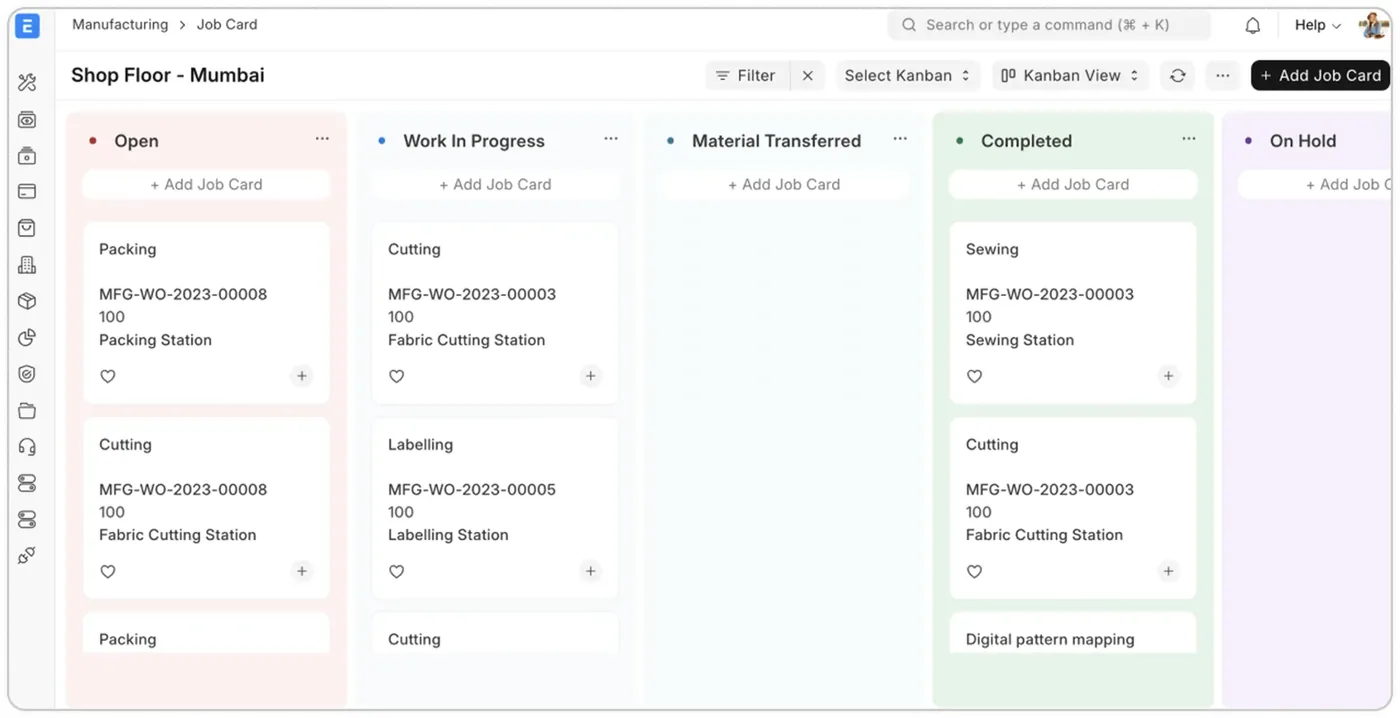
Manufacturing set up properly
Bills of materials, routings, workstations and work orders reflect how your floor actually runs. Scrap, by-products and subcontracting are handled where they apply.
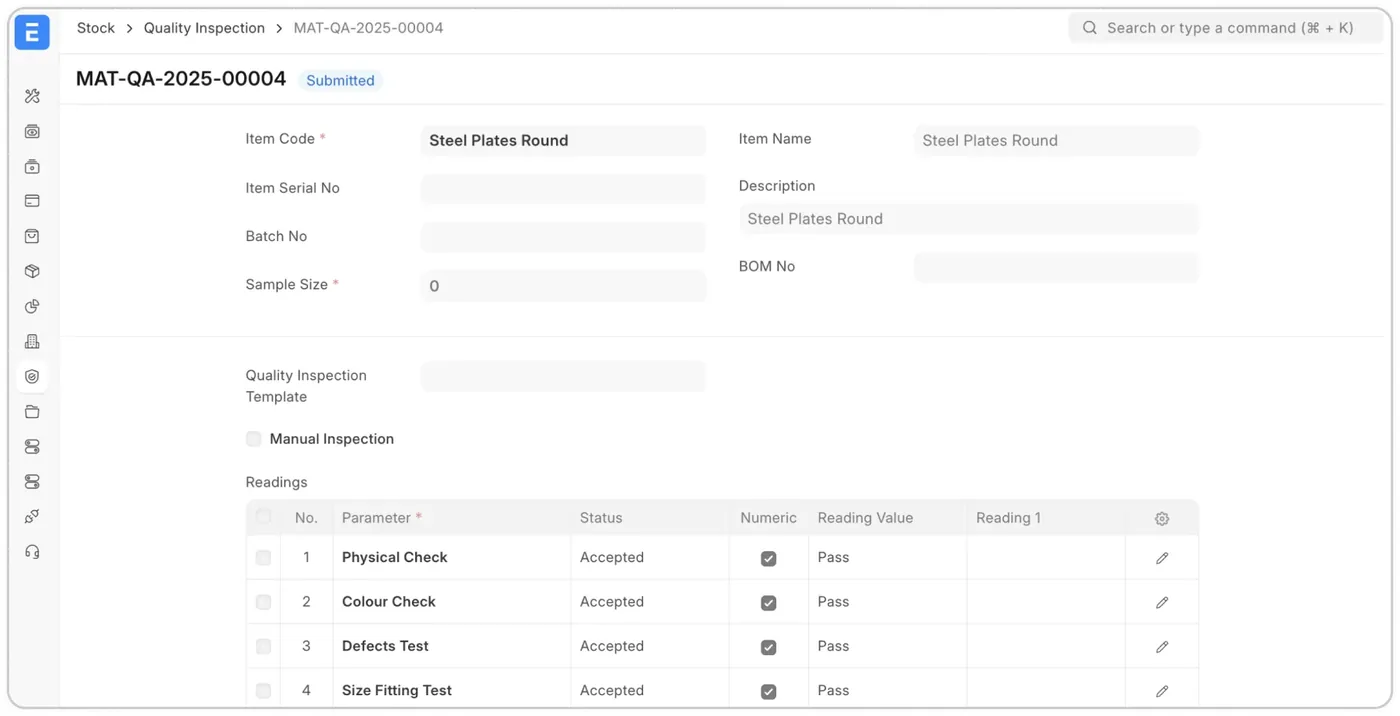
Quality and approvals
Quality inspection templates, purchase approval limits and credit checks on customers are set as workflow rules rather than left to memory.
Bilingual documents
Tax invoices, delivery notes and purchase orders are designed with Arabic and English text and your company details, ready for printing or email.
Role-based training
Storekeepers, accountants and sales staff each learn their own screens using your data, with short written guides they can keep beside the keyboard.
See it in ERPNext
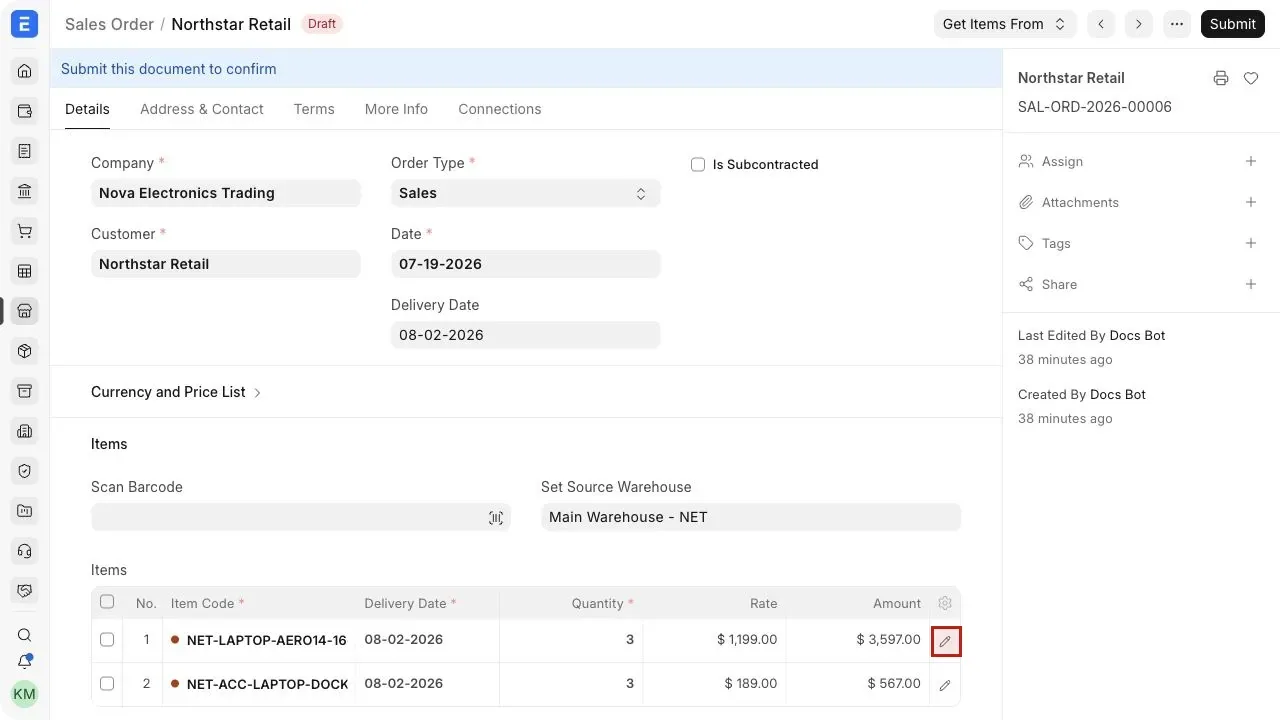
Real ERPNext and Frappe screens for the work described on this page. We configure them for Omani rules and your data.
ERPNext and the Frappe apps we implement
One open-source platform, one database, no per-user licence fees.







Local requirements handled during implementation
| Topic | The Omani rule | What we set up |
|---|---|---|
| VAT on transactions | Omani VAT applies at 5% on standard-rated supplies, with returns filed to the Oman Tax Authority. | Sales and purchase tax templates linked to item groups, so the correct rate appears on orders, invoices and credit notes automatically. |
| Electronic invoices | Decision 189/2026 sets 1 April 2027 for businesses above OMR 5 million in annual supplies and 1 October 2027 for the rest. | Customer tax IDs, item classifications and invoice fields captured from day one, so the later Fawtara connection needs no data clean-up. |
| Record language | Customers and public bodies in Oman commonly expect Arabic on commercial documents. | Arabic item and customer names held in their own fields and printed beside the English text. Item descriptions in Arabic follow a short naming guide. |
| Payroll link | Wages must pass through the Wage Protection System, run by the Ministry of Labour with the Central Bank of Oman. | Where Frappe HR is in scope, payroll journals post straight to cost centres and the salary file exports for your bank. |
We configure the system and check it against your accountant’s figures; we are not tax advisers, and your accountant files the returns. Last reviewed 27 November 2026.
The implementation plan, phase by phase
Blueprint
We record every process, report and integration in a blueprint document. It lists what is in scope, what is deferred and who signs off each area.
Build in a test site
Configuration happens on a copy your team can log into immediately. Weekly reviews catch misunderstandings while they are still cheap to fix.
Conference room pilot
Key users run a full cycle, from purchase to production to sale to payment, on test data. Gaps found here are fixed before migration. Department heads sign off the pilot before we move on.
Cut-over
Opening stock is counted, balances are loaded and checked, and the old system is frozen on an agreed date so there is one source of truth.
Hypercare
For the weeks after go-live our consultants watch transactions daily, answer questions quickly and steer the first month end through to closing.
Every ERPNext page for Omani businesses
Services
- ERPNext Partner in Oman
- ERPNext Implementation in Oman
- ERPNext Migration in Oman
Locations
Other countries
Worldwide

Written and reviewed by Vikas Saroj, Co-Founder, COO & Growth at Shyphan AI Solutions, who owns ERPNext, Odoo and Zoho delivery across Oman and the wider region. Reviewed against current Omani rules on 27 November 2026. Meet the team · LinkedIn
ERPNext Implementation in Oman: questions answered
How long does an ERPNext implementation take in Oman?
Do we have to buy licences first?
Can you train our team in Arabic?
Is Shyphan an official Frappe partner?
What if we need something ERPNext does not do?
Will you come to our site in Oman?
Request your free quote
Tell us about your project and a senior ERPNext consultant - not a bot - replies within 24 hours with scope, timeline and a fixed quote. The first 30-minute discovery call is free, with no obligation.
- Free 30-minute discovery call
- Fixed-quote SOW - no surprises
- Arabic · English delivery
- VAT 5%, OTA & SPF ready