





















 Saudi Arabia
 UAE
UAE Qatar
Qatar Bahrain
 Kuwait
 Oman
Oman Lebanon
 Egypt
Egypt India
India UK
UK Ireland
 Germany
 USA
USA Australia
 Singapore
 South Africa
 Iraq
Iraq Jordan
 Hungary
 Georgia
 Turkey
 LagosNigeria




 Enterprise software · UAE
Enterprise Software Solutions in the UAE
Enterprise software solutions UAE groups rely on must handle many entities, hundreds of users, strict approvals and audits. Shyphan designs the application landscape, then implements Dynamics 365, Odoo or Zoho where a package fits and builds custom software where it does not, with integration, single sign-on and UAE hosting planned in. Every phase gets a fixed quote in AED after a free discovery call.
Prefer to talk? Call +971 55 145 3265
Get a free recommendation
Tell us what you want to fix. A senior consultant replies within one working day with a written view.
Trusted by businesses across the UAE, Saudi Arabia and beyond












Enterprise Software Solutions in the UAE: the short answer
- What it is
- Enterprise software solutions are the core business systems of a large organisation, typically ERP, CRM, HR, service and reporting, designed to work together under one set of security, data and governance rules.
- Best suited to
- UAE groups and large companies with several legal entities, multiple emirates or GCC countries, 100 or more users, and internal audit, IT and procurement teams involved in every system decision.
- Core stack
- Dynamics 365 Finance, Business Central, Odoo Enterprise, Zoho One, Power Platform, Azure UAE North
- Typical timeline
- Four to sixteen weeks depending on the platform, modules, data migration and integrations; we phase larger programmes.
- What it costs
- A fixed price in AED after a free discovery call, phased so you are never committing to the whole programme on day one. Platform licences are billed by the vendor.
- Local specifics
- Group-wide e-invoicing readiness; Data residency in the UAE; Seven emirates, different rules.
- Delivered by
- Shyphan AI Solutions: Zoho Premium Partner, Official Odoo Partner, independent Dynamics 365 consultancy and custom software house, so the platform is chosen by fit.
- Last reviewed
- 29 September 2026
Enterprise Software Solutions in the UAE: who it is for
UAE groups and large companies with several legal entities, multiple emirates or GCC countries, 100 or more users, and internal audit, IT and procurement teams involved in every system decision. Enterprise software solutions are the core business systems of a large organisation, typically ERP, CRM, HR, service and reporting, designed to work together under one set of security, data and governance rules.
- Application landscape design
- Multi-entity, multi-currency finance
- Security and segregation of duties
- Integration as architecture
What we use to deliver enterprise software solutions
Tools and platforms we typically use, and the systems it connects to. The final choice is made against your systems, budget and team.





 Odoo
Odoo Business Central
 Microsoft 365
 WhatsApp
Enterprise Software Solutions in the UAE: what is included
Enterprise software solutions UAE groups rely on must handle many entities, hundreds of users, strict approvals and audits.
Application landscape design
Before choosing products we map every system, owner, integration and data flow across the group. The result is a target landscape showing which platform owns customers, items, employees and ledgers, so projects stop duplicating each other.
Multi-entity, multi-currency finance
Holding companies, mainland LLCs, free zone entities and GCC branches each keep their own ledgers, TRNs and currencies, with intercompany eliminations and group consolidation. Corporate Tax groupings and Qualifying Free Zone Person treatment are reflected in the structure.
Security and segregation of duties
Role design follows segregation of duties: the person who creates a vendor cannot approve its payment. Single sign-on through Microsoft Entra ID or Zoho Directory, MFA and audit logs satisfy internal audit and external auditors.
Integration as architecture
An integration layer connects ERP, CRM, HR, banks, e-invoicing providers and legacy systems through documented APIs rather than point-to-point scripts. Each interface has an owner, monitoring and a retry policy.
Custom where packages stop
Where a process is truly unique, such as a concession billing engine or a regulated workflow, we build it as a custom service or Power Apps / Odoo module that plugs into the core platform instead of modifying the vendor's code.
Governance and change control
A design authority, release calendar and test environments sit around every system. Changes pass through test and user acceptance before production, which matters when Dynamics 365 and Odoo publish major updates each year.
Semi-government supplier with audit pressure
How enterprise software solutions in the UAE looks in practice. Illustrative; every project is scoped to the business.
For example, a UAE facilities and utilities services company with contracts in Abu Dhabi, Sharjah and Ras Al Khaimah employs several hundred technicians. Finance runs one ERP, HR another, field work sits in spreadsheets, and internal audit keeps raising segregation-of-duties findings. The board wants a coherent application landscape that passes audit and supports contract reporting to government-linked clients.
- Map the current application landscape and audit findings, then design a target landscape with Business Central for finance, Dynamics 365 Field Service for work orders and Zoho People for HR.
- Define a role matrix with segregation-of-duties rules for purchasing, payments and payroll, enforced in each system and reviewed through a quarterly access report.
- Build a contract performance report in Power BI combining work orders, labour cost and invoices per client contract, for monthly client and board review.
See it on the platforms we deliver
Real screens from the platforms we implement. Yours are configured to your entities, processes and KPIs.
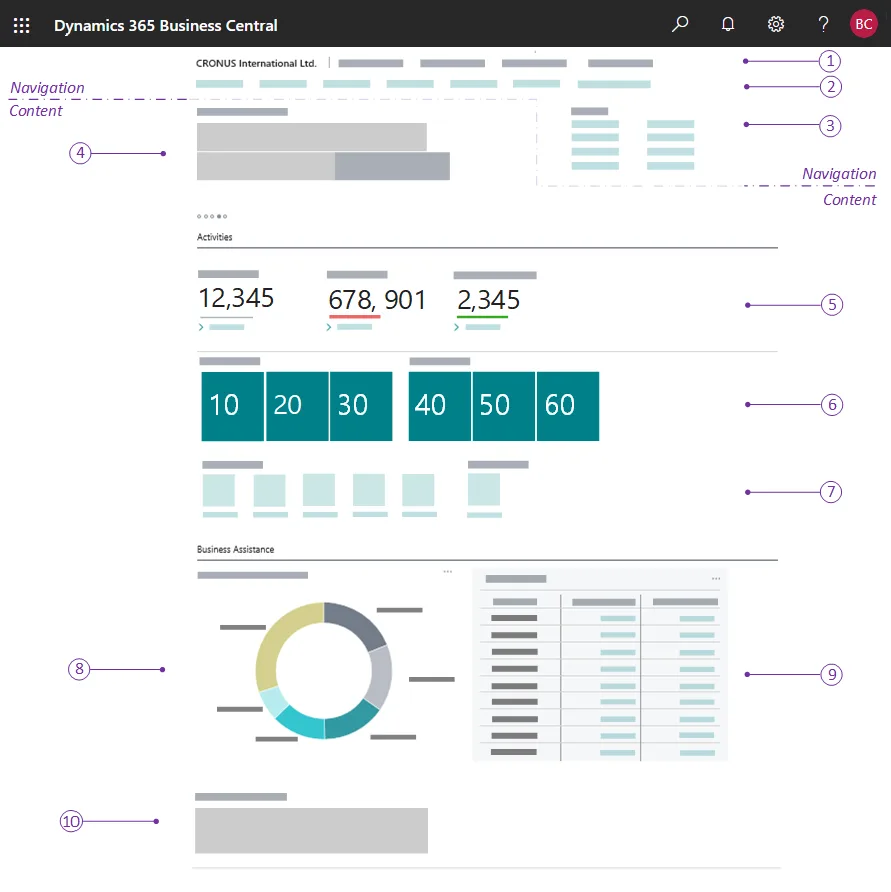
A Business Central role centre
The home page each user gets for their role: headlines, activity cues, KPI tiles, charts and actions. The numbered callouts come from Microsoft's documentation.
- Application landscape design
- Multi-entity, multi-currency finance
- Security and segregation of duties
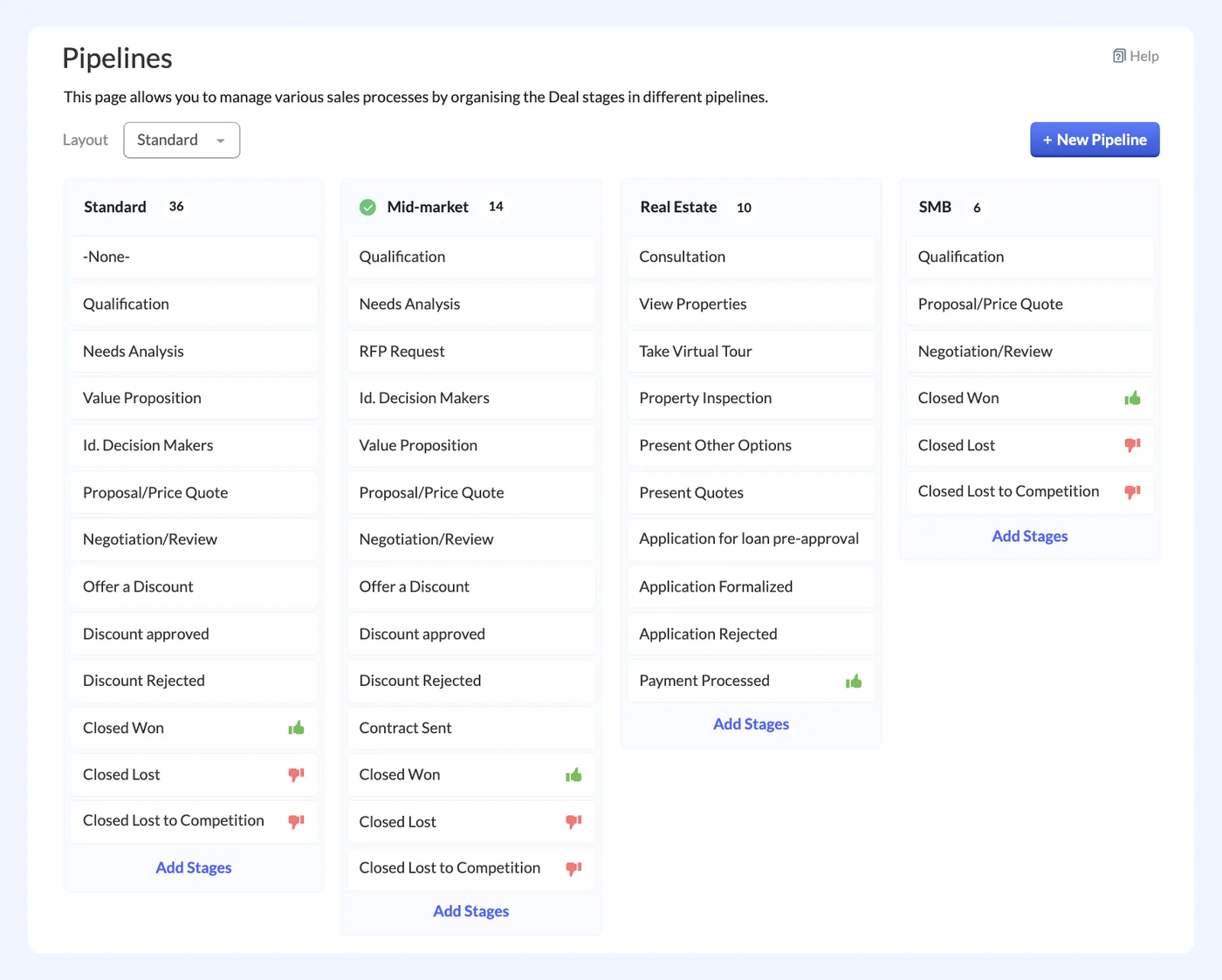
Multiple sales pipelines in Zoho CRM
Four deal pipelines side by side (standard, mid-market, real estate and SMB), each with its own stages from qualification to closed won or lost.
- Integration as architecture
- Group-wide e-invoicing readiness
- Data residency in the UAE
Which platform for enterprise software solutions in the UAE?
An honest comparison. We implement all of these, so the recommendation follows your processes, team and budget.
| Option | Best when | How it fits this need |
|---|---|---|
| Dynamics 365 suite | Heavy audit, many users and Microsoft-based IT operations. | Finance, field service and Power Platform share Dataverse, security and identity. Strong for governance-heavy organisations but carries higher licence and implementation cost than alternatives. |
| Odoo Enterprise | Broad operations must share one database at moderate cost. | Covers finance, field service, maintenance, HR and inventory in one system. Access controls are good but need deliberate design to meet strict audit expectations. |
| Best-of-breed mix | Existing systems are strong in some areas and weak in others. | Keeping good systems and replacing weak ones reduces disruption. It places more weight on integration, identity and governance, which must be designed and funded properly. |
| Custom enterprise application | A core process is unique and central to your contracts. | Justified for truly differentiating processes, such as a specialised contract or regulatory workflow. Standard finance, HR and CRM should almost always stay on packages. |
What changes in the UAE
The local rules and realities we design for before go-live. Rules change, so we re-check the current position at scoping.
Group-wide e-invoicing readiness
Under Ministerial Decisions 243 and 244 of 2025, businesses with AED 50M+ revenue are due to go live from 1 January 2027 via an Accredited Service Provider. Groups need one approach across entities; check the Ministry of Finance for the latest dates.
Data residency in the UAE
Microsoft, AWS, Oracle and Zoho run UAE data centre regions. Enterprises in regulated sectors can keep ERP and CRM data in-country, and Odoo can be self-hosted on Azure UAE North or AWS me-central-1.
Seven emirates, different rules
Groups often span Dubai, Abu Dhabi and the northern emirates, with mainland and free zone entities treated differently for VAT and licensing. The design keeps each entity's obligations visible while giving leadership one view.
What drives the cost, and what it connects to
No price list: we quote a fixed price in AED after discovery. These are the factors that move the effort up or down.
Applications in the landscape
Each application replaced or introduced brings data migration, training and integration. Programmes touching finance, HR, field service and CRM together need careful phasing and budget.
Controls and audit design
Segregation of duties, approval limits, access reviews and audit logs require design workshops with internal audit and testing that smaller projects skip.
User numbers and roles
Hundreds of users across many roles need role design, training materials and staged onboarding. Field technicians need different training from office finance staff.
Environments and hosting
Separate development, test and production environments with UAE hosting, backups and monitoring add infrastructure and operations effort well beyond the licence costs themselves.
What it connects to
One identity controls access to every enterprise application, with joiner, mover and leaver changes driven from HR.
Invoices and supporting documents are prepared in the ERP and submitted to government-linked clients' portals in required formats.
HR and payroll produce WPS salary files for each entity, and payroll journals post to finance automatically.
Tax invoices from every UAE entity pass through an Accredited Service Provider in PINT AE format, with status returned.
Finance, field and HR data combine into contract, entity and board reporting with row-level security.
How we deliver enterprise software solutions
Phases, indicative timing and what is delivered in each. Scope is fixed and priced in AED before we start.
Landscape assessment
Interviews with finance, operations, IT and audit, plus a review of every current system, licence and integration.
Target architecture
A platform decision by fit, a data ownership model, an integration design and a phased roadmap with business cases.
Pilot entity
One entity or business unit goes live first, proving the design, data migration and controls before a wider rollout.
Rollout waves
Remaining entities and emirates follow in waves, each with its own cutover plan, training and parallel checks where needed.
Run and improve
Application management, release testing, monitoring and a quarterly roadmap review with your IT and finance leaders.
When enterprise software solutions is the wrong answer
Enterprise programmes fail when the organisation cannot give business owners time. If no one from finance or operations can commit a few days a week, we would rather run a smaller, contained project first. Also, if you are already mid-way through an SAP or Oracle programme, we do not implement those; we would limit our role to surrounding apps and integration.
How we handle it: We implement Zoho, Odoo and Dynamics 365 and build AI and custom software, so our written recommendation can point you to a simpler option, or to doing nothing yet.
Checklist and common mistakes
Buyer's checklist
What to ask for before you choose a provider.
- Ask for a target application landscape showing each system's role, owner, data it masters and how it connects.
- Require a segregation-of-duties matrix and evidence of how each system will enforce it, before build begins.
- Confirm hosting regions for each system and how data residency expectations of government-linked clients are met.
- Check the provider's approach to release management, testing environments and change approval for hundreds of users.
- Ask how the design handles e-invoicing, Corporate Tax and WPS across all entities in scope.
- Request a support model covering incidents, change requests and periodic access reviews after go-live.
Common mistakes
What we see go wrong in the UAE, and how to avoid it.
- Buying modules without a landscapeUAE organisations often add systems one at a time until nobody knows which one holds the truth. Draw the target landscape first and fit each purchase into it.
- Audit involved too lateInternal audit seeing the design at go-live leads to rework. Invite internal audit into the role, approval and access design workshops from the first month.
- Over-customising a packageHeavy customisation of an ERP to mirror old processes raises upgrade cost for years. Change processes where the package's standard approach is reasonable.
- No application ownersSystems without named business owners drift and accumulate unused licences. Assign an owner to each application with budget, licence and change responsibility.


A UAE team you can meet in person
That is our team at Zoholics Dubai 2026. We deliver Zoho, Odoo, Dynamics 365 and custom projects from our Ras Al Khaimah office with remote delivery across all seven emirates, in English and Arabic, and we run workshops on site in Dubai, Abu Dhabi and Sharjah when a project needs it.
Enterprise Software Solutions in the UAE: questions we get asked
What do enterprise software solutions UAE projects usually include?
Do you recommend Dynamics 365, Odoo or Zoho for large companies?
Are you a Microsoft partner?
How long does an enterprise rollout take in the UAE?
How is enterprise software different from enterprise integration services?
How are enterprise projects priced?
How long should enterprise software solutions in the UAE take to plan before building?
Can enterprise software run for UAE and non-UAE entities together?
How do you handle licence optimisation for large user numbers?
Why choose Shyphan?

Talk to a consultant about enterprise software solutions
A free 30-minute call, then a written recommendation and a fixed quote in AED, including the honest option that this is not the right fit.
