





















 Saudi Arabia
 UAE
UAE Qatar
Qatar Bahrain
 Kuwait
 Oman
Oman Lebanon
 Egypt
Egypt India
India UK
UK Ireland
 Germany
 USA
USA Australia
 Singapore
 South Africa
 Iraq
Iraq Jordan
 Hungary
 Georgia
 Turkey
 LagosNigeria



 Systems integration · UAE
Enterprise Integration Services in the UAE
Enterprise integration services UAE companies buy when their systems stay but the manual re-keying between them has to stop. Shyphan connects ERP, CRM, HR, banks, e-commerce, e-invoicing providers and legacy databases through documented, monitored APIs, working with Dynamics 365, Odoo, Zoho and custom systems. Each integration phase is quoted as a fixed price in AED after a free discovery call.
Prefer to talk? Call +971 55 145 3265
Get a free recommendation
Tell us what you want to fix. A senior consultant replies within one working day with a written view.
Trusted by businesses across the UAE, Saudi Arabia and beyond












Enterprise Integration Services in the UAE: the short answer
- What it is
- Enterprise integration is the design, build and running of the connections that move data automatically and reliably between an organisation's business systems.
- Best suited to
- UAE organisations with several core systems, such as an ERP, a CRM, a payroll system and a warehouse or e-commerce platform, whose staff currently export, re-type or reconcile data between them.
- Core stack
- Azure Integration Services, Power Automate, Zoho Flow, Odoo JSON-RPC API, Node.js, PostgreSQL
- Typical timeline
- Four to sixteen weeks depending on the platform, modules, data migration and integrations; we phase larger programmes.
- What it costs
- A fixed price in AED after a free discovery call, phased so you are never committing to the whole programme on day one. Platform licences are billed by the vendor.
- Local specifics
- E-invoicing phases approaching; WPS and UAE bank formats; In-country integration hosting.
- Delivered by
- Shyphan AI Solutions: Zoho Premium Partner, Official Odoo Partner, independent Dynamics 365 consultancy and custom software house, so the platform is chosen by fit.
- Last reviewed
- 29 September 2026
Enterprise Integration Services in the UAE: who it is for
UAE organisations with several core systems, such as an ERP, a CRM, a payroll system and a warehouse or e-commerce platform, whose staff currently export, re-type or reconcile data between them. Enterprise integration is the design, build and running of the connections that move data automatically and reliably between an organisation's business systems.
- Integration map and ownership
- E-invoicing ASP connection
- Bank and payment files
- Legacy system bridges
What we use to deliver enterprise integration services
Tools and platforms we typically use, and the systems it connects to. The final choice is made against your systems, budget and team.





 Odoo
Odoo Business Central
 Microsoft 365
 WhatsApp
Enterprise Integration Services in the UAE: what is included
Enterprise integration services UAE companies buy when their systems stay but the manual re-keying between them has to stop.
Integration map and ownership
Every interface is listed with its source, target, trigger, frequency, owner and failure handling. That map becomes the reference for IT and auditors, and stops the common situation where nobody knows which script updates customer records overnight.
E-invoicing ASP connection
UAE e-invoicing under Ministerial Decisions 243 and 244 of 2025 requires invoices in PINT AE format through an Accredited Service Provider. We connect your ERP or billing system to the chosen ASP, handle status responses and store the returned references; check the Ministry of Finance for the latest dates.
Bank and payment files
Supplier payment files, WPS salary files for your MOHRE-approved agent, and bank statement imports are produced and read automatically in the formats your UAE banks accept, with approval steps kept inside the ERP.
Legacy system bridges
Older on-premise systems without modern APIs are connected through database views, scheduled file drops or a small API wrapper, so you can retire them gradually instead of in one risky cutover.
Monitoring and retries
Failed messages are logged, retried automatically where safe, and raised to a named person with the exact record and error. A simple status dashboard shows every interface's health, rather than finding out from an angry customer.
Secure credentials and access
API keys and service accounts are held in a secrets store, scoped to the minimum permissions, rotated on a schedule and never embedded in code. Logs avoid storing personal data unnecessarily, in line with the PDPL.
Healthcare group connecting clinics and finance
How enterprise integration services in the UAE looks in practice. Illustrative; every project is scoped to the business.
For example, a UAE outpatient clinic group operates in Abu Dhabi and the northern emirates, running a clinic management system, Zoho People for HR, and Odoo for purchasing and accounts. Finance re-keys daily revenue from clinic reports, HR updates doctor records in two places, and purchasing cannot see clinic consumption. The CFO wants the systems to talk before e-invoicing arrives.
- Draw an integration map of every system, data object and owner, agreeing that Odoo masters suppliers and items while Zoho People masters employees and doctors.
- Build a Node.js integration service hosted in a UAE cloud region that posts daily clinic revenue summaries and consumables usage into Odoo with full reconciliation reports.
- Sync new and leaving staff from Zoho People to the clinic system and Microsoft 365, with every run logged and failures sent to the IT lead.
See it on the platforms we deliver
Real screens from the platforms we implement. Yours are configured to your entities, processes and KPIs.
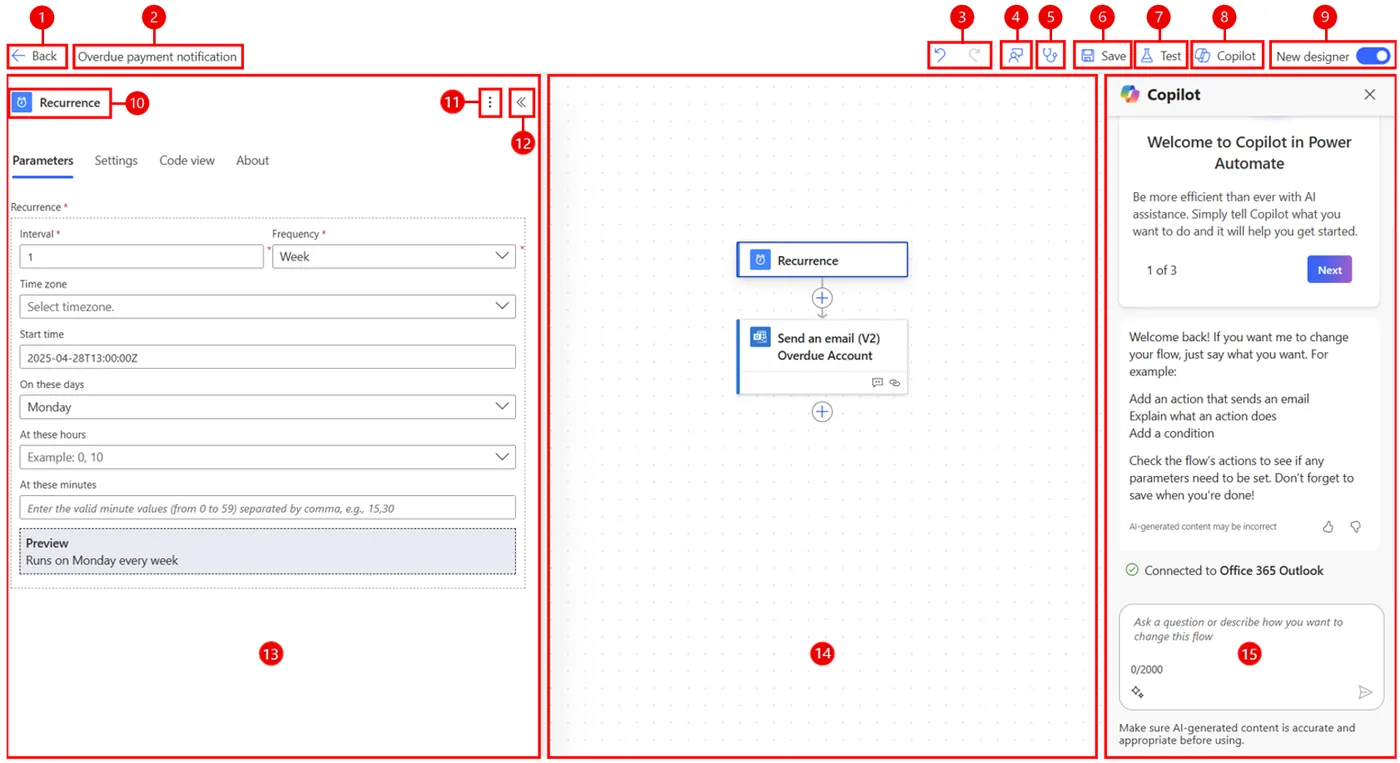
The Power Automate cloud flow designer
A scheduled flow that sends an overdue payment email, with the trigger settings, the flow canvas and the Copilot pane for building flows in plain language.
- Integration map and ownership
- E-invoicing ASP connection
- Bank and payment files
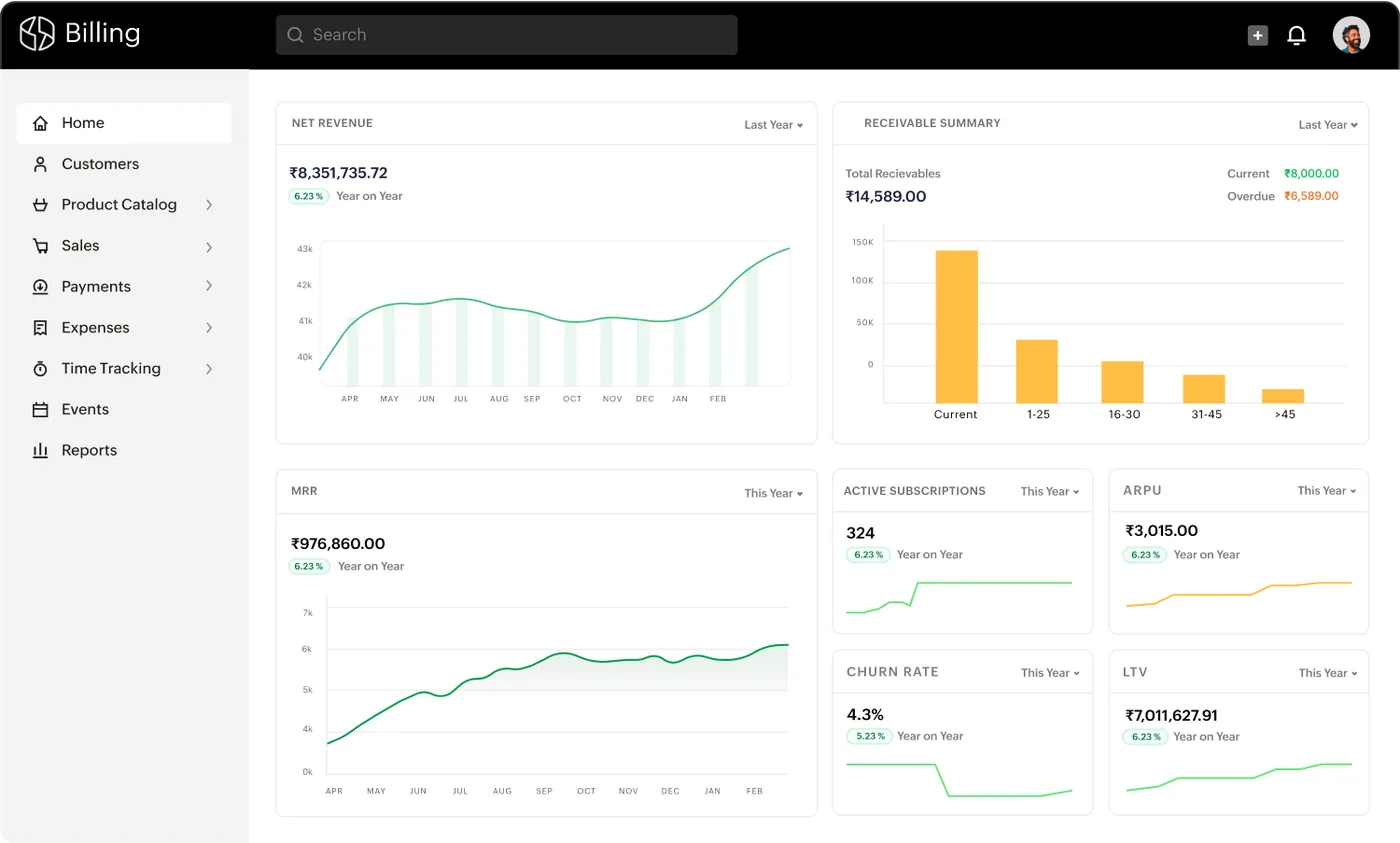
The Zoho Billing dashboard
Net revenue, receivables by ageing bucket, monthly recurring revenue, active subscriptions, ARPU, churn rate and customer lifetime value.
- Legacy system bridges
- E-invoicing phases approaching
- WPS and UAE bank formats
Which platform for enterprise integration services in the UAE?
An honest comparison. We implement all of these, so the recommendation follows your processes, team and budget.
| Option | Best when | How it fits this need |
|---|---|---|
| Middleware platform | Five or more systems exchange data in many directions. | A central layer such as Azure Integration Services gives one place for monitoring, retries and mapping. More set-up than point-to-point, but easier to govern as systems are added. |
| Native connectors | Two mainstream apps need a standard, simple sync. | Built-in Zoho, Odoo or Microsoft connectors are quick and cheap. They rarely handle complex rules, error handling or unusual fields, so check limits before relying on them. |
| Custom integration service | Legacy, local or clinical systems lack standard connectors. | A small service in Node.js or Python can bridge databases, files and odd APIs precisely. It needs documentation and monitoring so it is not a black box. |
| Manual export and import | Data moves monthly and volumes are very small. | For a handful of monthly records, a controlled import template may be cheaper than an integration. Once transfers become weekly or error-prone, automate them. |
What changes in the UAE
The local rules and realities we design for before go-live. Rules change, so we re-check the current position at scoping.
E-invoicing phases approaching
The e-invoicing pilot starts 1 July 2026, with businesses of AED 50M+ revenue live from 1 January 2027 and others from 1 July 2027. The integration to your ASP is often the critical path; check the Ministry of Finance for the latest dates.
WPS and UAE bank formats
Payroll must reach employees through the Wages Protection System. Integrating payroll with your agent's SIF format and bank portals removes manual uploads that commonly cause rejected salary files.
In-country integration hosting
Integration services can run in Azure UAE North or AWS me-central-1, so data moving between UAE systems stays in the country where your policies or sector regulators prefer that.
What drives the cost, and what it connects to
No price list: we quote a fixed price in AED after discovery. These are the factors that move the effort up or down.
Systems and directions
Each system pair and data direction adds mapping, testing and monitoring. A one-way nightly feed costs far less than a two-way, near real-time sync with conflict rules.
Legacy access
Older on-premise systems without APIs may need database access, file drops or vendor cooperation, which adds discovery time and sometimes vendor fees.
Reconciliation needs
Finance-grade flows need control totals and reconciliation reports to prove nothing was lost. This adds design and testing but is essential for audit.
Hosting and resilience
Running integrations in a UAE cloud region with queues, backups and failover costs more than a single script on a server, and protects against lost transactions.
What it connects to
Invoices leave the ERP in PINT AE format for validation and delivery; acceptance or rejection status returns to each invoice.
Payment files go from ERP to the bank; payment status and statements come back for automatic reconciliation.
Payroll output is converted to the SIF format for the MOHRE-approved agent, and confirmations are stored against the payroll run.
Joiners and leavers from HR create or disable user accounts across connected business systems automatically.
Read-only extracts from older systems feed the ERP or reporting layer without changing the legacy application itself.
How we deliver enterprise integration services
Phases, indicative timing and what is delivered in each. Scope is fixed and priced in AED before we start.
Interface inventory
We list current systems, manual transfers and existing scripts, then rank integrations by hours saved and error risk.
Design
Data mappings, master data ownership, triggers, error handling and security are written down and signed off by system owners.
Build
Integrations are built on standard tooling with test data, starting with the highest-value interface so benefits arrive early.
Test and cutover
End-to-end tests with real volumes, reconciliation against manual figures, then a planned switch-over with rollback steps.
Run
Monitoring, fixes when vendors change their APIs, and new interfaces added as your system landscape grows.
When enterprise integration services is the wrong answer
If you have only two cloud apps that already offer a native connector, such as Zoho CRM and Zoho Books, a formal integration project is unnecessary; switching on the connector is enough. And if your core system is due for replacement within a year, we usually suggest a light temporary link rather than a full build that will be thrown away.
How we handle it: We implement Zoho, Odoo and Dynamics 365 and build AI and custom software, so our written recommendation can point you to a simpler option, or to doing nothing yet.
Checklist and common mistakes
Buyer's checklist
What to ask for before you choose a provider.
- Ask for an integration map listing systems, data objects, direction, frequency and the master system for each record.
- Confirm where the integration layer will be hosted and whether UAE data residency applies to any of the data.
- Require logging of each integration run with record counts, failures and replay options your IT team can use.
- Check how credentials, API keys and certificates are stored and rotated, and who can access them.
- Ask how the design will accommodate e-invoicing through an Accredited Service Provider when your phase begins.
- Agree a support model with response times, and what counts as an integration fault versus a source system fault.
Common mistakes
What we see go wrong in the UAE, and how to avoid it.
- No master system agreedTwo systems both editing customers or items creates endless conflicts. Agree one master per data object before designing any sync between UAE systems.
- Integrations nobody can seeScripts on an old server run unnoticed until they fail. Centralise logging and give IT a dashboard of runs, counts and errors.
- Personal accounts as credentialsIntegrations using a staff member's login stop when that person leaves. Use dedicated service accounts with limited permissions and a documented business owner.
- Leaving e-invoicing until the deadlineRetrofitting ASP connections late means rushed mapping of tax data. Plan the connection now and check the Ministry of Finance for the latest dates.


A UAE team you can meet in person
That is our team at Zoholics Dubai 2026. We deliver Zoho, Odoo, Dynamics 365 and custom projects from our Ras Al Khaimah office with remote delivery across all seven emirates, in English and Arabic, and we run workshops on site in Dubai, Abu Dhabi and Sharjah when a project needs it.
Enterprise Integration Services in the UAE: questions we get asked
What systems can enterprise integration services UAE projects connect?
Do you use middleware or point-to-point integrations?
Can you connect our ERP to a UAE e-invoicing provider?
How is enterprise integration different from enterprise software solutions?
How much do integration services cost?
Who supports the integrations after go-live?
How do enterprise integration services in the UAE handle Arabic data between systems?
Can you take over integrations another provider built?
Should integrations run in real time or in batches?
Why choose Shyphan?

Talk to a consultant about enterprise integration services
A free 30-minute call, then a written recommendation and a fixed quote in AED, including the honest option that this is not the right fit.
