





















 Saudi Arabia
 UAE
UAE Qatar
Qatar Bahrain
 Kuwait
 Oman
Oman Lebanon
 Egypt
Egypt India
India UK
UK Ireland
 Germany
 USA
USA Australia
 Singapore
 South Africa
 Iraq
Iraq Jordan
 Hungary
 Georgia
 Turkey
 LagosNigeria




 ERP decision guide · UAE
Custom ERP vs Standard ERP in the UAE
Custom ERP vs standard ERP in the UAE comes down to one question: how much of your process is truly unusual. Standard ERP (Odoo, Zoho, Dynamics 365) covers VAT, inventory and finance out of the box; custom ERP suits workflows no package models well. Shyphan implements all three platforms and builds custom, so we can recommend either side honestly.
Prefer to talk? Call +971 55 145 3265
Get a free recommendation
Tell us what you want to fix. A senior consultant replies within one working day with a written view.
Trusted by businesses across the UAE, Saudi Arabia and beyond












Custom ERP vs Standard ERP in the UAE: the short answer
- What it is
- A comparison of buying a packaged ERP and configuring it versus commissioning an ERP built specifically around one company's processes.
- Best suited to
- UAE finance, operations and IT leads choosing between Odoo, Zoho or Dynamics 365 and a bespoke system before committing budget.
- Core stack
- Odoo Accounting, Zoho Books, Dynamics 365 Business Central, Zoho Creator, Custom web app, Power Platform
- Typical timeline
- Four to sixteen weeks depending on the platform, modules, data migration and integrations; we phase larger programmes.
- What it costs
- A fixed price in AED after a free discovery call, phased so you are never committing to the whole programme on day one. Platform licences are billed by the vendor.
- Local specifics
- E-invoicing tips the balance; Arabic output is not optional; Free zone and mainland entities.
- Delivered by
- Shyphan AI Solutions: Zoho Premium Partner, Official Odoo Partner, independent Dynamics 365 consultancy and custom software house, so the platform is chosen by fit.
- Last reviewed
- 29 September 2026
Custom ERP vs Standard ERP in the UAE: who it is for
UAE finance, operations and IT leads choosing between Odoo, Zoho or Dynamics 365 and a bespoke system before committing budget. A comparison of buying a packaged ERP and configuring it versus commissioning an ERP built specifically around one company's processes.
- Fit-gap scoring before any choice
- Compliance burden on each side
- The hybrid most firms end with
- Time to first go-live
What we use to deliver custom ERP vs standard ERP
Tools and platforms we typically use, and the systems it connects to. The final choice is made against your systems, budget and team.





 Odoo
Odoo Business Central
 Microsoft 365
 WhatsApp
Custom ERP vs Standard ERP in the UAE: what is included
Custom ERP vs standard ERP in the UAE comes down to one question: how much of your process is truly unusual.
Fit-gap scoring before any choice
We list your processes and score each one against Odoo, Zoho and Dynamics 365 as standard, configured or needing code. If most gaps close with configuration, standard ERP wins. If the core money-making process is the gap, custom starts to make sense.
Compliance burden on each side
A standard ERP vendor ships VAT changes and e-invoicing formats as updates. With custom ERP, you own every change: VAT 201 layouts, Corporate Tax reporting and PINT AE e-invoices through an Accredited Service Provider all become your development backlog for as long as the system lives.
The hybrid most firms end with
Many UAE companies keep standard ERP for accounting, VAT and payroll, then build a custom module or Zoho Creator app for the one process that makes them different, such as project costing or a trading workflow, integrated through APIs rather than rebuilt from scratch.
Time to first go-live
Standard ERP usually reaches a first go-live faster because finance, inventory and purchasing already exist. Custom ERP needs design, build and testing of every screen. We show both timelines side by side in the discovery report so the trade-off is visible, not assumed.
Upgrades and total ownership
Odoo releases a major version yearly and Dynamics 365 has twice-yearly waves; Zoho updates continuously. Standard ERP means planned upgrade work. Custom ERP means no forced upgrades but full responsibility for security, hosting and framework updates. We price both in the comparison.
Vendor lock-in versus key-person risk
Standard ERP ties you to a vendor's roadmap and licence model. Custom ERP ties you to whoever holds the code. We reduce both risks: documented configuration for packages, and for custom builds, your own Git repository, source code ownership and handover documentation.
A marine services firm weighs both routes
How custom ERP vs standard ERP in the UAE looks in practice. Illustrative; every project is scoped to the business.
For example, a Sharjah marine services company repairs vessels at several yards, bills owners per dry-dock day, tracks class-society survey findings and buys parts in dollars, euros and dirhams. Its managers suspect nothing off the shelf fits, while finance wants a packaged ledger that files VAT 201 without fuss. Both camps ask for a straight answer before any budget is approved.
- Run a fit-gap workshop scoring each process against standard Odoo and Business Central, marking survey findings and dry-dock billing as the only genuine gaps.
- Keep accounting, purchasing, multi-currency and inventory on a standard ERP, configured rather than coded, so VAT, Corporate Tax and e-invoicing updates arrive from the vendor.
- Build a small custom yard app for survey findings and dock-day tracking that posts billable lines into the ERP through its API, owned outright by the company.
See it on the platforms we deliver
Real screens from the platforms we implement. Yours are configured to your entities, processes and KPIs.
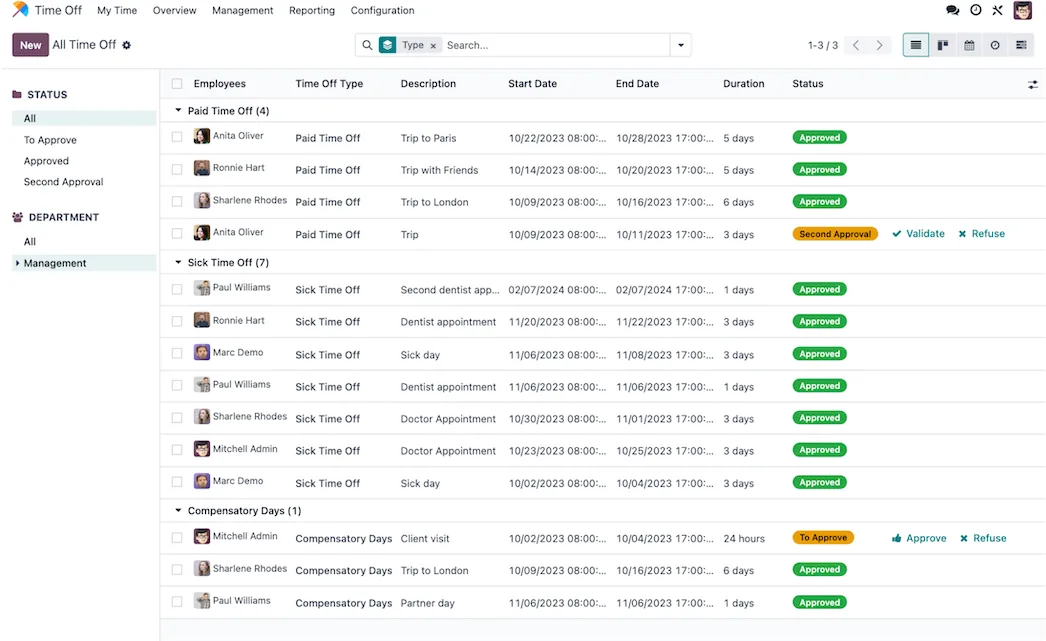
Time off requests in Odoo
Leave requests grouped by paid time off, sick time off and compensatory days, with dates, duration, approval status and approve or refuse actions.
- Fit-gap scoring before any choice
- Compliance burden on each side
- The hybrid most firms end with
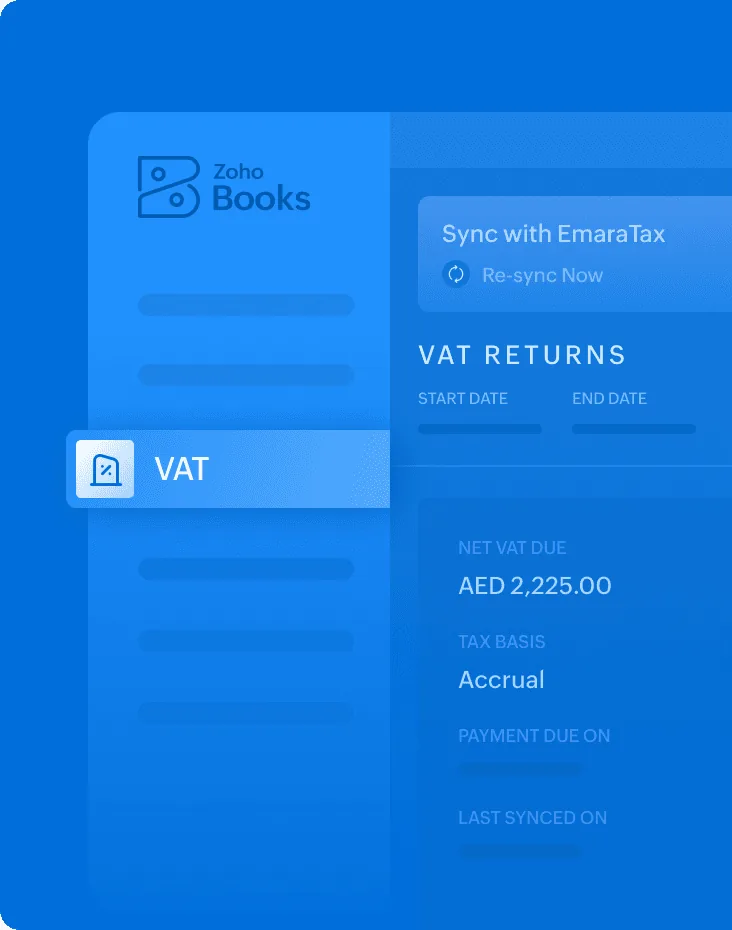
UAE VAT returns in Zoho Books
The VAT module with a return period, net VAT due in AED, accrual tax basis and a sync option for the FTA EmaraTax portal.
- Time to first go-live
- E-invoicing tips the balance
- Arabic output is not optional
Which platform for custom ERP vs standard ERP in the UAE?
An honest comparison. We implement all of these, so the recommendation follows your processes, team and budget.
| Option | Best when | How it fits this need |
|---|---|---|
| Odoo (standard, configured) | Most processes are common and a few need light custom modules | Covers accounting, stock, purchasing and projects with UAE localisation; custom modules in Git handle modest gaps, but every yearly upgrade must retest them, so keep them few. |
| Dynamics 365 Business Central | You want a packaged ledger within a Microsoft 365 estate | Strong finance and extension model through AL; UAE localisation comes from partners rather than Microsoft, so confirm who maintains VAT and e-invoicing changes before committing. |
| Zoho Books with Zoho Creator | A smaller firm needs standard books plus one bespoke workflow | Books handles VAT 201 and the ledger while Creator builds the odd process in low-code; it suits lighter operations rather than heavy manufacturing or complex costing. |
| Fully custom ERP | Core operations have no packaged equivalent anywhere | Gives an exact fit and full code ownership, but you carry VAT, Corporate Tax and e-invoicing changes yourself for life; only sensible when the unusual process is the business. |
What changes in the UAE
The local rules and realities we design for before go-live. Rules change, so we re-check the current position at scoping.
E-invoicing tips the balance
UAE e-invoicing under Ministerial Decisions 243 and 244 of 2025 phases in from 2026-2027 via ASPs; check the Ministry of Finance for the latest dates. Packages will ship PINT AE support; a custom ERP must build and maintain it.
Arabic output is not optional
Tax invoices, credit notes and many customer documents in the UAE need Arabic alongside English. Standard ERP handles bilingual templates; a custom build must design RTL layouts and Arabic PDFs from day one.
Free zone and mainland entities
Groups with a free zone and a mainland company need multi-company accounting, intercompany entries and different VAT treatment. Standard ERP does this natively; custom systems often underestimate it.
What drives the cost, and what it connects to
No price list: we quote a fixed price in AED after discovery. These are the factors that move the effort up or down.
Size of the real gap
The number of processes a package genuinely cannot model drives cost on both sides: more gaps mean more custom modules on a standard ERP or more screens in a bespoke build.
Compliance you must maintain
With custom ERP you fund VAT, Corporate Tax and e-invoicing changes yourself; with standard ERP the vendor ships most of them, so ongoing effort differs sharply.
Upgrade and retest effort
Heavily modified standard ERPs need regression testing at every major release, while custom systems need an internal or retained team to keep frameworks and security patches current.
Data migration and integrations
Moving history from legacy systems and connecting banks, e-commerce or yard tools costs similar effort either way, and is often underestimated when teams only compare licence and build prices.
What it connects to
Standard ERPs send e-invoices through vendor or partner connectors; a custom ERP needs its own build to produce PINT AE and receive status back.
Bank statements flow into the ledger for reconciliation; packaged ERPs offer connectors or file imports, custom builds must parse each bank's format.
Figures for VAT 201 and Corporate Tax returns come out of the ledger as reports, prepared for upload by finance either way.
User sign-in, Excel exports and approval emails connect to either route; Business Central links most directly, custom apps via Entra ID.
A hybrid pattern: the bespoke app pushes billable lines and job costs into the standard ERP through its API, keeping finance packaged.
How we deliver custom ERP vs standard ERP
Phases, indicative timing and what is delivered in each. Scope is fixed and priced in AED before we start.
Process inventory
We map order-to-cash, procure-to-pay, record-to-report and your special processes with the people who run them.
Fit-gap analysis
Each process is scored against Odoo, Zoho and Dynamics 365 so you see what is standard and what needs code.
Options and costs
You receive a standard, hybrid and custom option with scope, timeline and a fixed quote in AED for each.
Prototype the gap
We prototype the hardest process on the chosen route so the decision is tested before full commitment.
Build and go-live
Implementation or development in phases, with VAT and data migration checked before the first go-live.
When custom ERP vs standard ERP is the wrong answer
Custom ERP is rarely the right answer for a UAE trading or services company with ordinary processes: you pay to rebuild accounting and VAT that packages already do well. If your only gap is one workflow, we suggest standard ERP plus a small custom module or Zoho Creator app rather than a full bespoke system.
How we handle it: We implement Zoho, Odoo and Dynamics 365 and build AI and custom software, so our written recommendation can point you to a simpler option, or to doing nothing yet.
Checklist and common mistakes
Buyer's checklist
What to ask for before you choose a provider.
- Ask the provider to score your processes in a written fit-gap before recommending custom or standard, not after.
- Require a named owner for future VAT, Corporate Tax and PINT AE e-invoicing changes under whichever option you choose.
- Confirm the source code, database and documentation of any custom part are handed to you, not held by the developer.
- Ask how many customisations the standard option needs and how each will survive the vendor's next major upgrade.
- Get a total ownership view covering licences, hosting, support and upgrade testing for both routes, not just build cost.
- Check the provider genuinely delivers both packaged ERP and custom builds, so the advice is not simply what they sell.
Common mistakes
What we see go wrong in the UAE, and how to avoid it.
- Choosing custom to avoid process changeMany UAE firms commission bespoke ERP simply to copy old habits. Challenge each so-called unique process first; often the package's standard way is fine and far cheaper to maintain.
- Customising a package beyond recognitionRewriting core accounting or stock logic in Odoo or Business Central creates a custom system with vendor licence costs. Keep modifications at the edges and document every one.
- Forgetting e-invoicing ownershipThe UAE e-invoicing rollout from 2026 changes invoice data and transmission. Decide now whether the vendor, a partner or your own developers will keep this working, and check the Ministry of Finance for dates.
- No exit plan from the developerA custom ERP held on a freelancer's server with no documentation is a business risk. Insist on your own repository, hosting account and handover notes from the first sprint.


A UAE team you can meet in person
That is our team at Zoholics Dubai 2026. We deliver Zoho, Odoo, Dynamics 365 and custom projects from our Ras Al Khaimah office with remote delivery across all seven emirates, in English and Arabic, and we run workshops on site in Dubai, Abu Dhabi and Sharjah when a project needs it.
Custom ERP vs Standard ERP in the UAE: questions we get asked
Custom ERP vs standard ERP in the UAE: which is cheaper?
Can a standard ERP handle UAE VAT and Corporate Tax?
When does custom ERP clearly make sense?
Is a hybrid of standard and custom ERP realistic?
How does this page differ from your custom software vs SaaS comparison?
Who owns the code if you build a custom ERP?
Can we start on standard ERP and add custom parts later?
Does a custom ERP need its own UAE tax updates?
Is low-code a middle ground between custom and standard ERP?
Why choose Shyphan?

Talk to a consultant about custom ERP vs standard ERP
A free 30-minute call, then a written recommendation and a fixed quote in AED, including the honest option that this is not the right fit.
