





















 Saudi Arabia
 UAE
UAE Qatar
Qatar Bahrain
 Kuwait
 Oman
Oman Lebanon
 Egypt
Egypt India
India UK
UK Ireland
 Germany
 USA
USA Australia
 Singapore
 South Africa
 Iraq
Iraq Jordan
 Hungary
 Georgia
 Turkey
 LagosNigeria




 Startup ERP · UAE
ERP for Startups in the UAE
ERP for startups in the UAE should give founders investor-ready numbers and room to change fast, without locking a young company into a heavy system. Shyphan sets up Zoho or Odoo for UAE startups building a product or scaling a new venture: clean books, subscription or usage billing, burn and runway reporting, VAT and Corporate Tax records, then adds modules as the company grows. Fixed quote in AED.
Prefer to talk? Call +971 55 145 3265
Get a free recommendation
Tell us what you want to fix. A senior consultant replies within one working day with a written view.
Trusted by businesses across the UAE, Saudi Arabia and beyond












ERP for Startups in the UAE: the short answer
- What it is
- Startup ERP is a light, fast-changing ERP set-up that gives a new company clean financials, billing and reporting for investors, and expands module by module as it scales.
- Best suited to
- UAE start-ups from seed to Series B, often with a free zone entity, a holding company abroad, recurring revenue and investors asking for monthly reporting.
- Core stack
- Zoho Books, Zoho Billing, Zoho CRM, Odoo Accounting, Odoo Subscriptions, Zoho Analytics
- Typical timeline
- Four to sixteen weeks depending on the platform, modules, data migration and integrations; we phase larger programmes.
- What it costs
- A fixed price in AED after a free discovery call, phased so you are never committing to the whole programme on day one. Platform licences are billed by the vendor.
- Local specifics
- Free zone and Corporate Tax; ADGM, DIFC and free zone start-ups; E-invoicing from the start.
- Delivered by
- Shyphan AI Solutions: Zoho Premium Partner, Official Odoo Partner, independent Dynamics 365 consultancy and custom software house, so the platform is chosen by fit.
- Last reviewed
- 29 September 2026
ERP for Startups in the UAE: who it is for
UAE start-ups from seed to Series B, often with a free zone entity, a holding company abroad, recurring revenue and investors asking for monthly reporting. Startup ERP is a light, fast-changing ERP set-up that gives a new company clean financials, billing and reporting for investors, and expands module by module as it scales.
- Investor reporting and runway
- Subscription and usage billing
- Holding and operating entities
- Built to change
What we use to deliver ERP for startups
Tools and platforms we typically use, and the systems it connects to. The final choice is made against your systems, budget and team.





 Odoo
Odoo Business Central
 Microsoft 365
 WhatsApp
ERP for Startups in the UAE: what is included
ERP for startups in the UAE should give founders investor-ready numbers and room to change fast, without locking a young company into a heavy system.
Investor reporting and runway
Monthly P&L, balance sheet, cash flow, burn rate and runway come straight from the books, with departmental and project tags so investor updates and board packs stop being a founder's spreadsheet.
Subscription and usage billing
SaaS and service start-ups bill monthly or annual plans, usage or seats through Zoho Billing or Odoo Subscriptions, with MRR, churn and deferred revenue reported properly.
Holding and operating entities
A typical set-up has an overseas holding company and a UAE free zone or ADGM operating entity. Each is a separate company with its own currency and books, with consolidated reporting for the board.
Built to change
Start-ups pivot. We keep configuration standard and documented so new products, pricing models, entities or markets can be added in days, not re-implemented.
Connected to your product and payments
Your product's sign-ups, Stripe or local payment gateway payouts and bank feeds are connected so revenue and cash reconcile automatically, instead of a monthly CSV exercise.
Due-diligence ready records
Contracts, invoices, cap-table related documents and approvals are kept linked to transactions, so when a fundraise or acquisition due diligence starts, finance data can be shared quickly.
A SaaS start-up prepares for due diligence
How ERP for startups in the UAE looks in practice. Illustrative; every project is scoped to the business.
For example, an ADGM-registered B2B software start-up has a UAE operating company, a Delaware holding company and customers paying monthly, annually or by usage across the GCC. Invoices come from a billing tool, expenses from corporate cards, and the fractional CFO rebuilds deferred revenue in spreadsheets whenever a Series A investor's due diligence team asks new questions.
- Set up Zoho Books for the UAE operating company and the holding entity, with intercompany charges for development services recorded monthly in both ledgers.
- Connect Zoho Billing for plans, usage charges and annual prepayments, posting deferred revenue and recognising it monthly according to the policy the auditor has agreed.
- Build Zoho Analytics views for recurring revenue, churn, burn and runway, sourced from ledger and billing data so figures reconcile with the accounts.
See it on the platforms we deliver
Real screens from the platforms we implement. Yours are configured to your entities, processes and KPIs.
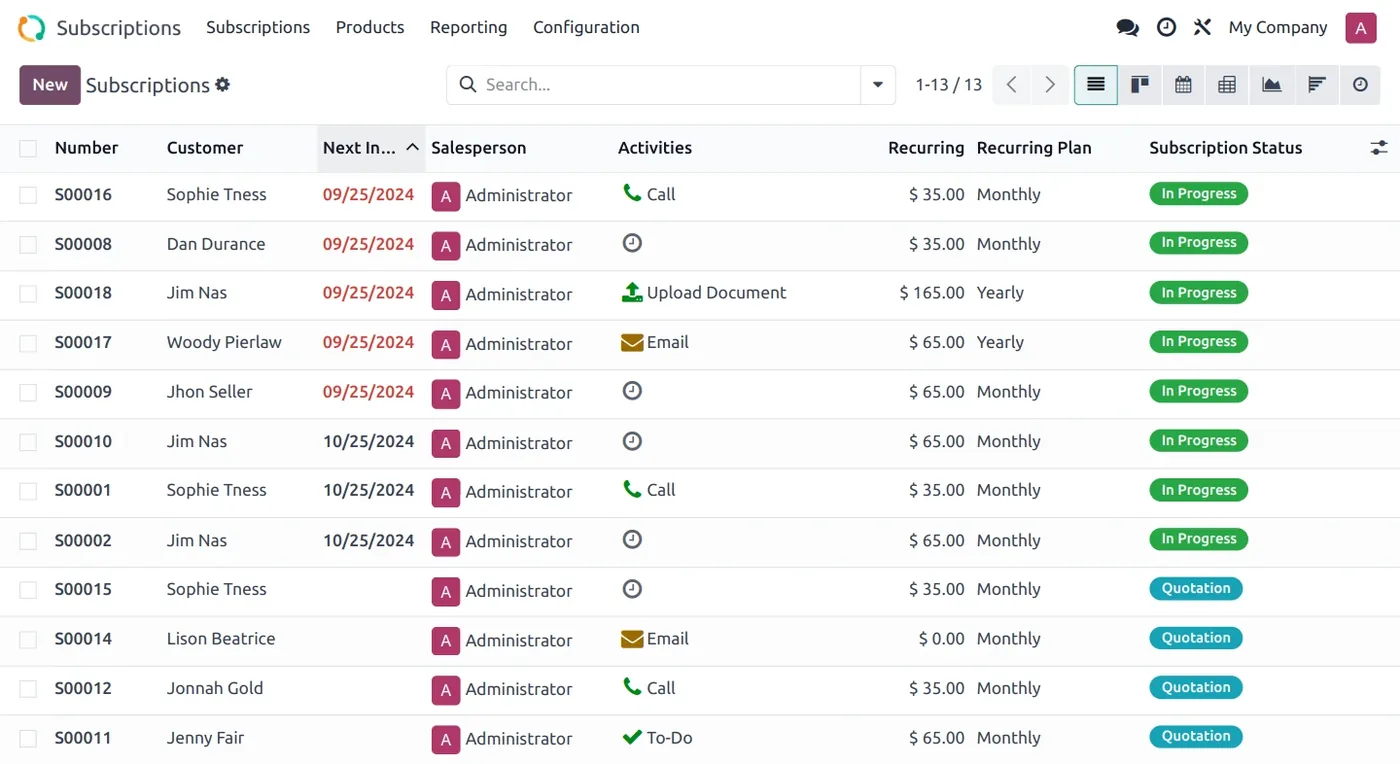
Recurring subscriptions in Odoo
Subscription orders with customer, next invoice date, salesperson, next activity, recurring amount, monthly or yearly plan and status.
- Investor reporting and runway
- Subscription and usage billing
- Holding and operating entities
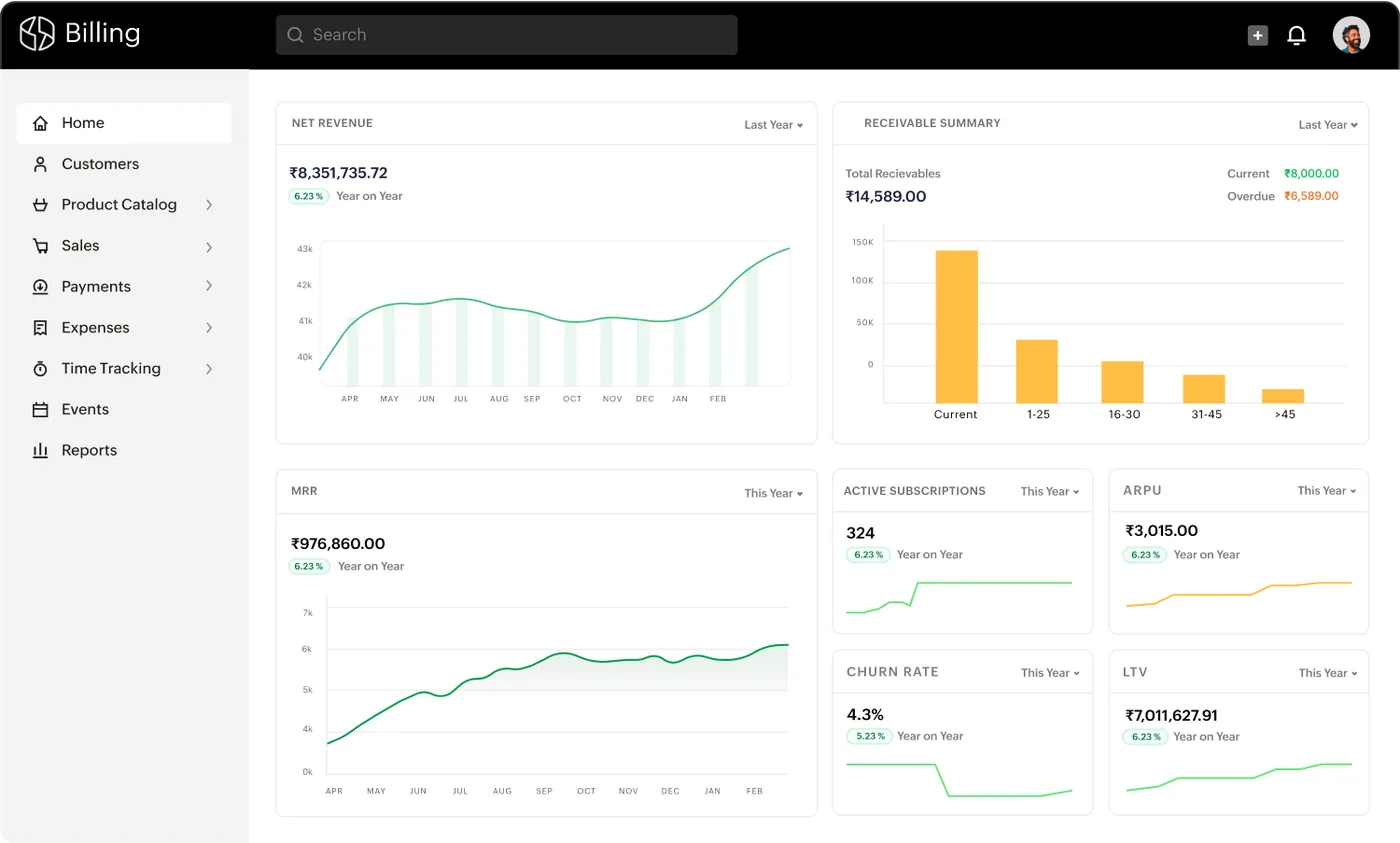
The Zoho Billing dashboard
Net revenue, receivables by ageing bucket, monthly recurring revenue, active subscriptions, ARPU, churn rate and customer lifetime value.
- Built to change
- Free zone and Corporate Tax
- ADGM, DIFC and free zone start-ups
Which platform for ERP for startups in the UAE?
An honest comparison. We implement all of these, so the recommendation follows your processes, team and budget.
| Option | Best when | How it fits this need |
|---|---|---|
| Zoho Books with Zoho Billing | Subscription and usage-based software start-ups | Plans, proration, usage charges, card payments and revenue recognition with low running cost; a practical fit for UAE SaaS start-ups from seed stage onwards. |
| Odoo Accounting with Subscriptions | Start-ups mixing subscriptions with physical products or services | One database for subscriptions, stock, projects and accounting; better when hardware, installations or field services accompany the software, as in IoT or proptech models. |
| Accounting software plus billing SaaS | Pre-seed teams with few customers and simple pricing | A billing tool feeding basic accounting software is enough early on; move to a structured ERP once investors ask for revenue schedules and cohort reporting. |
| Dynamics 365 Business Central | Later-stage scale-ups preparing for audit-heavy growth | Strong finance, dimensions and approvals, suited to scale-ups with finance teams; usually too heavy and costly for seed-stage founders managing their own books. |
What changes in the UAE
The local rules and realities we design for before go-live. Rules change, so we re-check the current position at scoping.
Free zone and Corporate Tax
Many UAE start-ups are Qualifying Free Zone Persons with 0% on qualifying income, while Small Business Relief may apply to others. We tag revenue and costs so your tax adviser can confirm treatment and file on EmaraTax.
ADGM, DIFC and free zone start-ups
Start-ups set up in ADGM, DIFC, Dubai Internet City or other free zones have different rules and data protection regimes. Entity, hosting and access design takes that into account.
E-invoicing from the start
UAE e-invoicing via Accredited Service Providers is due in phases from 2027 (check the Ministry of Finance). Start-ups that pick an ERP able to connect now avoid rebuilding billing just as they grow.
What drives the cost, and what it connects to
No price list: we quote a fixed price in AED after discovery. These are the factors that move the effort up or down.
Billing model complexity
Flat monthly plans are quick; usage metering, tiered pricing, proration and multi-currency plans need more configuration and a usage feed from your product to the billing system.
Entity structure
A UAE company plus an offshore holding company, and perhaps a Saudi branch, adds ledgers, currencies, intercompany rules and consolidated reporting that must be designed carefully.
Product and payment links
Connecting your application's user and usage data, payment gateway and corporate card provider adds integration work, depending on the APIs each offers.
Due diligence history
Cleaning and restating past revenue, deferred balances and expenses before a funding round adds effort, but it is cheaper than fixing them under investor deadline pressure.
What it connects to
Card payments, refunds and disputes flow into billing and accounts; payouts reconcile against bank deposits automatically.
Usage counts per customer flow from the application into billing each period, driving usage-based invoice lines.
Card transactions and receipts import into expenses and the ledger, categorised by department and cost centre.
Closed deals create customers and subscriptions in billing; invoice and payment status flows back to account owners.
Recurring revenue, churn, burn and runway flow out to founder and board dashboards shared ahead of each meeting.
How we deliver ERP for startups
Phases, indicative timing and what is delivered in each. Scope is fixed and priced in AED before we start.
Founder call
We understand the business model, entities, investors' reporting asks and the next 18 months.
Set-up
Entities, chart of accounts, VAT, billing plans and reporting tags configured.
Connect
Bank feeds, payment gateway and product sign-up data connected; opening balances loaded.
Reporting pack
Investor and board reporting pack built and reviewed with the founder or CFO.
Grow in phases
Add CRM, HR, inventory or procurement modules as the team and operations grow.
When ERP for startups is the wrong answer
If you are pre-revenue with a handful of founders, you do not need an ERP. A properly set-up Zoho Books or Odoo Accounting file with your accountant is enough. Start-ups also should not buy a heavy tier-one ERP early; the cost and rigidity slow you down.
How we handle it: We implement Zoho, Odoo and Dynamics 365 and build AI and custom software, so our written recommendation can point you to a simpler option, or to doing nothing yet.
Checklist and common mistakes
Buyer's checklist
What to ask for before you choose a provider.
- Ask how revenue recognition for annual prepayments and usage charges will be handled and agreed with your auditor.
- Confirm a holding company abroad can be set up alongside the UAE entity, with intercompany charges recorded consistently.
- Require runway and burn reports that reconcile to the ledger, not separate spreadsheets investors cannot trace.
- Check the payment gateway you use today connects directly, including refunds, disputes and payout reconciliation.
- Ask how free zone qualifying income will be tagged for Corporate Tax, leaving the conclusion to your tax adviser.
- Confirm you can change pricing models later without rebuilding billing, since start-up pricing rarely stays the same.
Common mistakes
What we see go wrong in the UAE, and how to avoid it.
- Recognising annual prepayments upfrontBooking a full year's subscription as revenue on invoice day overstates growth and fails due diligence. Defer it and recognise monthly according to an agreed policy.
- Mixing holding and operating costsPaying holding company expenses from the UAE entity without recording intercompany entries muddles both ledgers. Record every cross-entity payment properly from the start.
- Metrics defined differently each monthInvestors lose trust when churn or recurring revenue definitions shift. Agree definitions once, build them into reports and document them for the data room.
- Ignoring e-invoicing until laterUAE e-invoicing will apply to business invoices as rollout phases arrive. Choose tools with a clear path now, and check the Ministry of Finance for dates.


A UAE team you can meet in person
That is our team at Zoholics Dubai 2026. We deliver Zoho, Odoo, Dynamics 365 and custom projects from our Ras Al Khaimah office with remote delivery across all seven emirates, in English and Arabic, and we run workshops on site in Dubai, Abu Dhabi and Sharjah when a project needs it.
ERP for Startups in the UAE: questions we get asked
What is the best ERP for startups in the UAE?
When should a startup move from accounting software to ERP?
How is ERP for startups different from ERP for small business?
Can the ERP handle a holding company outside the UAE?
Can you connect Stripe or our payment gateway?
How much does startup ERP cost in the UAE?
Can ERP for startups in the UAE support employee stock option records?
Can we give investors direct access to our figures?
Can a start-up's grant or accelerator funding be tracked separately?
Why choose Shyphan?

Talk to a consultant about ERP for startups
A free 30-minute call, then a written recommendation and a fixed quote in AED, including the honest option that this is not the right fit.
