





















 Saudi Arabia
 UAE
UAE Qatar
Qatar Bahrain
 Kuwait
 Oman
Oman Lebanon
 Egypt
Egypt India
India UK
UK Ireland
 Germany
 USA
USA Australia
 Singapore
 South Africa
 Iraq
Iraq Jordan
 Hungary
 Georgia
 Turkey
 LagosNigeria




 Build or subscribe · UAE
Custom Software vs SaaS in the UAE
Custom software vs SaaS in the UAE is a choice between renting a finished tool and owning one shaped around your process. SaaS is quick and predictable; custom software fits exactly but needs budget and upkeep. Shyphan helps UAE firms decide per application, and often recommends a middle route: low-code on Zoho Creator or Power Apps.
Prefer to talk? Call +971 55 145 3265
Book a free discovery call
Tell us what you want to fix. A senior consultant replies within one working day with a written view.
Trusted by businesses across the UAE, Saudi Arabia and beyond












Custom Software vs SaaS in the UAE: the short answer
- What it is
- A comparison of subscribing to a ready-made cloud application versus commissioning software built and owned by your business.
- Best suited to
- UAE owners and managers choosing a tool for one job, such as a customer portal, booking system, field app or internal tracker.
- Core stack
- Zoho Creator, Power Apps, React, Node.js, Flutter, Azure UAE North
- Typical timeline
- A focused first release in 8 to 16 weeks after discovery: two to three weeks of discovery and prototype, then build in two-week increments you review.
- What it costs
- We quote a fixed price in AED after a discovery session, broken into phases so you are never committing to the whole build on day one.
- Local specifics
- UAE hosting expectations; PDPL and free zone data laws; Arabic support varies widely.
- Delivered by
- Shyphan AI Solutions, a custom software and mobile app development company that also implements Zoho, Odoo and Dynamics 365, so apps are built to connect to your systems.
- Last reviewed
- 29 September 2026
Custom Software vs SaaS in the UAE: who it is for
UAE owners and managers choosing a tool for one job, such as a customer portal, booking system, field app or internal tracker. A comparison of subscribing to a ready-made cloud application versus commissioning software built and owned by your business.
- Subscription versus build budget
- Low-code as the middle route
- Integration reality check
- Where your data lives
What we use to deliver custom software vs saas
Tools and platforms we typically use, and the systems it connects to. The final choice is made against your systems, budget and team.





 Odoo
Odoo Business Central
 Microsoft 365
 WhatsApp
Custom Software vs SaaS in the UAE: what is included
Custom software vs SaaS in the UAE is a choice between renting a finished tool and owning one shaped around your process.
Subscription versus build budget
SaaS spreads cost into per-user monthly fees that rise with headcount. Custom software front-loads cost into a build, then a smaller maintenance retainer. We model both over the period you care about so the comparison uses your real user numbers, not a vendor brochure.
Low-code as the middle route
Zoho Creator and Power Apps let us build an app around your process on a managed platform, with hosting, security and mobile apps included. It costs less than full custom code and bends further than off-the-shelf SaaS, which suits many UAE SMEs.
Integration reality check
SaaS products integrate where their APIs allow and no further. Custom software can talk to anything, including legacy systems and government portals, but each integration must be built and maintained. We list every system the tool must touch before recommending a route.
Where your data lives
Many SaaS vendors host outside the UAE. Custom software can run in Azure UAE North or AWS me-central-1. For regulated data, or clients asking for in-country hosting, that can decide the question on its own.
How fast you need to change
If your process changes monthly, SaaS may block you until the vendor ships a feature. Custom software changes when you pay for it. If your process is stable and common, SaaS improvements arrive free while a custom tool stands still unless funded.
Exit and ownership
Leaving a SaaS product means exporting data and retraining staff. Leaving a custom supplier means taking your code and documentation elsewhere. We check export options on SaaS and hand over source code and a Git repository on every custom build.
Choosing a customer portal for a logistics firm
How custom software vs saas in the UAE looks in practice. Illustrative; every project is scoped to the business.
Picture a Sharjah-based freight and warehousing company whose corporate customers want to track shipments, download documents and request collections online. Sales wants a branded portal built from scratch, finance wants to add a SaaS portal module from its current system, and the owner needs a decision that will still make sense as customers in several emirates grow.
- List portal requirements and mark which are standard, such as documents and tracking, and which are genuinely unique, such as customer-specific storage billing rules.
- Trial the closest SaaS or ERP portal module with two real customers for a few weeks, recording which needs it met and where users struggled.
- Build only the unique parts as a thin custom layer or low-code extension, connected to the chosen platform, rather than rebuilding everything.
See it on the platforms we deliver
Real screens from the platforms we implement. Yours are configured to your entities, processes and KPIs.
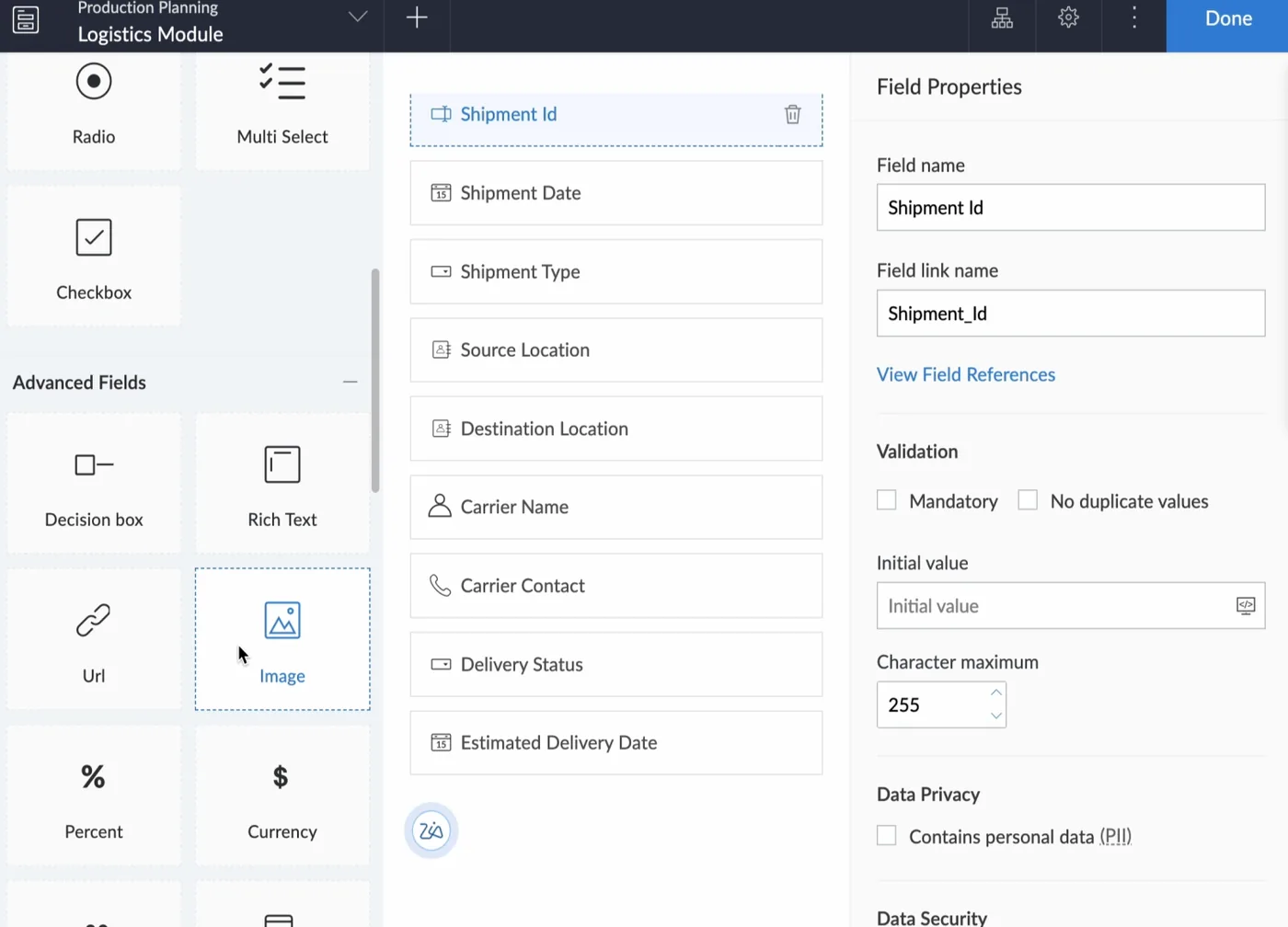
Building a form in Zoho Creator
A logistics shipment form being designed with drag-and-drop fields, and the field properties panel for validation, initial value, length and personal data flags.
- Subscription versus build budget
- Low-code as the middle route
- Integration reality check
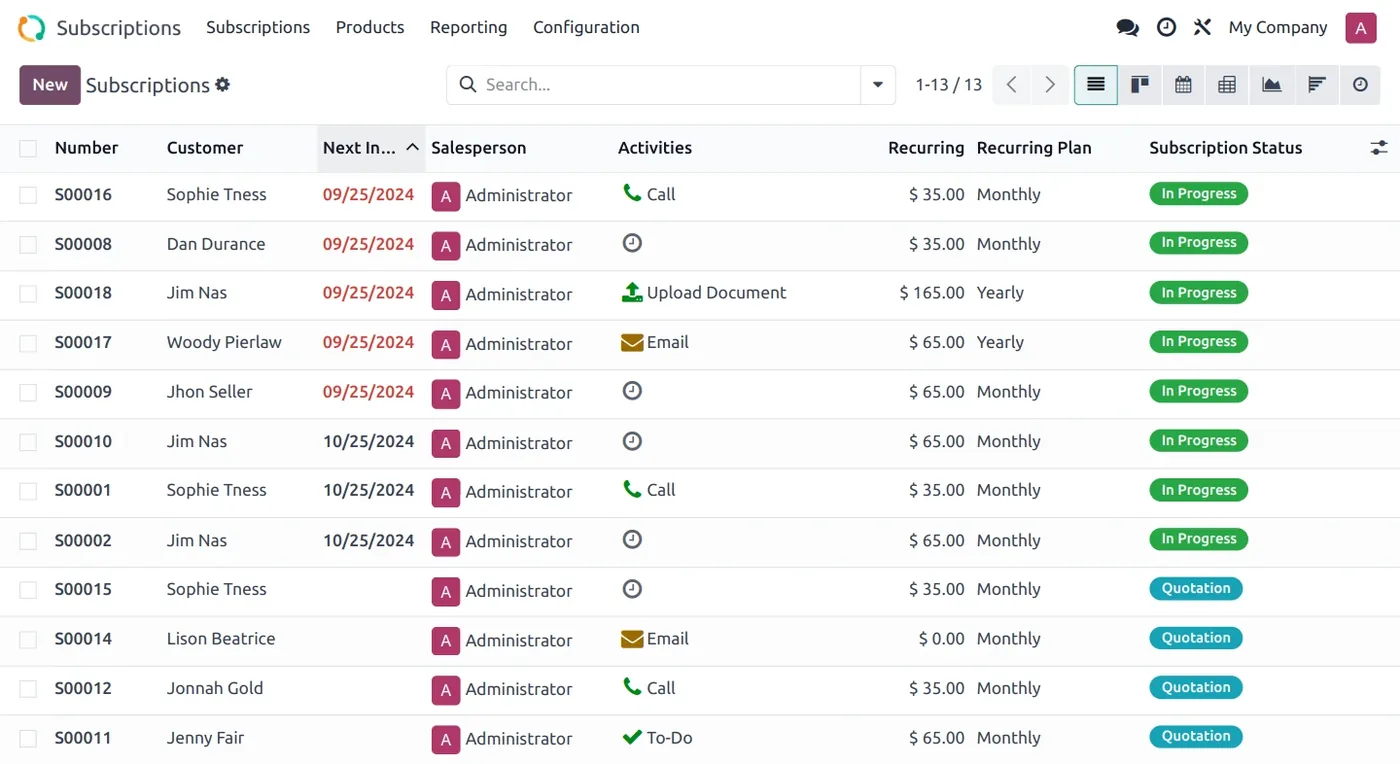
Recurring subscriptions in Odoo
Subscription orders with customer, next invoice date, salesperson, next activity, recurring amount, monthly or yearly plan and status.
- Where your data lives
- UAE hosting expectations
- PDPL and free zone data laws
Which platform for custom software vs saas in the UAE?
An honest comparison. We implement all of these, so the recommendation follows your processes, team and budget.
| Option | Best when | How it fits this need |
|---|---|---|
| SaaS product | Your process matches common practice in your industry | Fastest route with predictable monthly fees and vendor updates. Check UAE VAT invoicing, Arabic support, data location and export options before committing, as switching later can be painful. |
| Low-code on Zoho Creator or Power Apps | Unique rules, modest users, need to change often | A practical middle route for UAE firms: faster than custom code, more flexible than SaaS. Platform licences continue, and very high traffic public apps are better built conventionally. |
| Fully custom software | The tool is a competitive advantage or product | Gives full control, ownership and exact fit. Requires upfront investment, a maintenance budget and an internal owner, so it is rarely the right choice for common back-office tasks. |
| Hybrid: SaaS core with custom layer | Standard core, a few distinctive customer-facing features | Often the best balance: SaaS or ERP handles standard functions, while a small custom or low-code layer adds what differentiates you. Integration must be designed and documented carefully. |
What changes in the UAE
The local rules and realities we design for before go-live. Rules change, so we re-check the current position at scoping.
UAE hosting expectations
Government-linked clients, healthcare and financial firms in the UAE increasingly ask where data sits. Microsoft, AWS, Oracle and Zoho all run UAE data centre regions, so check which region a SaaS tool actually uses.
PDPL and free zone data laws
Personal data falls under the PDPL (Federal Decree-Law 45 of 2021), while DIFC and ADGM have their own data protection laws. Custom software lets you design consent and retention to match; with SaaS you rely on the vendor's terms.
Arabic support varies widely
Many global SaaS tools translate menus but not documents, search or right-to-left layouts. A custom build or a low-code app can be bilingual from the start, which matters for UAE customer-facing tools.
What drives the cost, and what it connects to
No price list: we quote a fixed price in AED after discovery. These are the factors that move the effort up or down.
Fit gap size
The more your process differs from standard SaaS, the more customisation or workarounds cost. A small gap favours SaaS; a large, valuable gap favours custom or low-code.
User numbers over time
Per-user SaaS and low-code licences grow with headcount and customers. Custom software has different economics, with higher build cost but fewer per-user charges later.
Maintenance responsibility
SaaS vendors handle updates and security. Custom software needs your budget for fixes, upgrades, hosting and security patches throughout its life, not just the initial build.
Integration with existing systems
Both SaaS and custom tools must connect to accounting, CRM or ERP. The number and quality of APIs involved often drives effort more than the choice itself.
What it connects to
Invoices, payments and customer balances flow from the chosen tool into accounting, keeping VAT records in one place.
Orders, stock or shipment data move between the ERP and the new tool, whether SaaS or custom, through APIs.
Staff sign in with company accounts using single sign-on, and access is removed centrally when people leave.
Customer notifications from the tool are sent through approved templates, regardless of whether it is SaaS or custom.
Data from SaaS and custom tools is combined for reporting, so switching tools later does not break management reports.
How we deliver custom software vs saas
Phases, indicative timing and what is delivered in each. Scope is fixed and priced in AED before we start.
Define the job
We write down what the tool must do, who uses it and which systems it must connect to.
Shortlist SaaS
We test two or three SaaS options against your list, including Arabic, VAT and data hosting.
Price the build
We scope a custom or low-code version and give a fixed quote in AED.
Recommend
You get a written recommendation with the reasoning, risks and the cost of each route.
Deliver
We configure the SaaS, build the low-code app or develop the custom software in sprints.
When custom software vs saas is the wrong answer
Custom software is the wrong choice for commodity needs like email, chat, basic accounting or HR leave requests, where mature SaaS already works well in the UAE. Building those yourself wastes budget. We suggest SaaS for the commodity and custom or low-code only where your process genuinely differs.
How we handle it: We implement Zoho, Odoo and Dynamics 365 and build AI and custom software, so our written recommendation can point you to a simpler option, or to doing nothing yet.
Checklist and common mistakes
Buyer's checklist
What to ask for before you choose a provider.
- List which requirements are standard and which are unique before asking any vendor or developer for a proposal.
- Ask SaaS vendors where data is hosted, how you export it and what happens to it if you cancel.
- Compare the full cost over several years, including subscriptions, customisation, maintenance and internal staff time, not just the first year.
- Check whether SaaS invoices and reports support UAE VAT and will support PINT AE e-invoicing when it applies to you.
- For custom builds, confirm who owns the code, who maintains it and how changes after launch are priced.
- Ask for a trial or pilot with real users before committing, whether the option is SaaS, low-code or custom.
Common mistakes
What we see go wrong in the UAE, and how to avoid it.
- Comparing only first-year costSaaS looks cheaper in year one and custom looks cheaper per user later. Compare several years including maintenance, licences and staff time before deciding.
- Customising SaaS beyond recognitionHeavy customisation of SaaS can break with vendor updates and still not fit. If you need that much change, consider low-code or custom instead.
- Building custom for common tasksCustom payroll, accounting or basic CRM rarely beats established products and adds compliance risk. Build custom only where your process creates real advantage.
- No exit plan either waySaaS can raise prices and custom developers can leave. Agree data export options and code ownership upfront so you can move if needed.


A UAE team you can meet in person
That is our team at Zoholics Dubai 2026. We deliver Zoho, Odoo, Dynamics 365 and custom projects from our Ras Al Khaimah office with remote delivery across all seven emirates, in English and Arabic, and we run workshops on site in Dubai, Abu Dhabi and Sharjah when a project needs it.
Custom Software vs SaaS in the UAE: questions we get asked
Custom software vs SaaS in the UAE: which should a growing company pick?
Is low-code on Zoho Creator custom software or SaaS?
Can SaaS be customised enough to avoid custom development?
How is this different from the custom ERP vs standard ERP page?
What does custom software cost compared with SaaS?
Who maintains custom software after launch?
Is SaaS or custom software better for UAE VAT and e-invoicing compliance?
Can we start on SaaS and move to custom software later?
How do we decide between custom software and SaaS for a single department?
Why choose Shyphan?

Talk to a consultant about custom software vs saas
A free 30-minute call, then a written recommendation and a fixed quote in AED, including the honest option that this is not the right fit.
