





















 Saudi Arabia
 UAE
UAE Qatar
Qatar Bahrain
 Kuwait
 Oman
Oman Lebanon
 Egypt
Egypt India
India UK
UK Ireland
 Germany
 USA
USA Australia
 Singapore
 South Africa
 Iraq
Iraq Jordan
 Hungary
 Georgia
 Turkey
 LagosNigeria




 Multiple legal entities · UAE
Multi-Entity ERP in the UAE
Multi-entity ERP in the UAE runs several legal companies in one system while keeping their books, TRNs and tax positions separate. A typical case is a mainland LLC that sells locally, a free zone company that imports or holds IP, and a service company employing staff. We set up intercompany billing, shared master data and entity-level VAT and Corporate Tax reporting.
Prefer to talk? Call +971 55 145 3265
Get a free recommendation
Tell us what you want to fix. A senior consultant replies within one working day with a written view.
Trusted by businesses across the UAE, Saudi Arabia and beyond












Multi-Entity ERP in the UAE: the short answer
- What it is
- Multi-entity ERP manages several legal entities in one database, each with its own ledger, tax registration and reporting, linked by intercompany transactions and shared master data.
- Best suited to
- UAE businesses running a mainland company alongside one or more free zone entities, which today keep separate systems and reconcile intercompany balances by hand.
- Core stack
- Business Central, Odoo Accounting, Zoho Books, Odoo Inventory, Power BI, Zoho Analytics
- Typical timeline
- Four to sixteen weeks depending on the platform, modules, data migration and integrations; we phase larger programmes.
- What it costs
- A fixed price in AED after a free discovery call, phased so you are never committing to the whole programme on day one. Platform licences are billed by the vendor.
- Local specifics
- Mainland plus free zone is common; Qualifying Free Zone Person status; VAT and Corporate Tax groups.
- Delivered by
- Shyphan AI Solutions: Zoho Premium Partner, Official Odoo Partner, independent Dynamics 365 consultancy and custom software house, so the platform is chosen by fit.
- Last reviewed
- 29 September 2026
Multi-Entity ERP in the UAE: who it is for
UAE businesses running a mainland company alongside one or more free zone entities, which today keep separate systems and reconcile intercompany balances by hand. Multi-entity ERP manages several legal entities in one database, each with its own ledger, tax registration and reporting, linked by intercompany transactions and shared master data.
- Separate books per entity
- Automated intercompany transactions
- Intercompany charges and recharges
- VAT per entity or tax group
What we use to deliver multi-entity ERP
Tools and platforms we typically use, and the systems it connects to. The final choice is made against your systems, budget and team.





 Odoo
Odoo Business Central
 Microsoft 365
 WhatsApp
Multi-Entity ERP in the UAE: what is included
Multi-entity ERP in the UAE runs several legal companies in one system while keeping their books, TRNs and tax positions separate.
Separate books per entity
Each company has its own chart of accounts, fiscal year, currency, TRN and bank accounts. Users switch between entities they are allowed to see, and nothing posts to the wrong company by accident.
Automated intercompany transactions
A sale from the free zone company to the mainland company creates the matching purchase in the other entity automatically. Intercompany balances agree by design, instead of being reconciled at month end.
Intercompany charges and recharges
Management fees, shared staff costs, rent and IT recharges are billed between entities on agreed bases. The calculations are documented, which supports transfer pricing files your adviser prepares. Recharges run monthly on schedule.
VAT per entity or tax group
Each entity files its own VAT 201 return, or entities registered as a VAT tax group file together. The ERP produces the right return for either structure, with intercompany supplies treated accordingly.
Corporate Tax data per entity
Each entity's profit, qualifying and non-qualifying income, and related party transactions are reported separately. This supports Qualifying Free Zone Person analysis and tax group calculations prepared by your adviser. Tagging happens at transaction entry.
Shared customers, suppliers, products
Master data is shared where appropriate, so one product or customer record serves all entities, while prices, taxes and accounts differ per company. Duplicate records across companies disappear. Access is still controlled per entity.
The platforms we deliver it on
Real screens from the platforms we implement. Yours are configured to your entities, processes and KPIs.
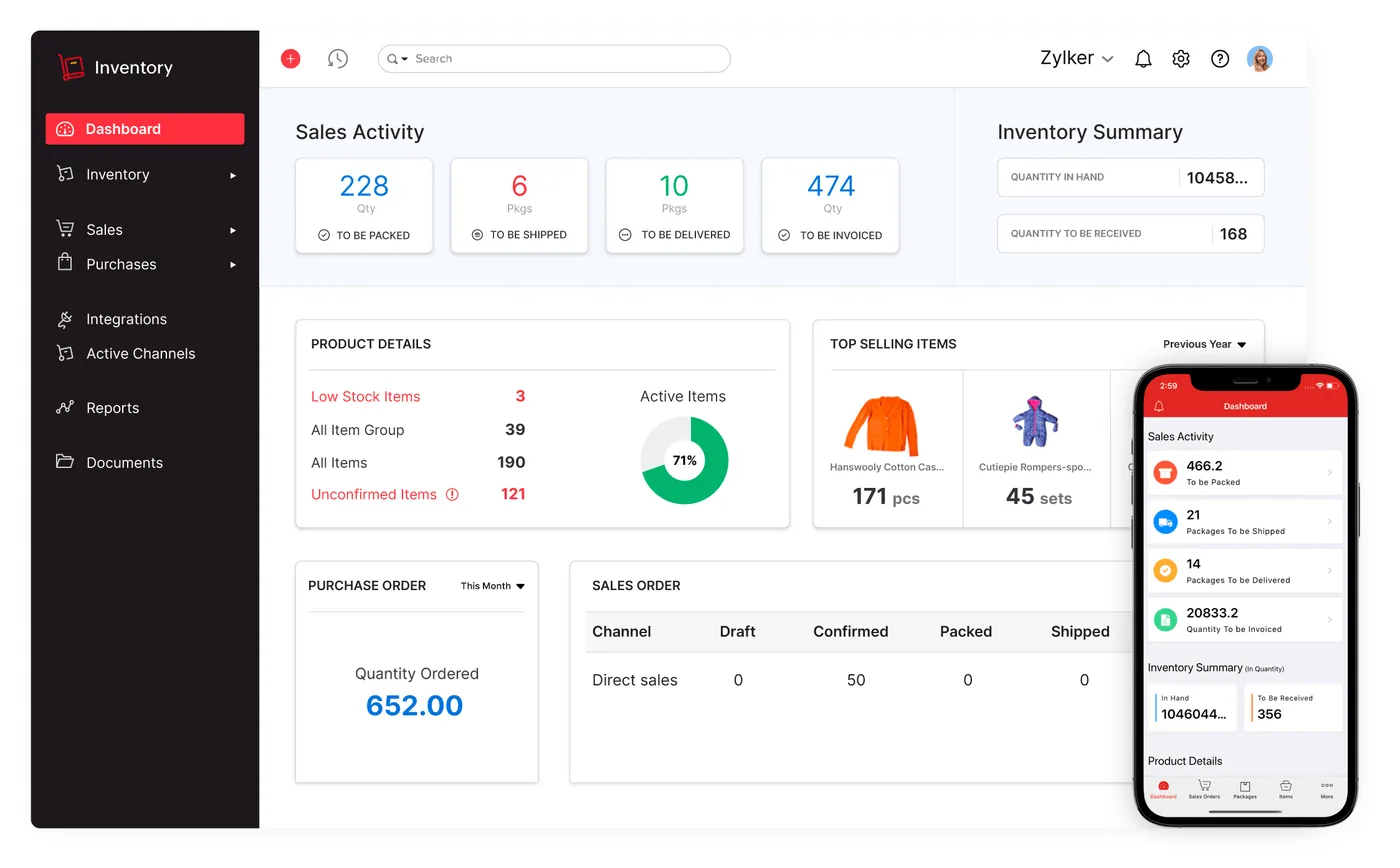
The Zoho Inventory dashboard
Sales activity, inventory summary, low-stock and top-selling items, and order status, on web and mobile.
- Zoho: fastest and lowest cost per user for SMEs and growing teams.
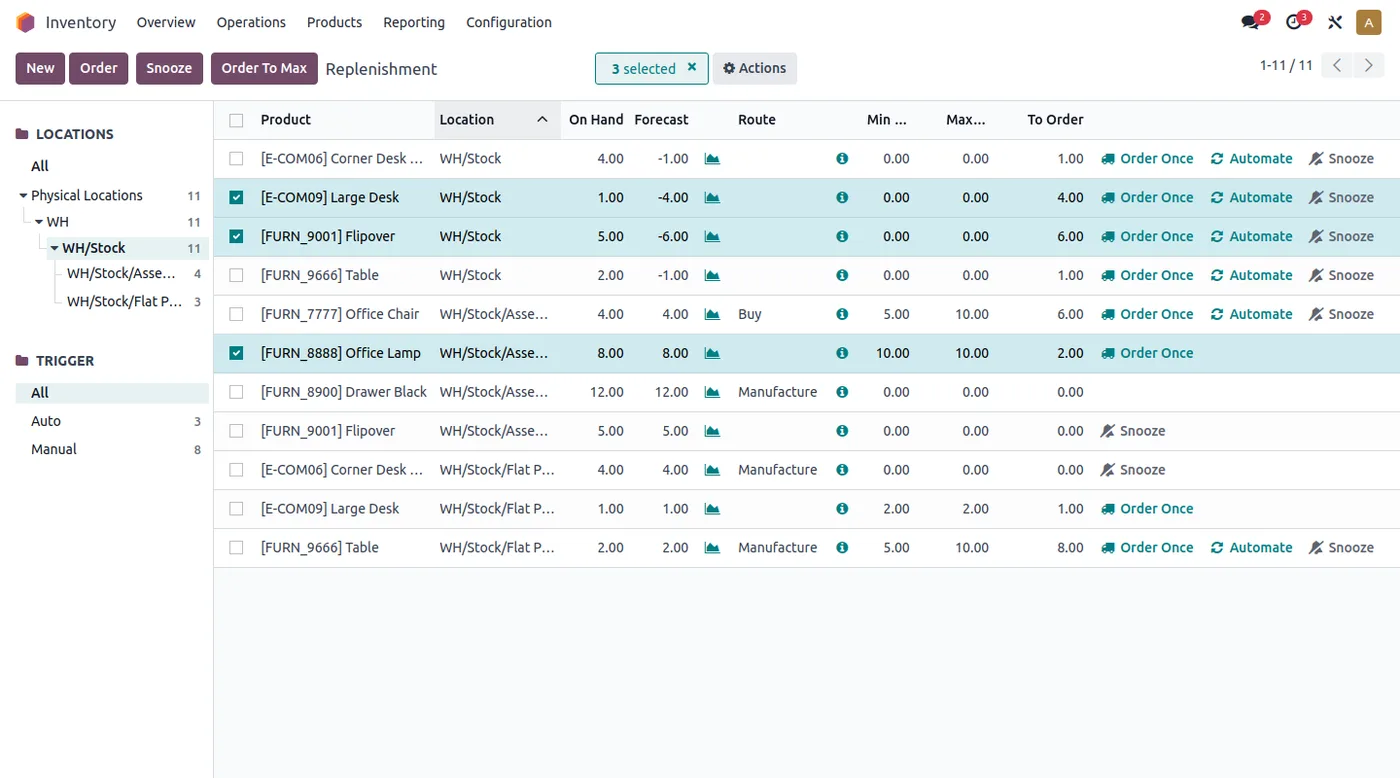
Replenishment in Odoo Inventory
Products below their minimum with the proposed route: buy, manufacture or transfer between warehouses.
- Odoo: strongest where stock, manufacturing and operations lead.
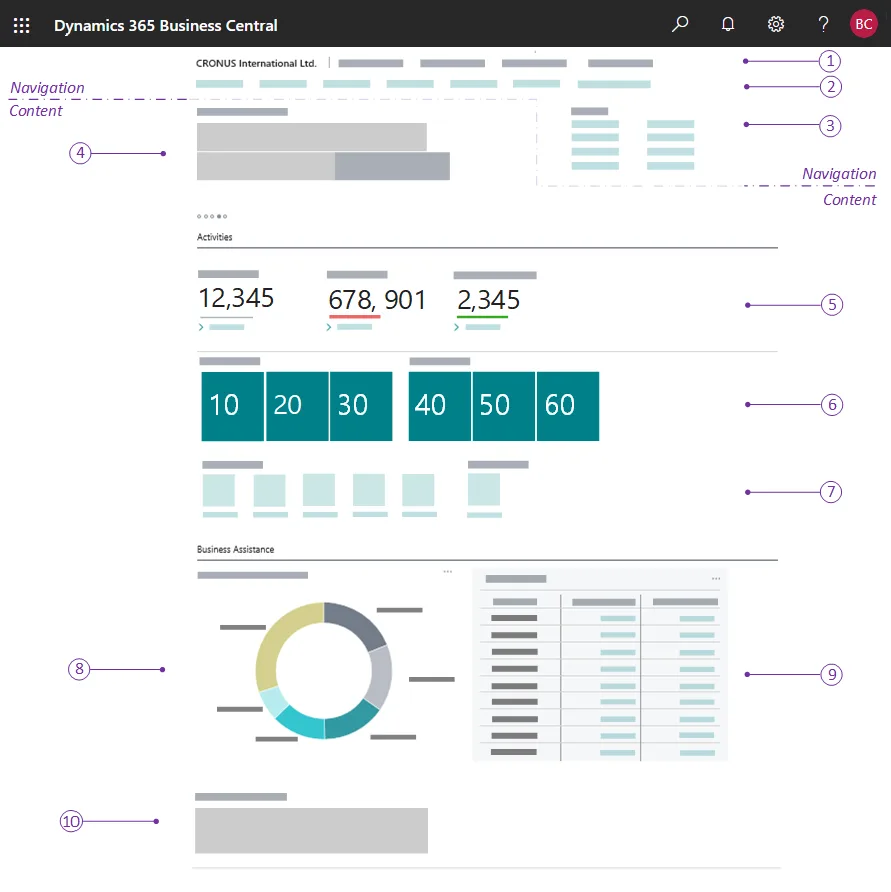
A Business Central role centre
The home page each user gets for their role: headlines, activity cues, KPI tiles, charts and actions. The numbered callouts come from Microsoft's documentation.
- Dynamics 365: best for Microsoft-centric companies and larger groups.
What changes in the UAE
The local rules and realities we design for before go-live. Rules change, so we re-check the current position at scoping.
Mainland plus free zone is common
Many UAE groups combine a mainland company for local sales with a free zone entity in JAFZA, DMCC, RAKEZ or KIZAD. One multi-entity ERP handles both without separate systems or double data entry.
Qualifying Free Zone Person status
Qualifying Free Zone Persons can have 0% Corporate Tax on qualifying income, but conditions apply to the income and substance. Separating entity data cleanly supports your adviser in assessing and evidencing that status.
VAT and Corporate Tax groups
UAE rules allow VAT tax groups and, subject to conditions, Corporate Tax groups. The ERP can report per entity and for the group, so you are ready whichever structure your adviser recommends.
How we deliver multi-entity ERP
Phases, indicative timing and what is delivered in each. Scope is fixed and priced in AED before we start.
Structure review
We map your legal entities, licences, TRNs, intercompany flows and how each entity trades today.
Entity design
Charts of accounts, intercompany rules, shared data policies and tax structures are agreed with finance and your tax adviser.
Configure entities
Entities, intercompany automation and tax reporting are configured, and opening balances loaded per company. Each entity is tested separately first.
Parallel month
One month runs in parallel, and intercompany balances, VAT and trial balances are reconciled per entity.
Go live
All entities go live, and a monthly intercompany and tax reporting routine is handed over.
When multi-entity ERP is the wrong answer
If you have one company with several branches, you need branch management, not multi-entity; separate books add work for no benefit. And where the main need is consolidating foreign subsidiaries for group reporting rather than running daily operations, group company ERP and a consolidation layer are the better focus.
How we handle it: We implement Zoho, Odoo and Dynamics 365 and build AI and custom software, so our written recommendation can point you to a simpler option, or to doing nothing yet.


A UAE team you can meet in person
That is our team at Zoholics Dubai 2026. We deliver Zoho, Odoo, Dynamics 365 and custom projects from our Ras Al Khaimah office with remote delivery across all seven emirates, in English and Arabic, and we run workshops on site in Dubai, Abu Dhabi and Sharjah when a project needs it.
Multi-Entity ERP in the UAE: questions we get asked
What is multi-entity ERP?
Can multi-entity ERP in the UAE handle a mainland and a free zone company together?
Does each entity file its own VAT return?
How does the system handle intercompany transactions?
Which ERP is best for multiple UAE entities?
How much does a multi-entity ERP implementation cost?
Why choose Shyphan?

Talk to a consultant about multi-entity ERP
A free 30-minute call, then a written recommendation and a fixed quote in AED, including the honest option that this is not the right fit.
