





















 Saudi Arabia
 UAE
UAE Qatar
Qatar Bahrain
 Kuwait
 Oman
Oman Lebanon
 Egypt
Egypt India
India UK
UK Ireland
 Germany
 USA
USA Australia
 Singapore
 South Africa
 Iraq
Iraq Jordan
 Hungary
 Georgia
 Turkey
 LagosNigeria




 Insurance billing · UAE
Medical Billing Software in the UAE
Medical billing software in the UAE turns each visit into a correct claim and makes sure the money arrives: payer price lists, prior approvals, claim status, remittance matching, rejections and resubmissions, patient co-pays and VAT. We implement the billing and revenue cycle layer on Odoo, Business Central or Zoho, connected to your clinical system, for clinics, day surgery centres and labs.
Prefer to talk? Call +971 55 145 3265
Get a free recommendation
Tell us what you want to fix. A senior consultant replies within one working day with a written view.
Trusted by businesses across the UAE, Saudi Arabia and beyond












Medical Billing Software in the UAE: the short answer
- What it is
- Medical billing software manages charges, insurer contracts, claims, remittances and rejections for healthcare providers, so services delivered become revenue actually collected.
- Best suited to
- UAE clinics, polyclinics, day surgery centres, labs and imaging centres where most revenue comes from insurers and third-party administrators and rejections are eating into cash.
- Core stack
- Odoo Accounting, Business Central, Zoho Books, Zoho Creator, Power BI, Power Automate
- Typical timeline
- Four to sixteen weeks depending on the platform, modules, data migration and integrations; we phase larger programmes.
- What it costs
- A fixed price in AED after a free discovery call, phased so you are never committing to the whole programme on day one. Platform licences are billed by the vendor.
- Local specifics
- Mandatory insurance across emirates; E-claims via payer channels; VAT on healthcare invoices.
- Delivered by
- Shyphan AI Solutions: Zoho Premium Partner, Official Odoo Partner, independent Dynamics 365 consultancy and custom software house, so the platform is chosen by fit.
- Last reviewed
- 29 September 2026
Medical Billing Software in the UAE: who it is for
UAE clinics, polyclinics, day surgery centres, labs and imaging centres where most revenue comes from insurers and third-party administrators and rejections are eating into cash. Medical billing software manages charges, insurer contracts, claims, remittances and rejections for healthcare providers, so services delivered become revenue actually collected.
- Payer contracts and price lists
- Prior approval tracking
- Claim batches and status
- Remittance matching
What we use to deliver medical billing software
Tools and platforms we typically use, and the systems it connects to. The final choice is made against your systems, budget and team.





 Odoo
Odoo Business Central
 Microsoft 365
 WhatsApp
Medical Billing Software in the UAE: what is included
Medical billing software in the UAE turns each visit into a correct claim and makes sure the money arrives: payer price lists, prior approvals, claim status, remittance matching, rejections and resubmissions, patient co-pays and VAT.
Payer contracts and price lists
Each insurer and TPA contract has its own price list, discounts, co-pay rules and exclusions. Charges are priced automatically per payer and plan, so billing staff stop checking rates in PDF contracts.
Prior approval tracking
Services needing approval are flagged at booking, and approval requests, reference numbers and outcomes are tracked. Claims for services without a valid approval are held back before submission rather than rejected afterwards.
Claim batches and status
Claims are batched per payer and submission cycle through the e-claims channel your facility uses, and each claim's status, from submitted to paid, partially paid or rejected, is visible in one list.
Remittance matching
Remittance advices are imported and matched to claims line by line, with underpayments and unexplained deductions separated for follow-up, so finance knows exactly what each payer still owes. Matching rules improve with each cycle.
Rejections and resubmissions
Rejected claims are grouped by reason, such as missing approval, coding or eligibility, and routed to the right person. Resubmission deadlines are tracked, and reasons are reported to fix the cause upstream.
Patient share and self-pay
Co-pays, deductibles and self-pay balances are billed to the patient, collected at reception or by payment link, and aged separately from insurer receivables. Reminders for unpaid balances can go by WhatsApp or email with a payment link attached.
Clinic group losing track of rejected claims
How medical billing software in the UAE looks in practice. Illustrative; every project is scoped to the business.
For example, a clinic group with branches in Abu Dhabi and Sharjah bills a dozen insurers, each with its own price list and rejection codes. Billing staff export claims from the clinical system into spreadsheets, re-key remittance advice by hand and cannot say which rejected claims are still inside the resubmission window or which insurer is slowest to pay.
- Import every payer contract as a price list keyed by insurer, network and plan, so each encounter is priced on the correct tariff before the claim leaves the clinic.
- Build a rejection worklist that groups denials by insurer and reason code, shows the days left to resubmit and assigns each claim to a named biller.
- Load remittance files against open claims automatically, post partial payments and write-offs to the insurer ledger, and flag underpayments against the contracted price for follow-up.
See it on the platforms we deliver
Real screens from the platforms we implement. Yours are configured to your entities, processes and KPIs.
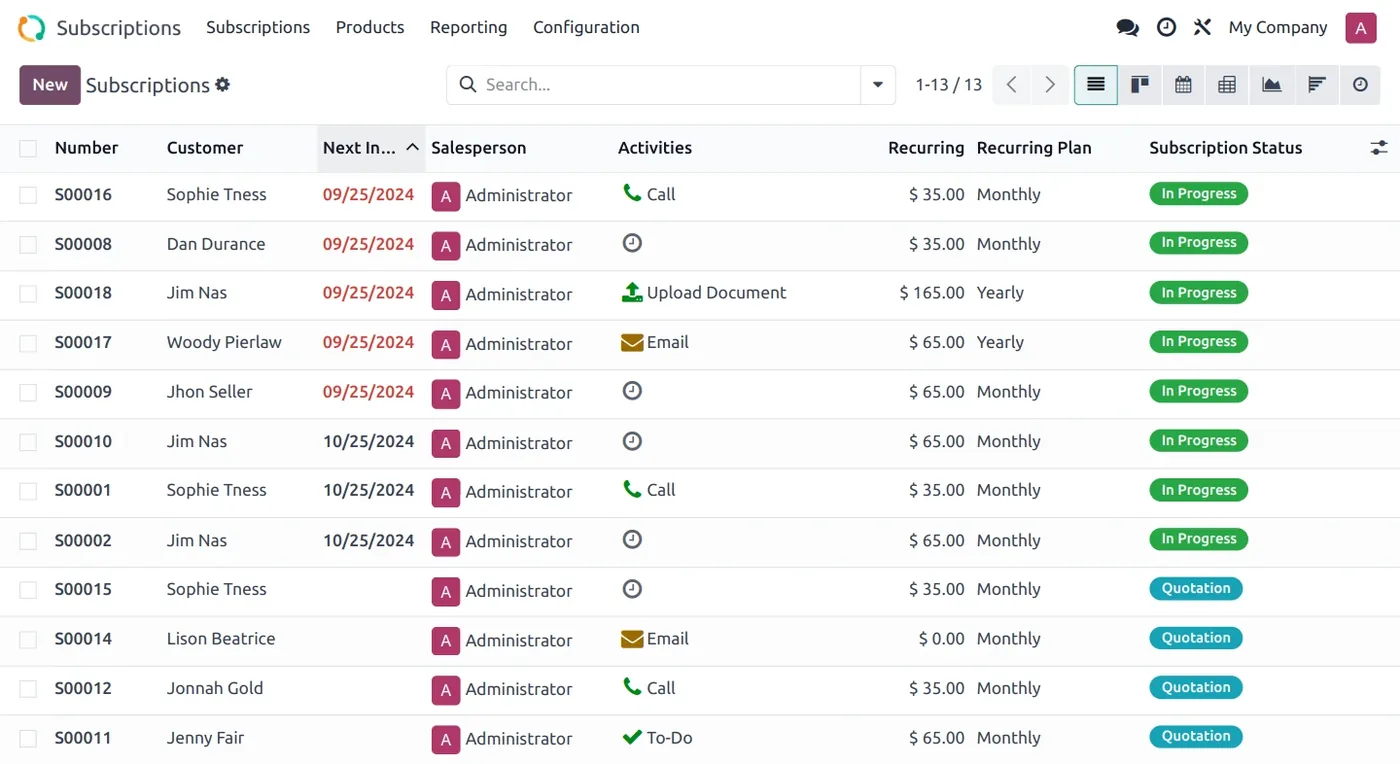
Recurring subscriptions in Odoo
Subscription orders with customer, next invoice date, salesperson, next activity, recurring amount, monthly or yearly plan and status.
- Payer contracts and price lists
- Prior approval tracking
- Claim batches and status
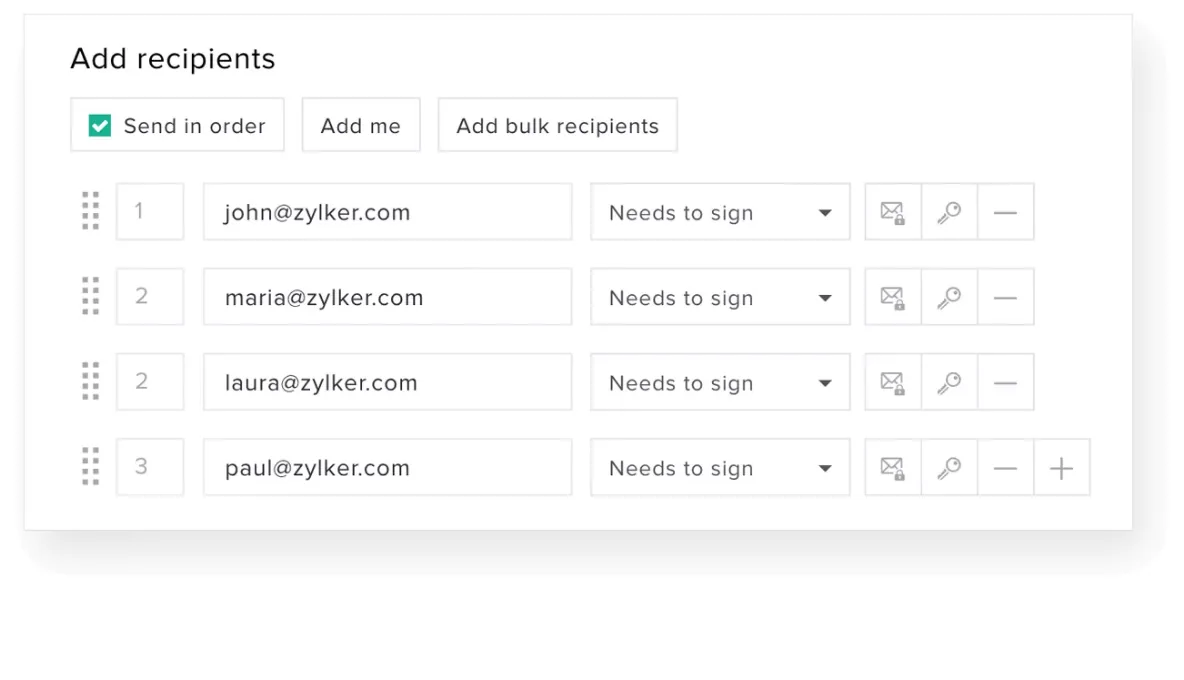
Adding signers in Zoho Sign
The recipient panel of a signing request: four signers in a set signing order, each marked as needs to sign, with options to add bulk recipients.
- Remittance matching
- Mandatory insurance across emirates
- E-claims via payer channels
Which platform for medical billing software in the UAE?
An honest comparison. We implement all of these, so the recommendation follows your processes, team and budget.
| Option | Best when | How it fits this need |
|---|---|---|
| Odoo Accounting with a claims module | You want billing and full accounting in one open, adaptable system | Good for clinic groups that need payer ledgers, remittance posting and VAT in one place. Claim-specific screens are built as a custom module, so budget for that development and its upkeep across upgrades. |
| Dynamics 365 Business Central | The group already runs Microsoft 365 and needs strong multi-entity finance | Suits hospital groups with several legal entities and a finance team used to Microsoft tools. Claims logic sits in AL extensions and Power Automate; licences come from Microsoft or a CSP, not from us. |
| Zoho Books with Zoho Creator | A single clinic or small group wants a lighter, lower-effort setup | Creator holds claims and rejections while Books handles invoices, VAT and receipts. Workable for modest claim volumes; it becomes stretched when many insurers, branches and daily remittance files are involved. |
| Billing module inside your clinical system | Your HIS or EMR already submits claims well and reports clearly | If the existing system already handles pricing, submission and remittance reliably, keep it and add reporting instead. Replacing a working claims engine only to change platforms rarely pays back. |
What changes in the UAE
The local rules and realities we design for before go-live. Rules change, so we re-check the current position at scoping.
Mandatory insurance across emirates
Health insurance is compulsory for employees in Dubai and Abu Dhabi, so most UAE provider revenue passes through insurers and TPAs. Billing is designed around payer rules first; we confirm the current requirement at scoping.
E-claims via payer channels
Claims are submitted electronically through the regulator and payer channels your facility is registered on. We integrate with those channels or your clinical system where the facility is eligible, without claiming certification.
VAT on healthcare invoices
Many preventive and basic healthcare services are zero-rated while cosmetic services and some goods carry 5% VAT. Tax codes per service are set with your tax adviser.
What drives the cost, and what it connects to
No price list: we quote a fixed price in AED after discovery. These are the factors that move the effort up or down.
Number of payer contracts
Each insurer, network and plan combination needs its price list and rules loaded and tested. A clinic with a few payers is far simpler than a group billing many insurers across emirates.
Clinical system integration
Pulling encounters, codes and patient details from your HIS or EMR is often the largest single task, and depends on whether that system offers an API, file exports or nothing usable.
E-claim and remittance formats
Supporting the claim submission and remittance formats used by your payers and emirate adds mapping and testing effort, particularly when several channels are involved for different branches.
Open claims migration
Bringing across outstanding claims, rejections still being worked and unallocated receipts takes careful reconciliation, so the insurer balances on day one match what the old records show.
What it connects to
Encounters, services, diagnosis codes and patient insurance details flow into billing; claim status can flow back for front-desk visibility.
Claim batches go out in the payer's required format; submission acknowledgements and remittance advice come back for automatic matching.
Insurer transfers arrive as bank lines that the system matches to remittance advice and posts against the right claims.
Patient co-pays and self-pay receipts taken at reception post to the patient account alongside the insurer share.
Receivables, rejection rates by reason and days to payment by insurer are read from billing data for management dashboards.
How we deliver medical billing software
Phases, indicative timing and what is delivered in each. Scope is fixed and priced in AED before we start.
Revenue cycle review
We trace claims from visit to payment and measure where rejections and delays arise today.
Contract load
Payer contracts, price lists, co-pay rules and approval requirements are captured and checked with your team.
Integrate and build
Charges flow in from the clinical system and claim, remittance and rejection workflows are configured.
Parallel month
One month of claims runs in both systems so figures are compared before switching over.
Go-live
Billing moves fully to the new system, with rejection reports reviewed monthly. Billers are trained on the new queues.
When medical billing software is the wrong answer
If your clinical system already produces and submits claims well, replacing its billing module adds risk; we would rather connect it to accounts and add remittance matching and reporting. Medical billing software also cannot fix clinical coding quality; that needs trained coders and doctors' documentation, and we make no clinical claims.
How we handle it: We implement Zoho, Odoo and Dynamics 365 and build AI and custom software, so our written recommendation can point you to a simpler option, or to doing nothing yet.
Checklist and common mistakes
Buyer's checklist
What to ask for before you choose a provider.
- Ask how payer price lists, networks and plan rules are loaded and updated when an insurer sends a revised tariff mid-year.
- Confirm the provider has connected billing to your specific clinical system before, and see how encounters and codes flow across.
- Require a rejection worklist with reason codes, resubmission deadlines and owner, not just a list of failed claims.
- Check that remittance files can be imported and matched automatically, including partial payments and bulk write-offs.
- Ask how patient shares, deductibles and self-pay balances appear on the same account as the insurer portion.
- Make sure access to diagnosis and patient data is restricted by role, with an audit trail of who viewed what.
Common mistakes
What we see go wrong in the UAE, and how to avoid it.
- Loading one price list for everyoneUAE insurers pay different rates by network and plan. Using a single tariff creates underbilling or rejections; load contracts per payer and plan, and re-check them whenever a contract renews.
- Ignoring resubmission deadlinesRejected claims have limited windows to resubmit. Without a deadline on each item, claims expire quietly. Put the due date on the worklist and alert billers before it passes.
- Posting remittances as lump sumsRecording a single insurer payment without allocating it to claims hides underpayments. Import remittance files line by line so short payments are visible and can be disputed.
- Treating all services the same for VATHealthcare VAT treatment varies by service and product. Map each service code to its VAT treatment during setup and have your tax adviser confirm the mapping.


A UAE team you can meet in person
That is our team at Zoholics Dubai 2026. We deliver Zoho, Odoo, Dynamics 365 and custom projects from our Ras Al Khaimah office with remote delivery across all seven emirates, in English and Arabic, and we run workshops on site in Dubai, Abu Dhabi and Sharjah when a project needs it.
Medical Billing Software in the UAE: questions we get asked
What does medical billing software do for a UAE clinic?
Can medical billing software submit e-claims in the UAE?
How is medical billing software different from a healthcare ERP?
Can it reduce claim rejections?
Does it handle co-pays and self-pay patients?
How much does medical billing software cost in the UAE?
Can one medical billing system serve clinics in Dubai and Abu Dhabi together?
How do you migrate open insurance claims from our old billing system?
Can billers see why an insurer rejected a claim without opening the clinical record?
Why choose Shyphan?

Talk to a consultant about medical billing software
A free 30-minute call, then a written recommendation and a fixed quote in AED, including the honest option that this is not the right fit.
