





















 Saudi Arabia
 UAE
UAE Qatar
Qatar Bahrain
 Kuwait
 Oman
Oman Lebanon
 Egypt
Egypt India
India UK
UK Ireland
 Germany
 USA
USA Australia
 Singapore
 South Africa
 Iraq
Iraq Jordan
 Hungary
 Georgia
 Turkey
 LagosNigeria



 Retail stock control · UAE
Retail Inventory Software in the UAE
Retail inventory software in the UAE tells you what is on each shelf and in each warehouse, what to reorder and what imported stock really cost after freight and 5% customs duty. Shyphan implements Odoo Inventory, Zoho Inventory or Business Central for UAE retailers, with barcode counts, store transfers and replenishment rules that match how you actually buy.
Prefer to talk? Call +971 55 145 3265
Get a free recommendation
Tell us what you want to fix. A senior consultant replies within one working day with a written view.
Trusted by businesses across the UAE, Saudi Arabia and beyond












Retail Inventory Software in the UAE: the short answer
- What it is
- Retail inventory software tracks stock quantities, locations, movements and costs across stores and warehouses, and drives reordering and transfers.
- Best suited to
- UAE retailers with several stores or a central warehouse, importers selling through their own shops, and online sellers who share stock with physical branches.
- Core stack
- Odoo Inventory, Zoho Inventory, Business Central, Odoo Barcode, Odoo Purchase, Power BI
- Typical timeline
- Four to sixteen weeks depending on the platform, modules, data migration and integrations; we phase larger programmes.
- What it costs
- A fixed price in AED after a free discovery call, phased so you are never committing to the whole programme on day one. Platform licences are billed by the vendor.
- Local specifics
- Customs duty in product cost; Mainland and designated zone stock; Seasonal demand planning.
- Delivered by
- Shyphan AI Solutions: Zoho Premium Partner, Official Odoo Partner, independent Dynamics 365 consultancy and custom software house, so the platform is chosen by fit.
- Last reviewed
- 29 September 2026
Retail Inventory Software in the UAE: who it is for
UAE retailers with several stores or a central warehouse, importers selling through their own shops, and online sellers who share stock with physical branches. Retail inventory software tracks stock quantities, locations, movements and costs across stores and warehouses, and drives reordering and transfers.
- Stock by store and warehouse
- Reorder rules per location
- Landed cost on imported stock
- Transfers between stores
What we use to deliver retail inventory software
Tools and platforms we typically use, and the systems it connects to. The final choice is made against your systems, budget and team.





 Odoo
Odoo Business Central
 Microsoft 365
 WhatsApp
Retail Inventory Software in the UAE: what is included
Retail inventory software in the UAE tells you what is on each shelf and in each warehouse, what to reorder and what imported stock really cost after freight and 5% customs duty.
Stock by store and warehouse
Every store, back room and warehouse is its own location, so you see on-hand, reserved and in-transit stock separately. Buyers stop guessing whether a slow seller in one branch could cover a stock-out in another.
Reorder rules per location
Minimum and maximum levels are set per product and location, and the system proposes purchase orders or warehouse transfers when stock drops. Seasonal items can have different rules for Ramadan, summer and back-to-school periods.
Landed cost on imported stock
Freight, insurance, clearing charges and the 5% GCC customs duty are spread across the shipment, so product cost reflects what you really paid. Margins at the till become accurate instead of flattering imported ranges.
Transfers between stores
Store-to-store and warehouse-to-store transfers are requested, picked, shipped and received with scans at both ends. Anything short or damaged shows up as a variance immediately rather than at the year-end count.
Cycle counts with handheld scanners
Instead of closing a store for a full stock take, staff count one category a day on a phone or handheld. The software posts adjustments with a reason code and shows which locations and products keep drifting.
Batch and expiry tracking
For cosmetics, food and other dated goods, lots and expiry dates are recorded on receipt and picked first-expiry-first-out. Reports list stock nearing expiry by store so it can be moved or promoted in time.
Hardware chain in Ajman and Fujairah
How retail inventory software in the UAE looks in practice. Illustrative; every project is scoped to the business.
Picture a building materials and hardware chain with stores in Ajman, Umm Al Quwain and Fujairah, importing tools, fittings and paints from China and India. Each store orders from suppliers separately, landed cost is guessed, and paints and adhesives sometimes expire on shelves. The owner suspects some best-selling items are priced below their true imported cost.
- Set up Odoo Inventory and Purchase with central buying, and landed cost allocation of freight, customs duty and clearing charges to each imported container.
- Add batch and expiry tracking for paints, adhesives and sealants, with first-expiry-first-out picking and alerts for batches approaching expiry.
- Configure reorder rules per store based on sales history and supplier lead times, with slower sea-freight items given longer planning horizons.
See it on the platforms we deliver
Real screens from the platforms we implement. Yours are configured to your entities, processes and KPIs.
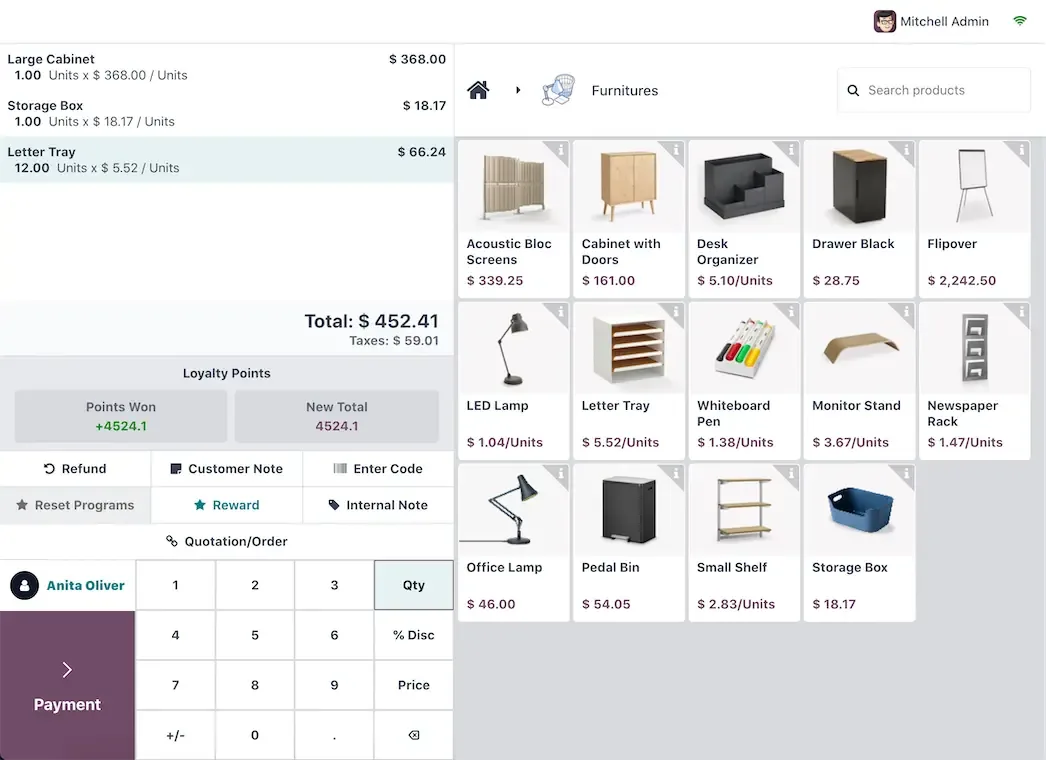
The Odoo Point of Sale screen
A shop till with the order lines and total, loyalty points, product tiles by category, a numeric keypad and the payment button.
- Stock by store and warehouse
- Reorder rules per location
- Landed cost on imported stock
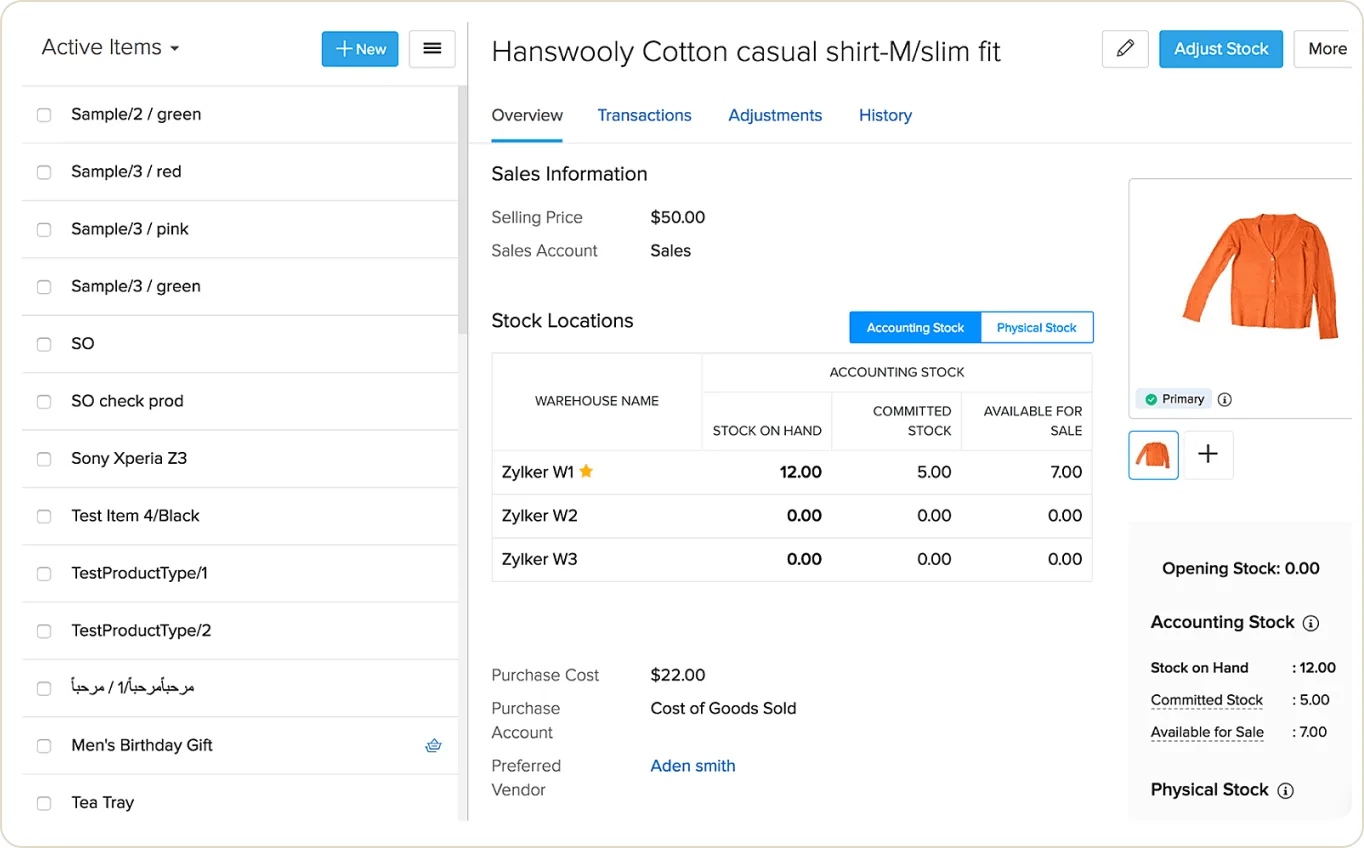
Item stock by warehouse in Zoho Inventory
Stock on hand, committed and available for sale per warehouse, for a single item.
- Transfers between stores
- Customs duty in product cost
- Mainland and designated zone stock
Which platform for retail inventory software in the UAE?
An honest comparison. We implement all of these, so the recommendation follows your processes, team and budget.
| Option | Best when | How it fits this need |
|---|---|---|
| Odoo Inventory + Purchase | Importing retailer needing landed cost, batches and multi-store rules | Strong landed cost, lot tracking and reorder rules suit UAE importers with several stores. POS and accounting in the same system avoid integration, though training takes effort. |
| Zoho Inventory | Smaller retailer with simple imports and an online store | Offers landed cost, batches and multi-warehouse at a modest cost. Advanced replenishment across many stores and complex purchasing rules are more limited than Odoo. |
| Business Central | Larger retailer with strong finance and many item categories | Good item tracking, planning and finance for bigger operations. Store POS normally comes from a partner product, which adds integration and licensing to plan. |
| POS stock module only | One store buying locally with few imported goods | Many POS systems track basic stock. That may be enough if you do not import, hold batches or run several locations with transfers. |
What changes in the UAE
The local rules and realities we design for before go-live. Rules change, so we re-check the current position at scoping.
Customs duty in product cost
Most UAE retail stock is imported and attracts the 5% GCC common customs tariff. Putting duty and freight into landed cost keeps margins honest and supports correct inventory valuation for Corporate Tax.
Mainland and designated zone stock
Designated zones and the mainland can have different VAT treatment. When you hold stock in a zone warehouse and sell from mainland stores, we model the locations and movements so your accountant can apply the right treatment.
Seasonal demand planning
Ramadan, Eid, summer and school terms shift UAE retail demand sharply. We set seasonal reorder rules and pre-season purchase proposals so buyers commit early without overstocking.
What drives the cost, and what it connects to
No price list: we quote a fixed price in AED after discovery. These are the factors that move the effort up or down.
Import and landed cost
Allocating freight, duty and clearing across containers needs agreed rules and consistent supplier documents. Retailers buying mostly from local distributors can skip most of this configuration work.
Batch and expiry tracking
Tracking lots and expiry for paints, food or cosmetics adds receiving steps and label printing. Products without expiry keep the warehouse and store processes simpler.
Replenishment rules
Reorder rules for many stores and thousands of SKUs need sales history and supplier lead times. Clean data speeds this up; gaps mean starting with manual minimums.
Store count and hardware
Each store needs scanners, label printers and training. Piloting in one store before rolling out to the rest reduces disruption and hardware mistakes.
What it connects to
Duty, freight and clearing invoices link to shipments so landed cost updates as charges arrive.
Supplier catalogues and prices import regularly so purchase orders and cost estimates use current figures.
Sales from every store reduce stock and feed reorder rules; batch numbers are checked at checkout.
Stock valuation, landed costs and VAT on imports post to the ledger for monthly close and VAT 201.
Stock cover, dead stock and margin after landed cost by store and category feed buying reviews.
How we deliver retail inventory software
Phases, indicative timing and what is delivered in each. Scope is fixed and priced in AED before we start.
Stock flow mapping
We map suppliers, warehouses, stores, transfer routes and counting habits, and agree the location and product structure.
Data clean-up
Product codes, barcodes, units and opening balances are cleaned and imported, with duplicates removed before they cause trouble.
Rules and costing
Reorder rules, routes, landed cost methods and valuation are configured and tested against a recent import shipment.
Opening count and go-live
A counted opening balance per location is loaded and stores start scanning receipts, transfers and sales.
Tuning
We adjust reorder levels using real sales data and train buyers on the replenishment and variance reports.
When retail inventory software is the wrong answer
If you have one store and fewer than a few hundred products, full warehouse routes and cycle-count programmes add work you do not need. Zoho Books or Odoo with basic stock tracking will do. We recommend proper retail inventory software once you run several locations or import your own stock.
How we handle it: We implement Zoho, Odoo and Dynamics 365 and build AI and custom software, so our written recommendation can point you to a simpler option, or to doing nothing yet.
Checklist and common mistakes
Buyer's checklist
What to ask for before you choose a provider.
- Ask how freight, customs duty and clearing charges are spread across items in a shipment to give real landed cost.
- Check that batch and expiry tracking works at the till, so expired stock cannot be sold by mistake.
- Require reorder rules per store that consider supplier lead time, including long sea-freight imports.
- Confirm how stock in designated zones and mainland stores is kept separate for VAT purposes.
- Ask how stock takes are done with handheld scanners while stores stay open.
- Check whether seasonal demand, such as Ramadan, summer or back-to-school, can be reflected in reorder levels.
Common mistakes
What we see go wrong in the UAE, and how to avoid it.
- Pricing on supplier invoice costItems are priced on the supplier's invoice before freight and 5% customs duty, eroding margin. Price from landed cost and review prices when shipment charges are finalised.
- Same reorder rules everywhereEvery store gets identical minimums regardless of demand. Set rules per store from its own sales, and review them before seasonal peaks like Ramadan.
- Skipping expiry at receivingExpiry dates are not captured when goods arrive, so tracking fails later. Make batch and expiry entry mandatory at receiving for products that need it.
- Big-bang stock take at go-liveAll stores are counted on one day with new scanners and untrained staff. Count and go live store by store, with support present.


A UAE team you can meet in person
That is our team at Zoholics Dubai 2026. We deliver Zoho, Odoo, Dynamics 365 and custom projects from our Ras Al Khaimah office with remote delivery across all seven emirates, in English and Arabic, and we run workshops on site in Dubai, Abu Dhabi and Sharjah when a project needs it.
Retail Inventory Software in the UAE: questions we get asked
What does retail inventory software in the UAE need to handle?
Should we choose Odoo Inventory, Zoho Inventory or Business Central?
Can the software suggest what to reorder?
How is retail inventory software different from a retail POS?
Do we have to close stores for a stock take?
How much does retail inventory software cost in the UAE?
Can retail inventory software in the UAE handle stock that we sell by different units?
Can we see dead stock that has not sold for months?
Can stores request stock from the central warehouse instead of ordering from suppliers?
Why choose Shyphan?

Talk to a consultant about retail inventory software
A free 30-minute call, then a written recommendation and a fixed quote in AED, including the honest option that this is not the right fit.
