





















 Saudi Arabia
 UAE
UAE Qatar
Qatar Bahrain
 Kuwait
 Oman
Oman Lebanon
 Egypt
Egypt India
India UK
UK Ireland
 Germany
 USA
USA Australia
 Singapore
 South Africa
 Iraq
Iraq Jordan
 Hungary
 Georgia
 Turkey
 LagosNigeria




 Application monitoring · UAE
ManageEngine Applications Manager Implementation in the UAE
ManageEngine Applications Manager UAE projects from Shyphan monitor the applications your business runs on, from ERP and e-commerce sites to databases and cloud services. We map each business service to its servers, databases and URLs, set up application performance monitoring and synthetic checks, and tune alerts so slowdowns are fixed before customers or staff notice.
Prefer to talk? Call +971 55 145 3265
Get a free recommendation
Tell us what you want to fix. A senior consultant replies within one working day with a written view.
Trusted by businesses across the UAE, Saudi Arabia and beyond












ManageEngine Applications Manager Implementation in the UAE: the short answer
- What it is
- Applications Manager is ManageEngine's application performance monitoring tool for servers, databases, web applications, middleware and cloud services.
- Best suited to
- UAE companies whose revenue or operations depend on in-house or hosted applications: e-commerce, banking and fintech, hospitals running clinical systems, logistics platforms and ERP-heavy manufacturers.
- Core stack
- ManageEngine Applications Manager, APM Insight agents, SQL Server, Oracle Database, AWS me-central-1, Azure UAE North
- Typical timeline
- Four to sixteen weeks depending on the platform, modules, data migration and integrations; we phase larger programmes.
- What it costs
- A fixed price in AED after a free discovery call, phased so you are never committing to the whole programme on day one. Platform licences are billed by the vendor.
- Local specifics
- UAE online sales peaks; Hybrid UAE hosting; Critical-sector evidence.
- Delivered by
- Shyphan AI Solutions: Zoho Premium Partner, Official Odoo Partner, independent Dynamics 365 consultancy and custom software house, so the platform is chosen by fit.
- Last reviewed
- 29 September 2026
ManageEngine Applications Manager Implementation in the UAE: who it is for
UAE companies whose revenue or operations depend on in-house or hosted applications: e-commerce, banking and fintech, hospitals running clinical systems, logistics platforms and ERP-heavy manufacturers. Applications Manager is ManageEngine's application performance monitoring tool for servers, databases, web applications, middleware and cloud services.
- Business service maps
- Code-level APM agents
- Database performance
- Synthetic user checks
What we use to deliver manageengine applications manager implementation
Tools and platforms we typically use, and the systems it connects to. The final choice is made against your systems, budget and team.





 Odoo
Odoo Business Central
 Microsoft 365
 WhatsApp
ManageEngine Applications Manager Implementation in the UAE: what is included
ManageEngine Applications Manager UAE projects from Shyphan monitor the applications your business runs on, from ERP and e-commerce sites to databases and cloud services.
Business service maps
We group the web servers, application servers, databases and external APIs behind each service, such as online orders or patient registration, so one dashboard shows whether that service is healthy.
Code-level APM agents
APM Insight agents for Java, .NET, Node.js, PHP, Python or Ruby show slow transactions, database calls and errors, pointing developers at the query or method that caused a slowdown. Traces are kept long enough to compare before and after a release.
Database performance
SQL Server, Oracle, MySQL and PostgreSQL are monitored for slow queries, locks, sessions and space, which is where ERP and e-commerce slowdowns usually start. Top queries by time and execution count are reported so DBAs can tune indexes with evidence rather than guesswork.
Synthetic user checks
Scripted checks log into your portal, search, add to basket or submit a form every few minutes from a chosen location, so a broken checkout is caught at 3 a.m. rather than by a customer.
Cloud and container monitoring
Applications Manager reads metrics from AWS, Azure and Kubernetes, useful when UAE workloads sit in me-central-1 or UAE North alongside on-premises systems. Cloud metrics sit in the same service map as on-premises parts, so a slow checkout can be traced across both.
Alerts with root-cause context
Threshold and anomaly alerts include the affected service and component, and can open a ServiceDesk Plus ticket or run a restart action, so the on-call engineer starts from the likely cause.
Courier company with a partner tracking API
How manageengine applications manager implementation in the UAE looks in practice. Illustrative; every project is scoped to the business.
Picture a UAE courier and last-mile delivery company whose e-commerce partners pull tracking updates through its API. The platform runs Odoo for operations, a custom Node.js API and PostgreSQL on AWS me-central-1. Partners report missing tracking updates on busy evenings, but the operations team only hears about it when a merchant escalates.
- Monitor the API tier with APM Insight, PostgreSQL with database monitors and Odoo workers with process and URL checks, grouped as one tracking service.
- Add synthetic API checks that request a test shipment's status every few minutes, alerting when responses slow down or return errors.
- Build a partner-facing status report by week, showing tracking API availability and response times, reviewed with the commercial team before partner meetings.
See it in ManageEngine Applications Manager
Real screens from the platforms we implement. Yours are configured to your entities, processes and KPIs.
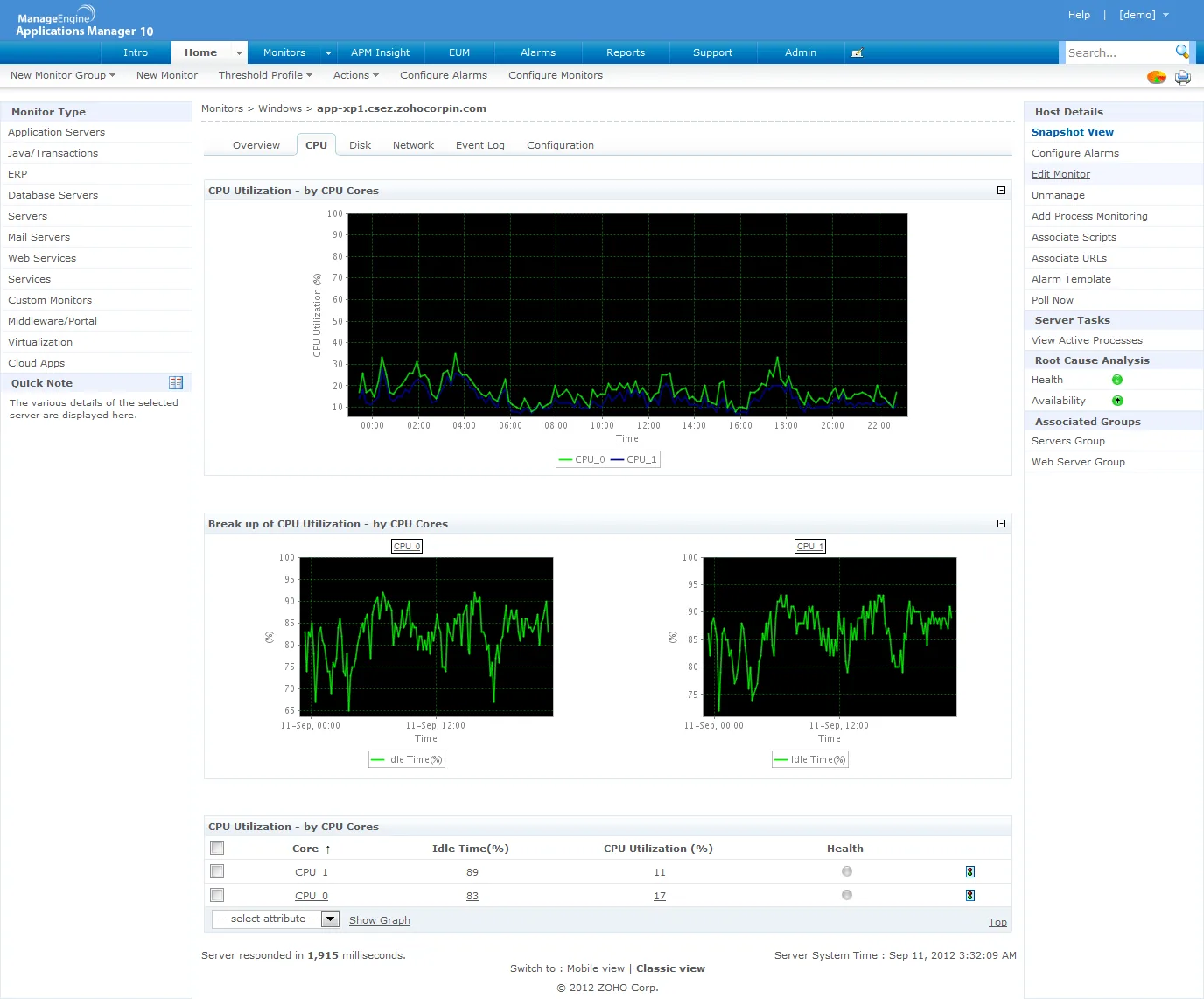
Server CPU monitoring in Applications Manager
A monitored Windows server's CPU utilisation over a day, broken down by core, with idle time, health status and links to configure alarms.
- Business service maps
- Code-level APM agents
- Database performance
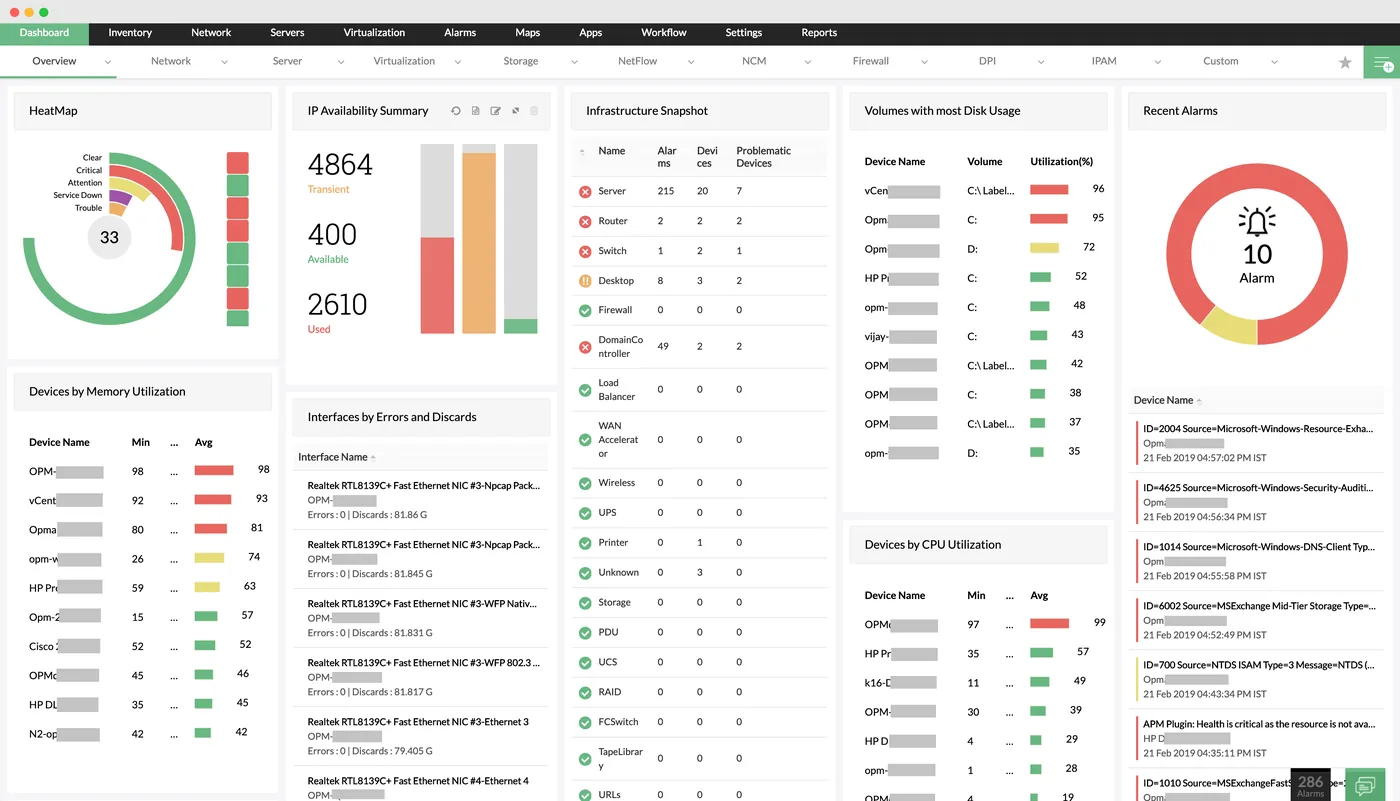
The network monitoring dashboard in OpManager
A heat map of device health, IP availability, infrastructure snapshot by device type, disk usage, CPU and memory utilisation and recent alarms.
- Synthetic user checks
- UAE online sales peaks
- Hybrid UAE hosting
 ServiceDesk Plus
 Endpoint Central
 PAM360
 OpManager
 ADManager Plus
 Log360
Which platform for manageengine applications manager implementation in the UAE?
An honest comparison. We implement all of these, so the recommendation follows your processes, team and budget.
| Option | Best when | How it fits this need |
|---|---|---|
| Applications Manager | Mixed stack of ERP, custom APIs and databases across hosting. | Covers packaged systems such as Odoo alongside custom code and databases in one tool, which suits UAE firms whose service depends on both. |
| Site24x7 | You prefer a SaaS monitoring tool with no server to run. | Zoho's cloud monitoring service offers similar coverage as SaaS. Good for cloud-first teams; Applications Manager suits those who want the tool on their own servers. |
| Open-source stack | You have engineers to build and maintain dashboards. | Prometheus and Grafana are flexible and free to license, but need significant engineering time to set up alerts, APM and reports that a commercial tool includes. |
| AWS CloudWatch only | Entirely AWS-hosted with simple services. | Covers AWS infrastructure metrics well and costs little to start. Application-level tracing, Odoo-specific checks and business service views need extra tooling or significant custom work. |
What changes in the UAE
The local rules and realities we design for before go-live. Rules change, so we re-check the current position at scoping.
UAE online sales peaks
UAE e-commerce and retail sites see sharp traffic peaks around Ramadan, Eid, White Friday and shopping festivals. We set capacity baselines and synthetic checks ahead of those peaks.
Hybrid UAE hosting
Many UAE applications split across on-premises servers and UAE cloud regions. Applications Manager monitors both from one server you host in the UAE, so monitoring data stays local.
Critical-sector evidence
Banks, hospitals and government-linked entities working to the UAE IA Regulation need availability and performance monitoring records. Applications Manager reports support that; we confirm the current requirement at scoping.
What drives the cost, and what it connects to
No price list: we quote a fixed price in AED after discovery. These are the factors that move the effort up or down.
Monitor count
Each server, database, URL and cloud service is a monitor, so the breadth of your stack drives licensing and the effort to configure sensible thresholds for each.
APM instrumentation
Adding code-level agents to APIs and web applications takes testing per runtime, framework and deployment pipeline, especially where containers are rebuilt frequently.
Cloud and container scope
Monitoring AWS or Azure accounts, Kubernetes clusters and serverless functions adds credentials, permissions and dashboards on top of traditional server and database monitoring.
Reporting needs
Internal dashboards are quick, but reports for partners, management or SLAs need design, scheduling and clear agreement on how availability is calculated.
What it connects to
Odoo web and worker processes, URLs and PostgreSQL are monitored, so ERP slowdowns show up alongside the services that rely on them.
EC2, RDS and load balancer metrics flow into Applications Manager and sit in the same service map as your own servers.
Critical alerts post to the operations channel, with links to the monitor and the affected business service.
Major alerts create incident tickets automatically, and resolution notes flow back into the monitoring history.
Deployment events are marked on performance graphs, so the team can link slowdowns to a specific release.
How we deliver manageengine applications manager implementation
Phases, indicative timing and what is delivered in each. Scope is fixed and priced in AED before we start.
Service mapping
List critical applications, their components, owners and what 'slow' means for each. Agree service owners and on-call contacts.
Install and connect
Install Applications Manager, add servers, databases and cloud accounts, and deploy APM agents in test.
Synthetics and baselines
Record synthetic transactions, gather baselines and set thresholds from real behaviour. Run for two weeks before fixing alert levels.
Alerts and tickets
Configure alert routing, actions and ServiceDesk Plus integration; review with developers. Agree escalation and quiet hours for each service.
Handover
Deliver dashboards per service owner, runbooks and training. Hand over dashboards per service owner, runbooks and admin training for your team.
When manageengine applications manager implementation is the wrong answer
If your main pain is network outages or unreachable branches, OpManager is the better starting point. And if all your applications are SaaS such as Zoho or Microsoft 365, the vendor's status pages plus basic synthetic checks cover most of the risk; a full APM rollout would be overkill.
How we handle it: We implement Zoho, Odoo and Dynamics 365 and build AI and custom software, so our written recommendation can point you to a simpler option, or to doing nothing yet.
Checklist and common mistakes
Buyer's checklist
What to ask for before you choose a provider.
- Ask how the provider will monitor your ERP, whether Odoo, Dynamics or SAP, with checks beyond server CPU.
- Require synthetic checks for the APIs your partners or customers actually call, with realistic test data.
- Check how database monitoring will identify slow queries, not only database availability.
- Ask which alerts go to operations, which to developers, and how duplicates are suppressed.
- Confirm the reports can be shared with business partners without exposing internal server details.
- Ask how monitors will be kept current when new servers, containers or services are deployed.
Common mistakes
What we see go wrong in the UAE, and how to avoid it.
- Only watching uptimeAn API can be up and still too slow for partners. Monitor response time and error rates on the calls customers use, with thresholds agreed with the business.
- Forgetting background workersQueues and scheduled jobs often fail silently while web pages stay fast. Add monitors for workers, job queues and scheduled tasks in the ERP and API.
- One alert list for everyoneSending every alert to every engineer causes fatigue. Route database alerts, API alerts and infrastructure alerts to the people who can actually fix them.
- Monitors not updated after changesNew servers and services appear without monitoring. Add a step to your release checklist so new components are added to Applications Manager before go-live.


A UAE team you can meet in person
That is our team at Zoholics Dubai 2026. We deliver Zoho, Odoo, Dynamics 365 and custom projects from our Ras Al Khaimah office with remote delivery across all seven emirates, in English and Arabic, and we run workshops on site in Dubai, Abu Dhabi and Sharjah when a project needs it.
ManageEngine Applications Manager Implementation in the UAE: questions we get asked
What does a ManageEngine Applications Manager UAE implementation include?
How is Applications Manager different from OpManager?
Can it monitor our ERP, such as Odoo, Dynamics or SAP?
Does it need agents on our servers?
Can Applications Manager monitor AWS and Azure in the UAE?
How are licences counted?
Can Applications Manager monitor an Odoo system in the UAE?
Is Applications Manager or Site24x7 better for a UAE cloud-first company?
Can Applications Manager reports be shared with our business partners?
Why choose Shyphan?

Talk to a consultant about manageengine applications manager implementation
A free 30-minute call, then a written recommendation and a fixed quote in AED, including the honest option that this is not the right fit.
