





















 Saudi Arabia
 UAE
UAE Qatar
Qatar Bahrain
 Kuwait
 Oman
Oman Lebanon
 Egypt
Egypt India
India UK
UK Ireland
 Germany
 USA
USA Australia
 Singapore
 South Africa
 Iraq
Iraq Jordan
 Hungary
 Georgia
 Turkey
 LagosNigeria




 Financial reporting · UAE
Financial Reporting Software in the UAE
Financial reporting software in the UAE produces the reports finance is asked for every month and year: management accounts, IFRS-based financial statements, VAT reconciliations, Corporate Tax schedules and dashboards for owners. Shyphan builds reporting on Power BI, Zoho Analytics or Odoo Spreadsheet on top of your existing accounting system, so reports refresh from the ledger instead of being rebuilt in Excel.
Prefer to talk? Call +971 55 145 3265
Get a free recommendation
Tell us what you want to fix. A senior consultant replies within one working day with a written view.

The first AI Enabled Zoho Partner in the Middle East and Africa. Accredited by Zoho on 14 October 2026 after the Zoho AI Accelerator Series. Read the announcement
AI Enabled Zoho Partner in the UAETrusted by businesses across the UAE, Saudi Arabia and beyond












Financial Reporting Software in the UAE: the short answer
- What it is
- Financial reporting software pulls data from the accounting system and presents it as statements, reconciliations and dashboards in consistent, repeatable formats.
- Best suited to
- UAE finance teams spending days each month exporting trial balances and building management packs by hand, whatever accounting system they use.
- Core stack
- Power BI, Zoho Analytics, Odoo Spreadsheet, Business Central, Zoho Books, Excel
- Typical timeline
- Four to sixteen weeks depending on the platform, modules, data migration and integrations; we phase larger programmes.
- What it costs
- A fixed price in AED after a free discovery call, phased so you are never committing to the whole programme on day one. Platform licences are billed by the vendor.
- Local specifics
- Corporate Tax data needs; VAT 201 accuracy; Arabic and English packs.
- Delivered by
- Shyphan AI Solutions: Zoho Premium Partner, Official Odoo Partner, independent Dynamics 365 consultancy and custom software house, so the platform is chosen by fit.
- Last reviewed
- 29 September 2026
Financial Reporting Software in the UAE: who it is for
UAE finance teams spending days each month exporting trial balances and building management packs by hand, whatever accounting system they use. Financial reporting software pulls data from the accounting system and presents it as statements, reconciliations and dashboards in consistent, repeatable formats.
- Monthly management accounts
- IFRS statement mapping
- VAT return reconciliation
- Corporate Tax schedules
What we use to deliver financial reporting software
Tools and platforms we typically use, and the systems it connects to. The final choice is made against your systems, budget and team.





 Odoo
Odoo Business Central
 Microsoft 365
 WhatsApp
Financial Reporting Software in the UAE: what is included
Financial reporting software in the UAE produces the reports finance is asked for every month and year: management accounts, IFRS-based financial statements, VAT reconciliations, Corporate Tax schedules and dashboards for owners.
Monthly management accounts
Profit and loss, balance sheet and cash flow by entity, department and project refresh from the ledger after close, with comparisons to budget and last year. The pack is the same layout every month, ready for review within days.
IFRS statement mapping
Your chart of accounts is mapped to IFRS-style statement lines, so draft financial statements and notes schedules come from the system. Auditors receive a trial balance mapping they can trace to the ledger.
VAT return reconciliation
Sales and purchase VAT by tax code is reconciled to the ledger and to the VAT 201 return boxes each quarter, with differences listed. Errors are caught before filing rather than in a later voluntary disclosure.
Corporate Tax schedules
Accounting profit, non-deductible items, related-party transactions and exempt or qualifying income are pulled into schedules for your tax adviser, supporting the EmaraTax return within nine months of year end. Each adjustment links to its source entries.
Owner and board dashboards
Revenue, gross margin, cash, receivables and key ratios are shown in dashboards owners can open on their phone, with drill-down to the underlying transactions when a figure raises a question.
Works with your ledger
Reporting connects to Zoho Books, Odoo, Business Central, Tally or QuickBooks through connectors or scheduled exports, so better reporting does not have to wait for an ERP replacement. Mappings are maintained by your finance team.
A Sharjah trading group automates management accounts
How financial reporting software in the UAE looks in practice. Illustrative; every project is scoped to the business.
Picture a family-owned trading group in Sharjah with three companies using Odoo for two and an older desktop package for the third. The accountant exports trial balances each month, combines them in Excel, adjusts for intercompany sales and sends owners a management pack two to three weeks late, often with numbers that change after the owner asks questions.
- Connect both Odoo databases and the desktop package to Power BI, mapping all three charts of accounts to one management reporting structure with intercompany elimination rules.
- Build a monthly pack with profit and loss by company and product line, balance sheet, cash flow and IFRS-style statement layouts for the external auditor.
- Add VAT reconciliation checks comparing ledger VAT accounts to VAT 201 figures, and a Corporate Tax adjustments schedule reviewed with the group's tax adviser.
See it on the platforms we deliver
Real screens from the platforms we implement. Yours are configured to your entities, processes and KPIs.
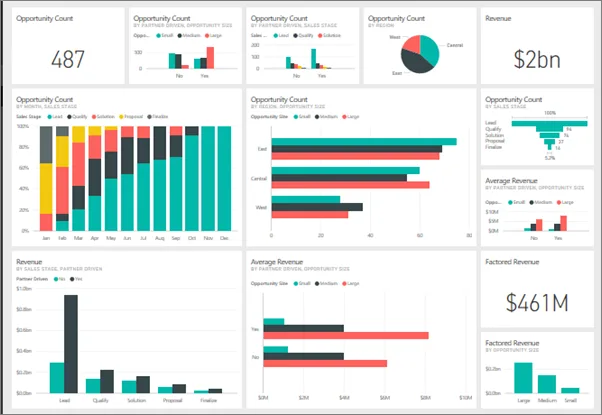
A Power BI dashboard
Pipeline, revenue and opportunity tiles pinned from several reports into one dashboard, the layer we put over Dynamics 365 data.
- Monthly management accounts
- IFRS statement mapping
- VAT return reconciliation
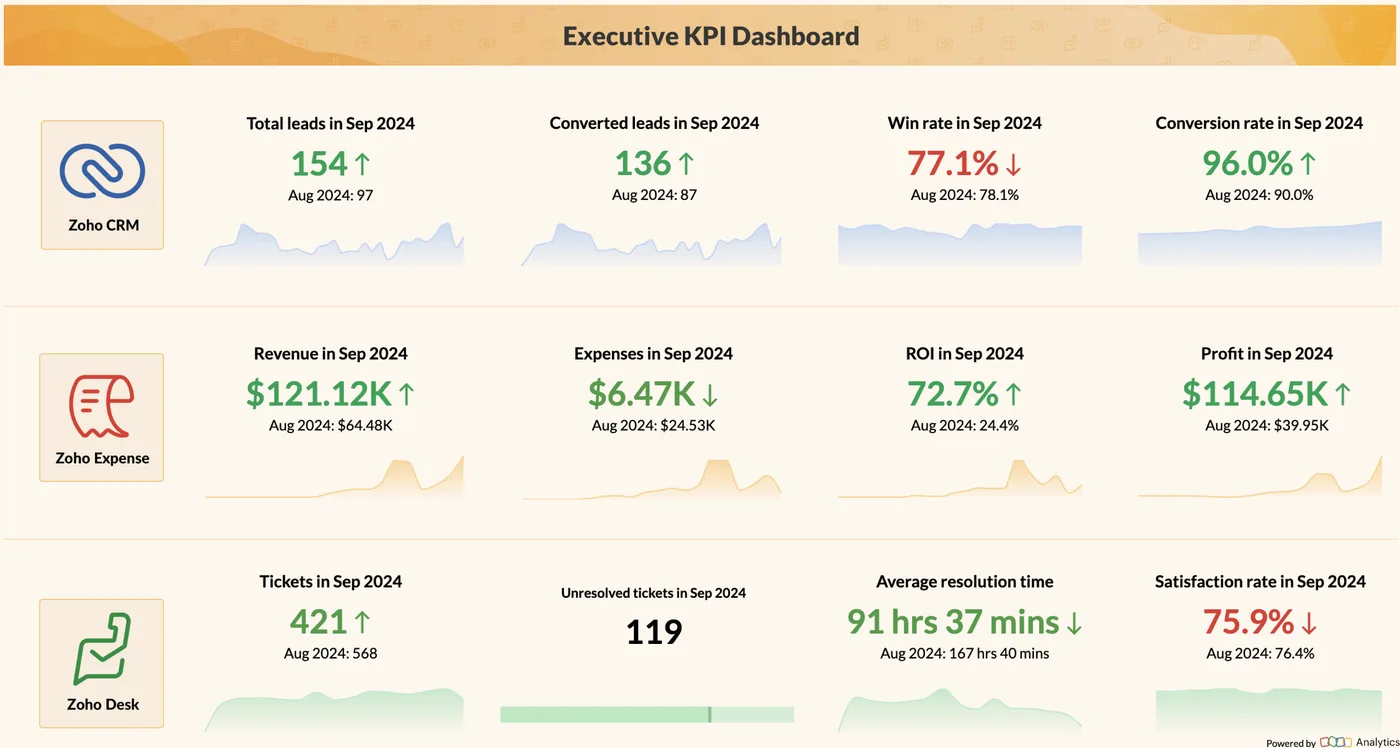
Executive KPI dashboard in Zoho Analytics
Leads, conversions, revenue, expenses, profit, tickets and satisfaction on one board, drawn from Zoho CRM, Expense and Desk.
- Corporate Tax schedules
- Corporate Tax data needs
- VAT 201 accuracy
Which platform for financial reporting software in the UAE?
An honest comparison. We implement all of these, so the recommendation follows your processes, team and budget.
| Option | Best when | How it fits this need |
|---|---|---|
| Power BI | Several ledgers or complex group structures | Best for combining different accounting systems, intercompany eliminations and detailed drill-down. Needs data modelling skills to maintain; we document it so your team or ours can keep it running. |
| Zoho Analytics | Zoho Books users wanting quick management packs | Quickest route for Zoho Books companies, with native connectors and reasonable cost. It also connects to other sources, though complex multi-ledger groups are often easier in Power BI. |
| Odoo Spreadsheet dashboards | All entities already on one Odoo database | Keeps reporting inside Odoo with live data and no extra licence. Works well for single-database groups; combining external ledgers is harder. Combining external ledgers is harder and usually needs Power BI instead. |
| Excel with a disciplined template | One entity and a simple chart | A well-designed Excel pack linked to a clean trial balance export may be enough for a single small company. It becomes fragile once several entities or frequent questions appear. |
What changes in the UAE
The local rules and realities we design for before go-live. Rules change, so we re-check the current position at scoping.
Corporate Tax data needs
UAE Corporate Tax at 9% above AED 375,000 of taxable income means finance must produce adjusted profit data every year. Reporting that tags adjustments monthly avoids a year-end scramble.
VAT 201 accuracy
The VAT 201 return is usually filed quarterly, 28 days after period end. Reconciling tax codes to the ledger before filing is a routine report, not a special exercise.
Arabic and English packs
Boards, family shareholders and government-linked stakeholders in the UAE may want reports in Arabic. Report labels can be switched between English and Arabic from the same data model.
What drives the cost, and what it connects to
No price list: we quote a fixed price in AED after discovery. These are the factors that move the effort up or down.
Number of source ledgers
One accounting system connects quickly. Several different systems need separate connectors, mapping and reconciliation, which increases effort and ongoing maintenance each month.
Consolidation and eliminations
Groups with intercompany sales, loans and recharges need elimination rules and checks. Single-entity reporting avoids this layer entirely and costs less to build.
Tax reconciliation scope
Adding VAT 201 and Corporate Tax schedules requires design with your tax adviser and testing against past returns, but removes risky manual reconciliations later.
Ledger data quality
Miscoded transactions and unused accounts distort reports. Cleaning the chart of accounts and tagging often takes as long as building the reports themselves.
What it connects to
Journal entries, analytic tags and balances flow into the reporting model daily, with drill-down back to source entries.
Trial balances and transactions flow through the native connector into Zoho Analytics or Power BI.
Scheduled exports of trial balances and ledgers load into the reporting model where direct connections are not available.
Filed VAT 201 figures are entered or imported to reconcile against ledger VAT accounts before each new return.
Finished monthly packs and supporting schedules are published to a shared folder for owners, auditors and banks.
How we deliver financial reporting software
Phases, indicative timing and what is delivered in each. Scope is fixed and priced in AED before we start.
Report inventory
We collect every report finance produces today, who receives it, how long it takes and where data comes from.
Data model
Connections to the ledger, account mappings and dimensions are built and tested against the trial balance.
Report build
Management pack, statements, VAT and tax schedules and dashboards are built and reviewed with finance.
Parallel close
One month-end runs with old and new reports side by side, and differences are explained.
Handover
Finance is trained to maintain mappings and add reports, and the old spreadsheets are retired.
When financial reporting software is the wrong answer
If your accounting system's standard reports already give you what you need and month-end takes a day, a separate reporting layer adds licences and upkeep. And reporting cannot fix a messy ledger; if accounts are miscoded or reconciliations are behind, clean up the accounting first.
How we handle it: We implement Zoho, Odoo and Dynamics 365 and build AI and custom software, so our written recommendation can point you to a simpler option, or to doing nothing yet.
Checklist and common mistakes
Buyer's checklist
What to ask for before you choose a provider.
- Ask how the tool will connect to each accounting system you use, including older desktop packages.
- Require intercompany eliminations and a clear reconciliation showing how consolidated figures tie to entity ledgers.
- Confirm VAT 201 reconciliation checks between ledger accounts and filed returns are part of the build.
- Check how Corporate Tax adjustments, such as non-deductible expenses, will be captured and reported by entity.
- Ask for IFRS statement layouts your auditor can use, not only management dashboards.
- Make sure Arabic versions of key reports are possible if owners or banks need them.
Common mistakes
What we see go wrong in the UAE, and how to avoid it.
- Reporting on uncleaned ledgersBeautiful dashboards over miscoded data mislead owners. Fix the chart of accounts and coding rules first, then build reports that people can trust.
- No tie-back to trial balancePacks that cannot be reconciled to the ledger lose credibility quickly. Include a control page showing totals match each entity's trial balance.
- Skipping VAT reconciliationDifferences between ledger VAT and filed returns often surface only during FTA audits. Reconcile every quarter as part of the reporting cycle.
- Too many dashboardsBuilding dozens of views nobody opens wastes budget. Start with the pack management actually reads each month, and add views only on request.


A UAE team you can meet in person
That is our team at Zoholics Dubai 2026. We deliver Zoho, Odoo, Dynamics 365 and custom projects from our Ras Al Khaimah office with remote delivery across all seven emirates, in English and Arabic, and we run workshops on site in Dubai, Abu Dhabi and Sharjah when a project needs it.
Financial Reporting Software in the UAE: questions we get asked
What is financial reporting software for UAE companies?
How is financial reporting software different from financial management software?
Can financial reporting software in the UAE prepare Corporate Tax schedules?
Do we need to change our accounting system first?
Which tool is best: Power BI, Zoho Analytics or Odoo Spreadsheet?
How much does financial reporting software cost?
Can financial reporting software in the UAE combine Odoo and another accounting package?
Can the reporting software prepare figures for our external auditor?
What training does our finance team need to maintain the reports?
Why choose Shyphan?

Talk to a consultant about financial reporting software
A free 30-minute call, then a written recommendation and a fixed quote in AED, including the honest option that this is not the right fit.
