





















 Saudi Arabia
 UAE
UAE Qatar
Qatar Bahrain
 Kuwait
 Oman
Oman Lebanon
 Egypt
Egypt India
India UK
UK Ireland
 Germany
 USA
USA Australia
 Singapore
 South Africa
 Iraq
Iraq Jordan
 Hungary
 Georgia
 Turkey
 LagosNigeria




 Accounts receivable · UAE
Accounts Receivable Software in the UAE
Accounts receivable software in the UAE helps you collect what customers owe: credit limits checked at order, reminders sent by email and WhatsApp, post-dated cheques tracked to clearing, bounced cheques followed up and ageing reported by salesperson. Shyphan configures AR on Zoho Books, Odoo or Business Central for UAE businesses with long payment terms and slow collections.
Prefer to talk? Call +971 55 145 3265
Get a free recommendation
Tell us what you want to fix. A senior consultant replies within one working day with a written view.

The first AI Enabled Zoho Partner in the Middle East and Africa. Accredited by Zoho on 14 October 2026 after the Zoho AI Accelerator Series. Read the announcement
AI Enabled Zoho Partner in the UAETrusted by businesses across the UAE, Saudi Arabia and beyond












Accounts Receivable Software in the UAE: the short answer
- What it is
- Accounts receivable software manages customer credit, outstanding invoices, reminders, receipts and collections until each invoice is paid.
- Best suited to
- UAE B2B companies with 30 to 120 day terms, many customers paying by cheque, and a finance team chasing payments from spreadsheets.
- Core stack
- Zoho Books, Zoho CRM, Odoo Accounting, Business Central, WhatsApp Business Platform, Zoho Analytics
- Typical timeline
- Four to sixteen weeks depending on the platform, modules, data migration and integrations; we phase larger programmes.
- What it costs
- A fixed price in AED after a free discovery call, phased so you are never committing to the whole programme on day one. Platform licences are billed by the vendor.
- Local specifics
- Cheque-based collections; WhatsApp reminders; Bad debts and Corporate Tax.
- Delivered by
- Shyphan AI Solutions: Zoho Premium Partner, Official Odoo Partner, independent Dynamics 365 consultancy and custom software house, so the platform is chosen by fit.
- Last reviewed
- 29 September 2026
Accounts Receivable Software in the UAE: who it is for
UAE B2B companies with 30 to 120 day terms, many customers paying by cheque, and a finance team chasing payments from spreadsheets. Accounts receivable software manages customer credit, outstanding invoices, reminders, receipts and collections until each invoice is paid.
- Credit limits at order entry
- Reminder sequences
- PDC receivables register
- Bounced cheque handling
What we use to deliver accounts receivable software
Tools and platforms we typically use, and the systems it connects to. The final choice is made against your systems, budget and team.





 Odoo
Odoo Business Central
 Microsoft 365
 WhatsApp
Accounts Receivable Software in the UAE: what is included
Accounts receivable software in the UAE helps you collect what customers owe: credit limits checked at order, reminders sent by email and WhatsApp, post-dated cheques tracked to clearing, bounced cheques followed up and ageing reported by salesperson.
Credit limits at order entry
Each customer has a credit limit and terms. Sales orders that would exceed the limit, or that come from customers with overdue balances, are held for finance approval before goods leave the warehouse.
Reminder sequences
Friendly reminders before due date, then escalating messages after, are sent by email and approved WhatsApp templates with the statement attached. Tone and timing vary by customer segment, so key accounts are not spammed.
PDC receivables register
Post-dated cheques received from customers are logged with bank, number and date, deposited on schedule and matched when cleared. Finance sees cheques in hand as a separate figure from true overdue balances.
Bounced cheque handling
A returned cheque reverses the receipt, adds any bank charges to the customer, puts the account on hold and starts a follow-up task. Legal escalation is tracked where your policy calls for it.
Collections by salesperson
Ageing, overdue lists and promises to pay are shown by salesperson and account manager in CRM, so the people who own the relationship help collect, and commissions can be tied to collected revenue.
Online payment links
Invoices and reminders include payment links through UAE payment gateways, so smaller customers pay by card or bank transfer immediately, and receipts are matched automatically. Gateway fees are posted to the right expense account at settlement.
An industrial supplier with retention receivables
How accounts receivable software in the UAE looks in practice. Illustrative; every project is scoped to the business.
Picture an industrial equipment supplier in Musaffah, Abu Dhabi, supplying pumps, valves and installation to contractors on projects in Abu Dhabi, Dubai and the northern emirates. Contracts hold back retention until handover, payment certificates arrive late, and retention amounts owed from finished projects sit forgotten in spreadsheets long after the defects liability period ends.
- Record retention percentage and release conditions on every contract, splitting each invoice into amount due now and retention held, with separate receivable tracking for both.
- Add handover and defects liability end dates to each project, generating retention release invoices and a reminder to the account owner when the date arrives.
- Report retention receivable by customer, project and expected release date, so management sees cash tied up and which releases need chasing this quarter.
See it on the platforms we deliver
Real screens from the platforms we implement. Yours are configured to your entities, processes and KPIs.
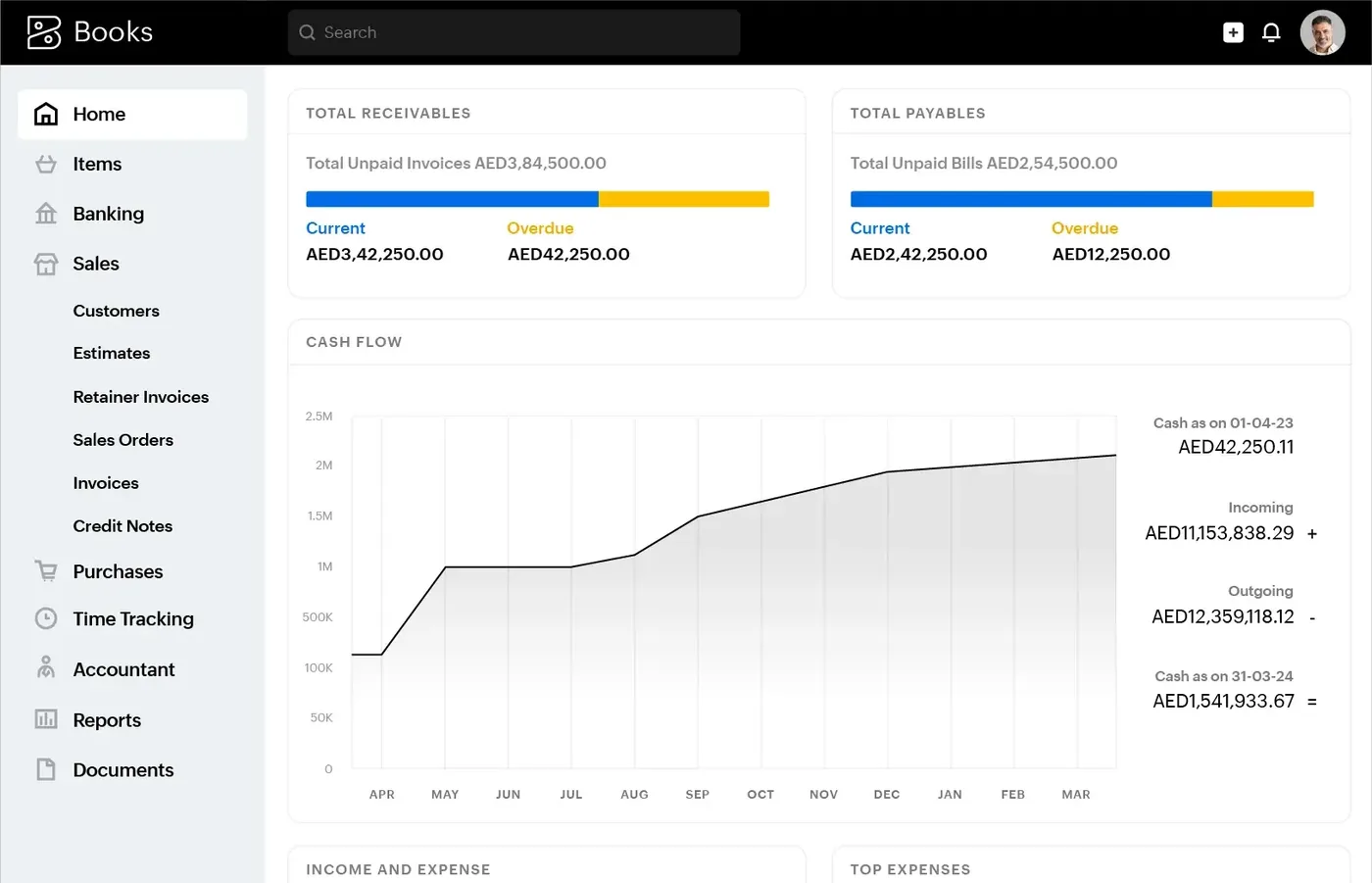
The Zoho Books dashboard in AED
Total receivables and payables split into current and overdue, and a twelve-month cash flow chart with incoming, outgoing and closing cash, all in UAE dirhams.
- Credit limits at order entry
- Reminder sequences
- PDC receivables register
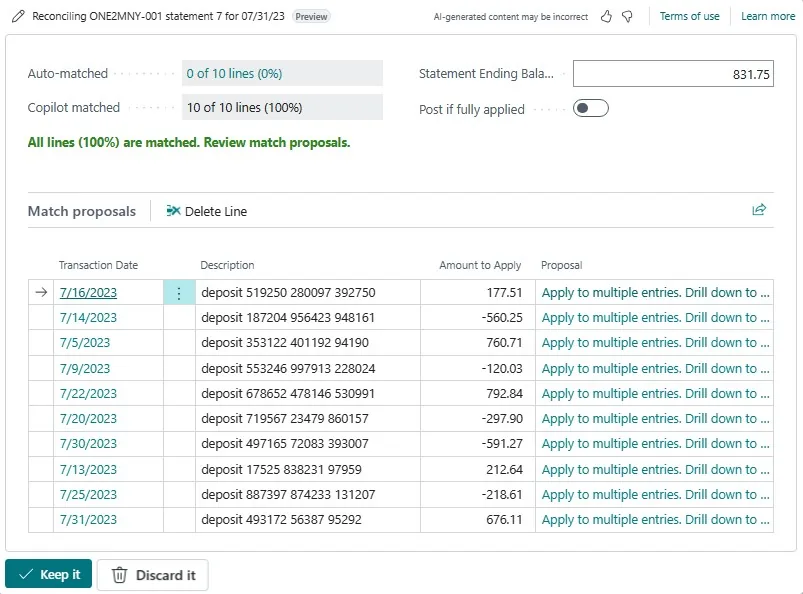
Bank reconciliation with Copilot in Business Central
Copilot proposing matches for a bank statement: ten of ten lines matched, each deposit with its date, amount and suggested entry, with keep or discard buttons.
- Bounced cheque handling
- Cheque-based collections
- WhatsApp reminders
Which platform for accounts receivable software in the UAE?
An honest comparison. We implement all of these, so the recommendation follows your processes, team and budget.
| Option | Best when | How it fits this need |
|---|---|---|
| Odoo Accounting with Project and Sales | Project supply and installation with retention and progress billing | A good fit for UAE suppliers and contractors needing progress invoices, retention tracking and project costs together, with sensible licensing and custom rules where needed. |
| Business Central | Larger group needing strict controls and Microsoft reporting | Handles receivables, collections and project billing well for multi-entity groups. Retention usually needs configuration or an app, and costs are higher than Odoo. |
| Zoho Books | Straightforward invoicing without retention or progress claims | Excellent for SMEs with standard invoices, reminders and online payments. Retention and progress billing need workarounds or Zoho Creator, so project suppliers may outgrow it. |
| Keep existing package, add a collections routine | Few projects and retention amounts are small | With a handful of projects, a disciplined register of retention and handover dates may be enough. Software helps once many projects and customers are in play. |
What changes in the UAE
The local rules and realities we design for before go-live. Rules change, so we re-check the current position at scoping.
Cheque-based collections
Many UAE B2B customers still pay by cheque, often post-dated. Treating cheques in hand separately from overdue balances gives a true picture of what needs chasing.
WhatsApp reminders
WhatsApp is how many UAE customers prefer to be contacted. Reminders go through the WhatsApp Business Platform with approved templates and opt-in, not from staff's personal phones.
Bad debts and Corporate Tax
Provisions and write-offs affect your Corporate Tax computation and VAT bad debt relief has its own conditions. We tag them in the ledger so your adviser can apply the rules; we confirm the current requirement at scoping.
What drives the cost, and what it connects to
No price list: we quote a fixed price in AED after discovery. These are the factors that move the effort up or down.
Contract billing rules
Retention, advance recovery, progress billing and certified values vary by contract, and each rule must be designed and tested against real past invoices before go-live.
Historic retention records
Gathering retention owed from finished projects, often scattered across spreadsheets and files, takes investigation time before balances can be loaded and trusted.
Forecasting and reporting
Cash forecasts combining open invoices, retention releases and expected certificates need report design and agreement on the assumptions management wants to see.
Ownership across teams
Collections involving project managers and sales, not only finance, need roles, notifications and training so every overdue item has a responsible person.
What it connects to
Customer transfers and cheque clearances flow in for matching against invoices and retention release invoices.
Handover and completion dates flow into receivables to trigger retention release reminders on the right date.
Reminders and statements go to customers' accounts teams; replies are logged on the customer record for follow-up.
Payment certificates, handover certificates and signed delivery notes are stored with the invoices they support.
Receivables, retention and forecast data flow in to management dashboards showing cash expected by month and customer.
How we deliver accounts receivable software
Phases, indicative timing and what is delivered in each. Scope is fixed and priced in AED before we start.
Ageing analysis
We analyse your ageing, terms, cheque volumes and the real causes behind the oldest balances.
Credit policy set-up
Credit limits, terms, order holds and approval rules are configured with finance and sales leaders.
Reminders and payments
Email and WhatsApp templates, reminder sequences and payment links are set up and tested with real customers.
PDC and cheque flows
Cheque registers, deposit schedules and bounced cheque workflows are configured and matched to your bank.
Go-live and review
AR goes live and we review collection results with you at the end of the first two months.
When accounts receivable software is the wrong answer
If most customers pay upfront or by card, you do not need AR software beyond payment links and the reminders already in your accounting tool. And software cannot fix a sales culture that grants terms freely; if credit limits will not be enforced, collections will not improve much.
How we handle it: We implement Zoho, Odoo and Dynamics 365 and build AI and custom software, so our written recommendation can point you to a simpler option, or to doing nothing yet.
Checklist and common mistakes
Buyer's checklist
What to ask for before you choose a provider.
- Ask to see an invoice split into amount due now and retention held, with both tracked separately.
- Confirm retention release dates trigger reminders or draft invoices without someone checking a spreadsheet.
- Check how progress billing against certified values is handled when the certificate differs from your claim.
- Ask how VAT is treated on retention invoices and confirm the approach with your tax adviser.
- Require cash forecast reports that include expected retention releases by month, customer and project.
- Confirm how customer statements show retention separately so contractors can reconcile quickly.
Common mistakes
What we see go wrong in the UAE, and how to avoid it.
- Retention buried in invoice totalsWhen retention is not split out, ageing reports mislead and releases are forgotten. Record retention as a separate receivable with its own due date from day one.
- No handover dates recordedWithout handover and defects liability end dates, nobody knows when retention is due. Capture these on each project and review them in monthly collections meetings.
- Invoicing claims, not certificatesInvoicing your claimed value when the certificate is lower creates disputes and credit notes. Invoice the certified amount and track the difference separately.
- Collections left only to financeFinance chasing contractors without project context gets slow answers. Involve project managers and sales in overdue reviews, with named owners for each balance.


A UAE team you can meet in person
That is our team at Zoholics Dubai 2026. We deliver Zoho, Odoo, Dynamics 365 and custom projects from our Ras Al Khaimah office with remote delivery across all seven emirates, in English and Arabic, and we run workshops on site in Dubai, Abu Dhabi and Sharjah when a project needs it.
Accounts Receivable Software in the UAE: questions we get asked
What does accounts receivable software do for UAE companies?
How is accounts receivable software different from invoice management software?
Can AR software send WhatsApp payment reminders in the UAE?
How does accounts receivable software track post-dated cheques?
Which platform suits accounts receivable in the UAE?
How much does accounts receivable software in the UAE cost to implement?
Can accounts receivable software in the UAE track retention owed by contractors?
How do we handle payment certificates that differ from our claim?
Can AR software forecast cash from retention releases?
Why choose Shyphan?

Talk to a consultant about accounts receivable software
A free 30-minute call, then a written recommendation and a fixed quote in AED, including the honest option that this is not the right fit.
