





















 Saudi Arabia
 UAE
UAE Qatar
Qatar Bahrain
 Kuwait
 Oman
Oman Lebanon
 Egypt
Egypt India
India UK
UK Ireland
 Germany
 USA
USA Australia
 Singapore
 South Africa
 Iraq
Iraq Jordan
 Hungary
 Georgia
 Turkey
 LagosNigeria



 WMS and 3PL · UAE
Warehouse Management System in the UAE
A warehouse management system in the UAE for businesses running several warehouses across emirates, and for third-party logistics providers storing stock for many clients. It controls stock to bin level, directs putaway, picking and packing by scanner, moves goods between Dubai, Abu Dhabi and the northern emirates and, for 3PLs, bills each client for storage and handling. We implement it on Odoo, Dynamics 365 or Zoho Inventory.
Prefer to talk? Call +971 55 145 3265
Get a free recommendation
Tell us what you want to fix. A senior consultant replies within one working day with a written view.
Trusted by businesses across the UAE, Saudi Arabia and beyond












Warehouse Management System in the UAE: the short answer
- What it is
- A warehouse management system directs and records every movement inside and between warehouses, at bin and lot level, using scanners and rules rather than paper.
- Best suited to
- UAE distributors with warehouses in more than one emirate, and 3PL operators storing goods for several clients who each need their own stock view and bill.
- Core stack
- Odoo Inventory, Odoo Barcode, Dynamics 365 Supply Chain Management, Business Central, Zoho Inventory
- Typical timeline
- Four to sixteen weeks depending on the platform, modules, data migration and integrations; we phase larger programmes.
- What it costs
- A fixed price in AED after a free discovery call, phased so you are never committing to the whole programme on day one. Platform licences are billed by the vendor.
- Local specifics
- Designated zones and mainland sites; Inter-emirate transfers; The UAE 3PL market.
- Delivered by
- Shyphan AI Solutions: Zoho Premium Partner, Official Odoo Partner, independent Dynamics 365 consultancy and custom software house, so the platform is chosen by fit.
- Last reviewed
- 29 September 2026
Warehouse Management System in the UAE: who it is for
UAE distributors with warehouses in more than one emirate, and 3PL operators storing goods for several clients who each need their own stock view and bill. A warehouse management system directs and records every movement inside and between warehouses, at bin and lot level, using scanners and rules rather than paper.
- Multi-emirate warehouse network
- 3PL multi-client ownership
- 3PL storage and handling billing
- Scanner-directed operations
What we use to deliver warehouse management system
Tools and platforms we typically use, and the systems it connects to. The final choice is made against your systems, budget and team.





 Odoo
Odoo Business Central
 Microsoft 365
 WhatsApp
Warehouse Management System in the UAE: what is included
A warehouse management system in the UAE for businesses running several warehouses across emirates, and for third-party logistics providers storing stock for many clients.
Multi-emirate warehouse network
Warehouses in Jebel Ali, Musaffah, Sharjah industrial areas and Ras Al Khaimah run in one system with their own layouts. Head office sees stock by emirate and site, and transfers between them are tracked as goods in transit.
3PL multi-client ownership
Stock is held by owner, so a 3PL can store goods for many clients in shared racks while each client's stock, lots and movements stay separate. Picking rules never mix one client's goods into another's order.
3PL storage and handling billing
Storage per pallet or cubic metre, inbound and outbound handling, value-added services and special requests are captured automatically from warehouse activity and billed monthly per client with 5% VAT. Each client's bill lists the activity behind every charge.
Scanner-directed operations
Receiving, putaway, picking, packing and cycle counts are done on handheld scanners that direct the operator to the right bin and lot. Errors drop because the scanner refuses the wrong item or location.
Client portal for 3PL customers
3PL clients log in to see their stock, lots, expiry dates, inbound shipments and outbound orders, and place orders themselves. Fewer emails and spreadsheets pass between your customer service team and theirs.
Carrier and courier integration
Outbound orders produce labels and tracking numbers for UAE couriers and freight forwarders through their APIs where available, so the warehouse does not retype addresses into carrier websites. Proof of delivery flows back to the order for the client to see.
Pharma distributor with three emirate warehouses
How warehouse management system in the UAE looks in practice. Illustrative; every project is scoped to the business.
For example, a pharmaceutical and medical supplies distributor runs warehouses in Dubai, Abu Dhabi and Sharjah, supplying hospitals, clinics and pharmacies across the UAE. Each site keeps its own spreadsheet of batches and expiry dates, transfers between emirates are reconciled by phone, and a product recall recently took days to trace across the three sites.
- Set up Odoo Inventory with lot and expiry tracking at every site, enforcing FEFO picking so the shortest-dated batch leaves first.
- Move stock between emirates with two-step transfers and in-transit locations, scanning batches at dispatch and receipt so every lot is always accounted for.
- Build a recall report that lists every customer who received a given batch, across all three warehouses, from a single search.
See it on the platforms we deliver
Real screens from the platforms we implement. Yours are configured to your entities, processes and KPIs.
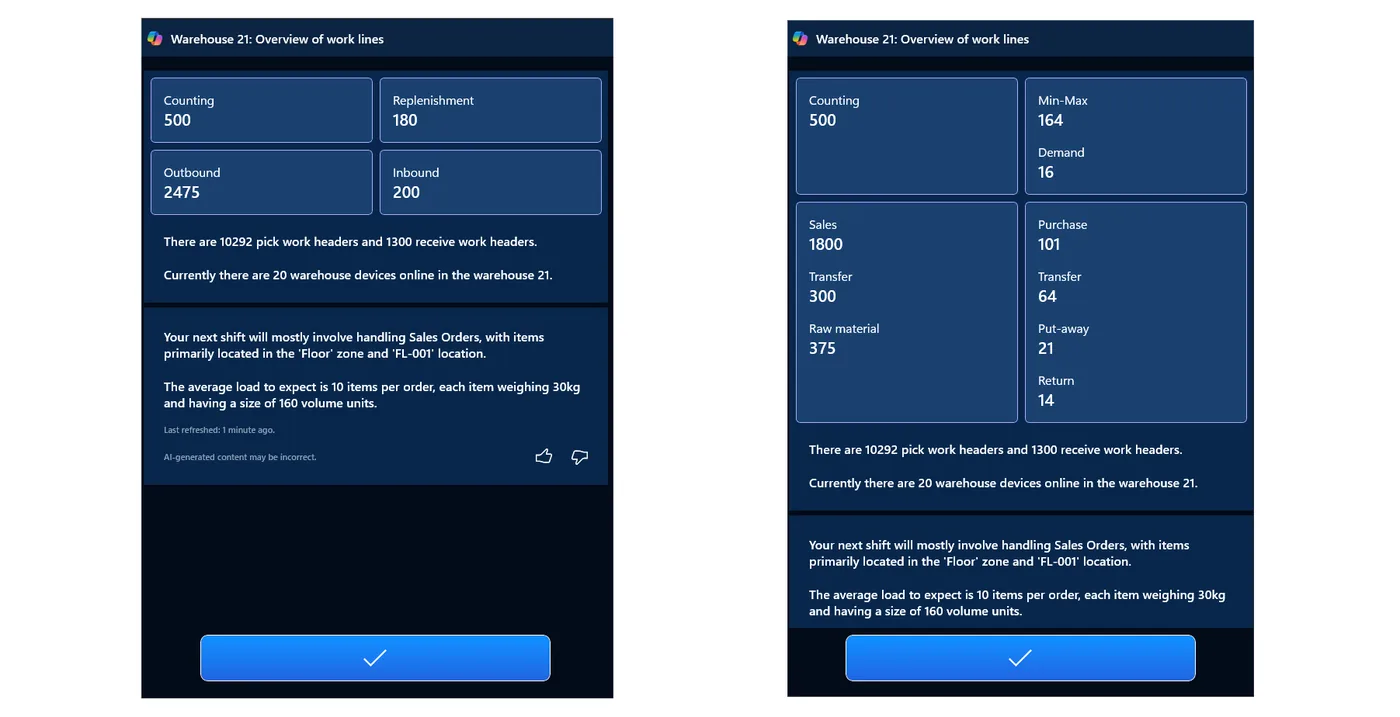
Copilot shift summary in the Warehouse Management app
The warehouse mobile app summarising work lines by type, such as counting, replenishment, sales and purchase, and what the next shift should expect.
- Multi-emirate warehouse network
- 3PL multi-client ownership
- 3PL storage and handling billing
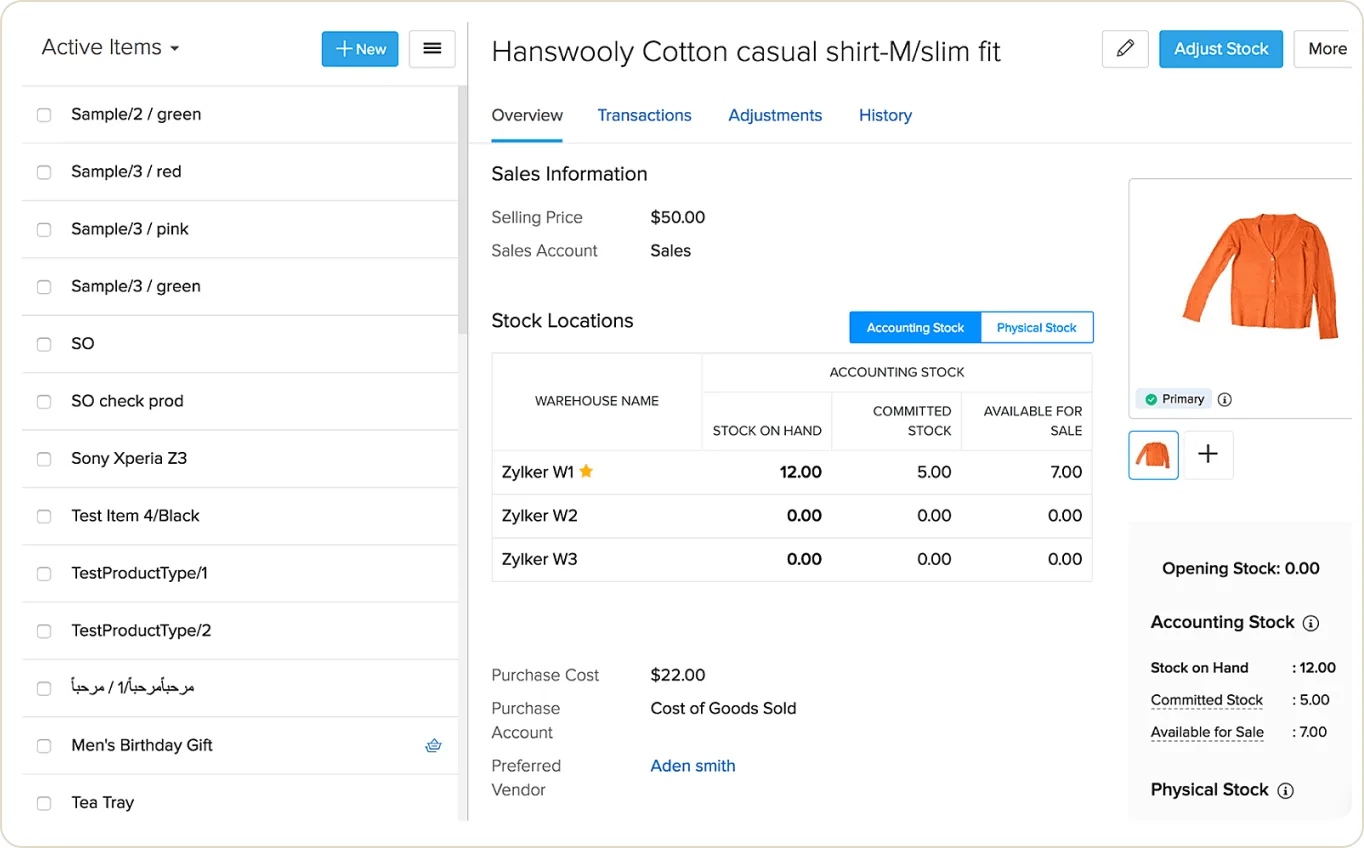
Item stock by warehouse in Zoho Inventory
Stock on hand, committed and available for sale per warehouse, for a single item.
- Scanner-directed operations
- Designated zones and mainland sites
- Inter-emirate transfers
Which platform for warehouse management system in the UAE?
An honest comparison. We implement all of these, so the recommendation follows your processes, team and budget.
| Option | Best when | How it fits this need |
|---|---|---|
| Odoo Inventory + Barcode | Multi-site distributors needing lots, FEFO and accounting together | Handles several warehouses, lots, expiry and transfers with scanning, plus accounting. A strong default for UAE distributors with warehouses in several emirates. |
| Dynamics 365 Supply Chain Management | Large, complex warehouse networks with advanced automation | Advanced warehousing, wave planning and automation support suit large operations. The cost and project size only make sense for bigger distributors and groups. |
| Business Central | Mid-sized groups standardised on Microsoft finance | Warehouse receipts, picks and lot tracking are capable for mid-sized networks. Shyphan works as an independent consultancy; licences come from Microsoft or a CSP. |
| Zoho Inventory | Lighter operations with simple stock movements | Multi-warehouse and batch tracking at a low cost. Detailed bin control and scanner-directed work are lighter, so it suits smaller or simpler networks. |
What changes in the UAE
The local rules and realities we design for before go-live. Rules change, so we re-check the current position at scoping.
Designated zones and mainland sites
A UAE network often mixes free zone warehouses in JAFZA or KIZAD with mainland sites. Moving stock between them can change VAT and customs treatment, so transfers carry the right documents. We confirm the current requirement at scoping.
Inter-emirate transfers
Trucks between Dubai, Abu Dhabi and the northern emirates carry stock that must stay visible in transit. Transfer documents and receiving at the other end close the loop, so stock does not vanish on the E11.
The UAE 3PL market
Many UAE brands outsource storage to 3PLs in Dubai South, JAFZA and KIZAD. A WMS with owner-level stock and automatic billing is what lets a 3PL win and serve those contracts at scale.
What drives the cost, and what it connects to
No price list: we quote a fixed price in AED after discovery. These are the factors that move the effort up or down.
Number of sites
Each warehouse needs locations, users, labels and training. Rolling out site by site spreads effort but still multiplies configuration and go-live support.
Traceability requirements
Lot, serial and expiry control add scanning steps and data checks. Regulated goods such as pharmaceuticals need more testing and validation than general stock.
3PL billing needs
Storing and billing stock for clients requires ownership, storage and handling charges and client reports, which is substantial additional work. Scope it separately if needed.
Existing ERP integration
If a separate ERP stays for finance or sales, integrating orders, receipts and stock levels adds design, testing and ongoing support. Replacing the ERP is sometimes simpler.
What it connects to
Sales orders flow in for picking, and receipts, deliveries and valuations flow back for finance.
Online orders flow in and available stock by site flows out to prevent overselling.
Shipment details flow out and tracking numbers flow back for customer updates.
Clients see their own stock, orders and storage charges without calling the warehouse.
Stock by site, expiry risk and warehouse productivity flow out to management dashboards.
How we deliver warehouse management system
Phases, indicative timing and what is delivered in each. Scope is fixed and priced in AED before we start.
Network and flow study
We visit your main warehouses, map layouts, flows and client contracts, and measure where errors and delays happen today.
WMS design
Locations, putaway and picking strategies, owner rules, billing tariffs and scanner hardware are designed and agreed.
Configure and label
The platform is configured, bins are labelled, scanners are set up and client, carrier and ERP integrations are built.
Site-by-site go-live
The first warehouse goes live after a full stock count, followed by other sites once the first is stable.
Optimise
Pick paths, slotting and billing rules are tuned from real data, and KPIs are reported weekly to operations.
When warehouse management system is the wrong answer
If you run one small warehouse with a few hundred items and a handful of staff, a full WMS with directed putaway is overkill; inventory with barcode scanning in Zoho Inventory or Odoo is enough. Very high-volume automated warehouses with conveyors and robots may need a specialist WMS alongside the ERP.
How we handle it: We implement Zoho, Odoo and Dynamics 365 and build AI and custom software, so our written recommendation can point you to a simpler option, or to doing nothing yet.
Checklist and common mistakes
Buyer's checklist
What to ask for before you choose a provider.
- Ask how lots, expiry dates and FEFO picking are enforced at every warehouse, not only at the main site.
- Confirm transfers between emirates use in-transit locations so stock is never counted twice or lost.
- Check that a recall report can list every customer who received a batch across all sites.
- Require role-based access so each site's staff see and move only their own stock.
- Ask how 3PL clients would be separated and billed if you store goods for others.
- Make sure the provider can support rollouts on site in Dubai, Abu Dhabi and Sharjah when needed.
Common mistakes
What we see go wrong in the UAE, and how to avoid it.
- Different processes at each siteLetting each warehouse keep its own habits undermines group reporting. Agree common location codes, receiving rules and picking methods before rollout. Document them once for all sites.
- Moving stock without in-transit locationsInstant transfers hide stock on trucks between emirates. Use two-step transfers so goods on the road are visible and missing items are spotted quickly.
- Ignoring expiry until it is too lateExpired stock is found during counts rather than prevented. Report short-dated stock weekly per site so it can be sold or moved in time.
- Going live at every site at onceSimultaneous go-lives stretch support thin. Start at one warehouse, fix issues, then roll out to the others with a proven setup. Train site champions at each location.


A UAE team you can meet in person
That is our team at Zoholics Dubai 2026. We deliver Zoho, Odoo, Dynamics 365 and custom projects from our Ras Al Khaimah office with remote delivery across all seven emirates, in English and Arabic, and we run workshops on site in Dubai, Abu Dhabi and Sharjah when a project needs it.
Warehouse Management System in the UAE: questions we get asked
What does a warehouse management system UAE 3PLs use need that inventory software lacks?
Is WMS software UAE distributors buy different from a 3PL WMS?
How is this UAE page different from your Sharjah and Ajman WMS pages?
Which platform suits a UAE warehouse network?
Can the WMS connect to our ERP and e-commerce stores?
How long does a WMS implementation take?
Can a warehouse management system in the UAE trace a batch recall across sites?
Should we roll out the WMS at all warehouses at the same time?
Can the WMS enforce FEFO picking for products with expiry dates?
Why choose Shyphan?

Talk to a consultant about warehouse management system
A free 30-minute call, then a written recommendation and a fixed quote in AED, including the honest option that this is not the right fit.
