





















 Saudi Arabia
 UAE
UAE Qatar
Qatar Bahrain
 Kuwait
 Oman
Oman Lebanon
 Egypt
Egypt India
India UK
UK Ireland
 Germany
 USA
USA Australia
 Singapore
 South Africa
 Iraq
Iraq Jordan
 Hungary
 Georgia
 Turkey
 LagosNigeria




 Hospitality ERP · Dubai
Custom ERP for Hospitality Companies in Dubai
Custom ERP for hospitality companies Dubai operators run sits behind the PMS and POS: central purchasing, recipe costing, outlet-level profit and loss, owner statements and Tourism Dirham reconciliation. Shyphan builds it on Odoo or Business Central with custom modules for hotel groups, restaurant groups and holiday-home operators, connected to the front-desk and outlet systems your teams already use.
Prefer to talk? Call +971 55 145 3265
Get a free recommendation
Tell us what you want to fix. A senior consultant replies within one working day with a written view.
Trusted by businesses across the UAE, Saudi Arabia and beyond












Custom ERP for Hospitality Companies in Dubai: the short answer
- What it is
- A custom hospitality ERP is a finance and operations system extended with hotel and restaurant logic, such as recipes, outlets, departmental reporting and owner accounting, that packaged ERPs leave out.
- Best suited to
- Dubai hotel and serviced-apartment groups, multi-brand restaurant groups with a central kitchen, and holiday-home operators managing units for many owners.
- Core stack
- Odoo Accounting, Odoo Purchase, Business Central, AL extensions, Power BI, REST APIs
- Typical timeline
- Four to sixteen weeks depending on the platform, modules, data migration and integrations; we phase larger programmes.
- What it costs
- A fixed price in AED after a free discovery call, phased so you are never committing to the whole programme on day one. Platform licences are billed by the vendor.
- Local specifics
- Tourism Dirham and DET reporting; Summer lows and event peaks; Large multinational workforces.
- Delivered by
- Shyphan AI Solutions: Zoho Premium Partner, Official Odoo Partner, independent Dynamics 365 consultancy and custom software house, so the platform is chosen by fit.
- Last reviewed
- 29 September 2026
Custom ERP for Hospitality Companies in Dubai: who it is for
Dubai hotel and serviced-apartment groups, multi-brand restaurant groups with a central kitchen, and holiday-home operators managing units for many owners. A custom hospitality ERP is a finance and operations system extended with hotel and restaurant logic, such as recipes, outlets, departmental reporting and owner accounting, that packaged ERPs leave out.
- Central purchasing and commissary
- Recipe and menu costing
- Departmental P&L by property
- Tourism Dirham reconciliation
What we use to deliver custom ERP for hospitality companies
Tools and platforms we typically use, and the systems it connects to. The final choice is made against your systems, budget and team.





 Odoo
Odoo Business Central
 Microsoft 365
 WhatsApp
Custom ERP for Hospitality Companies in Dubai: what is included
Custom ERP for hospitality companies Dubai operators run sits behind the PMS and POS: central purchasing, recipe costing, outlet-level profit and loss, owner statements and Tourism Dirham reconciliation.
Central purchasing and commissary
Outlets raise requisitions against a central store or commissary kitchen, buyers consolidate them into supplier orders, and transfers to each outlet are costed. Price variances by supplier show up weekly, not at month-end, which matters when fresh produce prices move with the season.
Recipe and menu costing
Recipes and sub-recipes link to purchase prices, so the cost of every dish updates when supplier prices change. Theoretical food cost is compared with actual consumption per outlet, and chefs see which items have drifted above their target margin.
Departmental P&L by property
Rooms, food and beverage, spa and other departments report their own revenue and costs per property in a USALI-style layout, with undistributed expenses allocated by agreed rules. Owners and management companies read the same numbers without spreadsheet rework.
Tourism Dirham reconciliation
Tourism Dirham charges, service charges and 5% VAT collected on guest folios are reconciled against what the PMS reports and what is paid over, property by property, so fee and VAT balances are explained before returns are prepared.
Holiday-home owner statements
For operators managing apartments on behalf of owners, the ERP records bookings, commission, cleaning, maintenance and utility recharges per unit and produces monthly owner statements and payouts, with each owner able to view their own figures in a portal.
PMS and POS integration
Night audit revenue, deposits and city ledger balances flow from the PMS, and sales by item flow from the POS, through their APIs or scheduled exports. The ERP never asks front-desk or outlet staff to key the same data twice.
Restaurant group reconciling delivery app payouts
How custom ERP for hospitality companies in Dubai looks in practice. Illustrative; every project is scoped to the business.
For example, a Dubai restaurant group runs a central kitchen in Al Quoz, dine-in outlets in JLT and Dubai Hills, and two delivery-only brands. A large share of revenue comes through delivery apps, payouts arrive net of commissions and promotions, and the finance team spends days each month matching payouts to POS sales.
- Import delivery platform settlement reports into a custom Odoo module, matching each payout to POS orders by brand and outlet and separating commission, promotions and refunds.
- Post platform commissions and marketing charges to their own accounts per brand, so the profit of delivery-only brands is visible after every platform deduction.
- Record central kitchen transfers to outlets and virtual brands at standard cost, with daily wastage logged by item on the kitchen tablet.
See it on the platforms we deliver
Real screens from the platforms we implement. Yours are configured to your entities, processes and KPIs.
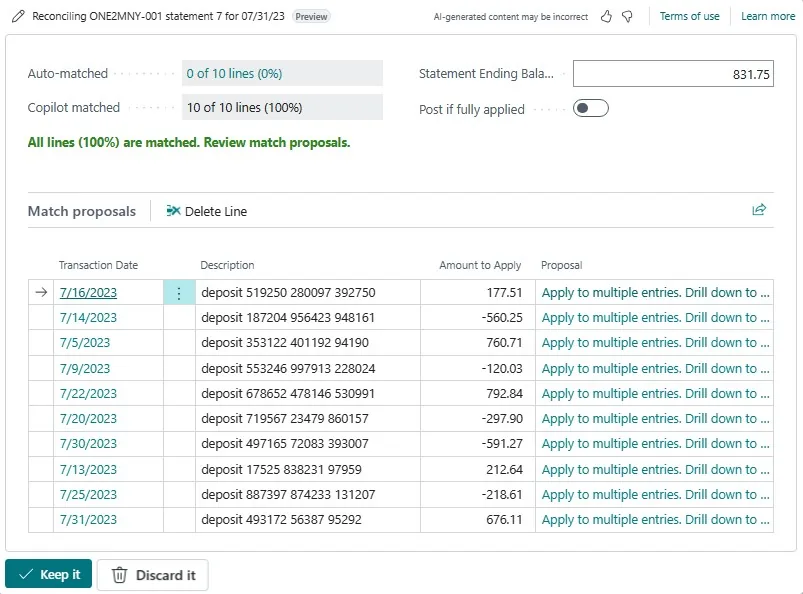
Bank reconciliation with Copilot in Business Central
Copilot proposing matches for a bank statement: ten of ten lines matched, each deposit with its date, amount and suggested entry, with keep or discard buttons.
- Central purchasing and commissary
- Recipe and menu costing
- Departmental P&L by property
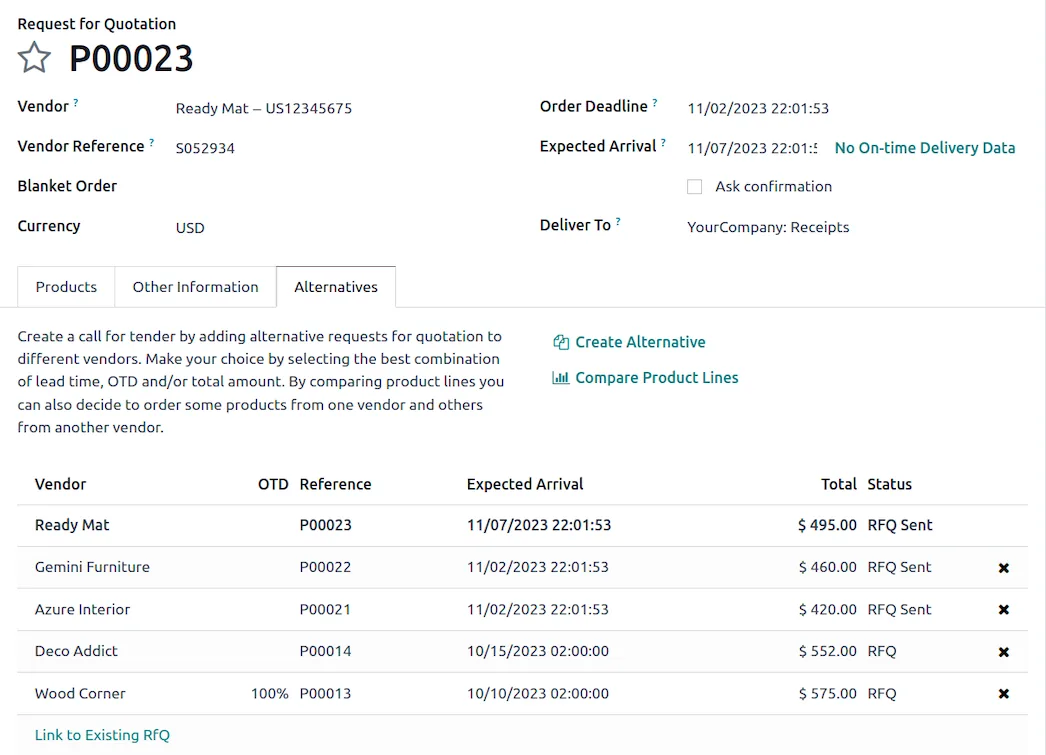
Comparing vendor quotes in Odoo Purchase
An RFQ with its alternatives tab: the same request sent to five vendors, with on-time delivery rate, expected arrival and total for each, ready to compare.
- Tourism Dirham reconciliation
- Tourism Dirham and DET reporting
- Summer lows and event peaks
Which platform for custom ERP for hospitality companies in Dubai?
An honest comparison. We implement all of these, so the recommendation follows your processes, team and budget.
| Option | Best when | How it fits this need |
|---|---|---|
| Odoo with custom modules | Restaurant or hotel group needing commissary, outlets and finance together | Purchase, Inventory, Accounting and custom modules for delivery reconciliation fit Dubai F&B groups well. Our common recommendation where several brands share a central kitchen. |
| Business Central with AL extensions | Hotel group with owners, multiple entities and Microsoft 365 | Strong for departmental accounting and owner reporting across properties. Delivery and recipe features usually come from integrated specialist systems rather than Business Central itself. |
| Specialist F&B back-office software | Restaurant group wanting recipe and inventory control only | Dedicated back-office tools handle recipes, par levels and stock counts well. They typically still need an accounting system and integration for group finance. |
| POS reports and spreadsheets | Single outlet with little delivery revenue | A single restaurant with modest delivery sales can manage with POS reports and an accountant. Spreadsheets break down with multiple brands and delivery platforms. |
What changes in Dubai
The local rules and realities we design for before go-live. Rules change, so we re-check the current position at scoping.
Tourism Dirham and DET reporting
Dubai hotels and holiday homes collect the Tourism Dirham fee and report guest stays to the Department of Economy and Tourism. We keep ERP fee balances aligned with PMS figures and confirm the current requirement at scoping.
Summer lows and event peaks
Dubai occupancy dips in the hottest months and spikes around major exhibitions, conferences and the winter season. Cash-flow and purchasing budgets are built by month so group finance can plan refurbishments and supplier commitments around that curve.
Large multinational workforces
Hotel and restaurant staff come from many countries and often live in company accommodation. The ERP tracks accommodation and transport costs per department and passes payroll data to WPS-compliant payroll through MOHRE-approved agents.
Working with businesses in Dubai: we support companies across JAFZA, DMCC, Dubai Silicon Oasis, Dubai Internet City, DIFC, Al Quoz and Dubai South, with remote delivery and on-site workshops where the project needs them.
What drives the cost, and what it connects to
No price list: we quote a fixed price in AED after discovery. These are the factors that move the effort up or down.
Delivery platforms connected
Each delivery platform provides settlement reports in its own format. More platforms and brands mean more import mappings, matching rules and testing before month-end is reliable.
Outlets and virtual brands
Every outlet and delivery-only brand needs its own analytic structure, menus and reporting. Groups with many virtual brands require careful design to avoid confusion.
Central kitchen operations
Production planning, transfers, yields and wastage at a commissary add Manufacturing or custom modules beyond purchasing and accounting, plus training for chefs and kitchen staff.
POS integration
Different POS systems across outlets, or older systems without APIs, increase integration effort. A single POS across the group is much simpler to connect.
What it connects to
Payout reports import weekly, splitting gross sales, commission, promotions and refunds by brand and outlet.
Daily sales by item, payment type and outlet flow into the ERP for revenue, VAT and stock consumption.
Purchase orders go to food suppliers by email or portal, and deliveries are received at the central kitchen with prices checked.
Staff costs by outlet and kitchen post to departmental profit and loss after payroll runs through your WPS agent.
Brand, outlet and channel profitability, food cost and wastage are published to owners and operations managers weekly.
How we deliver custom ERP for hospitality companies
Phases, indicative timing and what is delivered in each. Scope is fixed and priced in AED before we start.
Property and outlet map
We list every property, outlet, kitchen and revenue stream, plus the PMS, POS and reports each owner or brand expects.
Gap design
Standard Odoo or Business Central features are mapped first; recipe, owner and fee logic are designed as custom modules.
Build and integrate
Custom modules and PMS and POS connectors are built and tested against a full month of historical transactions.
Pilot property
One hotel or outlet cluster runs live first, and month-end closes in the ERP before others follow.
Group rollout
Remaining properties join in waves planned around the low season, with finance and chef training at each.
When custom ERP for hospitality companies is the wrong answer
A single restaurant or a small boutique hotel rarely needs a custom ERP; Zoho Books or Odoo with a POS integration covers it at a fraction of the cost. Properties under an international brand that mandates its own finance system should extend that system instead, and we would only build the reporting or owner layer around it.
How we handle it: We implement Zoho, Odoo and Dynamics 365 and build AI and custom software, so our written recommendation can point you to a simpler option, or to doing nothing yet.
Checklist and common mistakes
Buyer's checklist
What to ask for before you choose a provider.
- Ask how delivery platform settlement files will be matched to POS sales, and how unmatched orders are investigated.
- Confirm commissions, promotions and refunds from each platform post separately, by brand and outlet, not as one net figure.
- Require central kitchen transfers at a defined cost basis, with wastage and yield variances reported by item.
- Check how the Tourism Dirham fee, service charges and VAT are handled for dine-in outlets inside and outside hotels.
- Ask how daily POS sales from each outlet reach the ERP, and what happens if an outlet's POS is offline.
- Confirm reports show profit by brand, outlet and channel, including dine-in, takeaway and each delivery platform.
Common mistakes
What we see go wrong in the UAE, and how to avoid it.
- Booking delivery payouts as net revenueRecording only the net payout hides commission and promotion costs. Post gross sales and each deduction separately so brand profitability reflects the true platform cost.
- Standard costs never updatedCommissary transfer costs based on old ingredient prices distort outlet margins. Review standard costs every month and after any significant supplier price change.
- Ignoring wastage dataWithout daily wastage logs, food cost variances cannot be explained. Make wastage entry quick on a kitchen tablet and review it weekly with chefs.
- One entity for every brandBrands with different owners or licences need separate books. Decide the legal and reporting structure before configuring the ERP, not after go-live.


A UAE team you can meet in person
That is our team at Zoholics Dubai 2026. We deliver Zoho, Odoo, Dynamics 365 and custom projects from our Ras Al Khaimah office with remote delivery across all seven emirates, in English and Arabic, and we run workshops on site in Dubai, Abu Dhabi and Sharjah when a project needs it.
Custom ERP for Hospitality Companies in Dubai: questions we get asked
What is custom ERP for hospitality companies Dubai groups actually buying?
Does the ERP replace our PMS or POS?
How is this different from AI automation for hospitality companies in Dubai?
Can it run owner statements for holiday homes in Dubai Marina, JBR or Downtown?
Should we choose Odoo or Business Central?
How long does a hospitality ERP take and what does it cost?
Can custom ERP for hospitality companies Dubai restaurant groups handle franchise royalties?
Can the ERP manage catering orders from corporate clients?
How are stock counts done across many outlets?
Why choose Shyphan?

Talk to a consultant about custom ERP for hospitality companies
A free 30-minute call, then a written recommendation and a fixed quote in AED, including the honest option that this is not the right fit.
