





















 Saudi Arabia
 UAE
UAE Qatar
Qatar Bahrain
 Kuwait
 Oman
Oman Lebanon
 Egypt
Egypt India
India UK
UK Ireland
 Germany
 USA
USA Australia
 Singapore
 South Africa
 Iraq
Iraq Jordan
 Hungary
 Georgia
 Turkey
 LagosNigeria



 Cloud applications · UAE
Cloud Application Development in the UAE
Shyphan provides cloud application development in the UAE for businesses building portals, SaaS products and data-heavy internal systems that must scale, stay available and keep data in the country. We design on AWS me-central-1 or Azure UAE North with containers, serverless functions and infrastructure as code, and keep the monthly bill visible.
Prefer to talk? Call +971 55 145 3265
Book a free discovery call
Tell us what you want to fix. A senior consultant replies within one working day with a written view.
Trusted by businesses across the UAE, Saudi Arabia and beyond












Cloud Application Development in the UAE: the short answer
- What it is
- Cloud application development is building software designed to run on managed cloud services, using containers, serverless functions and managed databases so it scales with demand, recovers from failures and is billed by use.
- Best suited to
- UAE businesses building SaaS products, customer portals or high-traffic systems that need to scale, stay available and keep data in a UAE region.
- Core stack
- AWS me-central-1, Azure UAE North, Docker, Kubernetes, PostgreSQL, Terraform
- Typical timeline
- A focused first release in 8 to 16 weeks after discovery: two to three weeks of discovery and prototype, then build in two-week increments you review.
- What it costs
- We quote a fixed price in AED after a discovery session, broken into phases so you are never committing to the whole build on day one.
- Local specifics
- UAE cloud regions; PDPL obligations; Seven-emirate delivery.
- Delivered by
- Shyphan AI Solutions, a custom software and mobile app development company that also implements Zoho, Odoo and Dynamics 365, so apps are built to connect to your systems.
- Last reviewed
- 29 September 2026
Cloud Application Development in the UAE: who it is for
UAE businesses building SaaS products, customer portals or high-traffic systems that need to scale, stay available and keep data in a UAE region. Cloud application development is building software designed to run on managed cloud services, using containers, serverless functions and managed databases so it scales with demand, recovers from failures and is billed by use.
- Containers and serverless
- Infrastructure as code
- Autoscaling and resilience
- Cloud cost control
What we use to deliver cloud application development
Tools and platforms we typically use, and the systems it connects to. The final choice is made against your systems, budget and team.





 Odoo
Odoo Business Central
 Microsoft 365
 WhatsApp
Cloud Application Development in the UAE: what is included
Shyphan provides cloud application development in the UAE for businesses building portals, SaaS products and data-heavy internal systems that must scale, stay available and keep data in the country.
Containers and serverless
We package services in Docker and run them on managed Kubernetes, AWS Fargate or Azure Container Apps, or use serverless functions for spiky workloads, choosing whichever keeps the monthly bill and the operations effort lowest for your traffic.
Infrastructure as code
Networks, databases, queues and permissions are defined in Terraform and stored in your Git repository, so staging and production match, changes are reviewed like code, and a lost environment can be rebuilt instead of rediscovered.
Autoscaling and resilience
Applications scale out during month-end or campaign peaks and back in afterwards, run across availability zones, and use managed database backups with tested point-in-time restore, so one failed server does not become an outage.
Cloud cost control
We tag resources, set budgets and alerts, and review spend each month. Reserved capacity, storage tiers and scheduled shutdown of non-production environments are applied where they cut the bill without hurting performance.
Security by design
Identity is managed centrally with single sign-on and least-privilege roles, secrets live in a key vault, data is encrypted at rest and in transit, and audit logs are kept for the period your policies require.
Multi-tenant SaaS patterns
If you are building a product for many customers, we design tenant isolation, per-tenant configuration, usage metering and subscription billing from the start, so onboarding customer fifty is as routine as customer five.
The systems it plugs into
Real screens from the platforms we implement. Yours are configured to your entities, processes and KPIs.
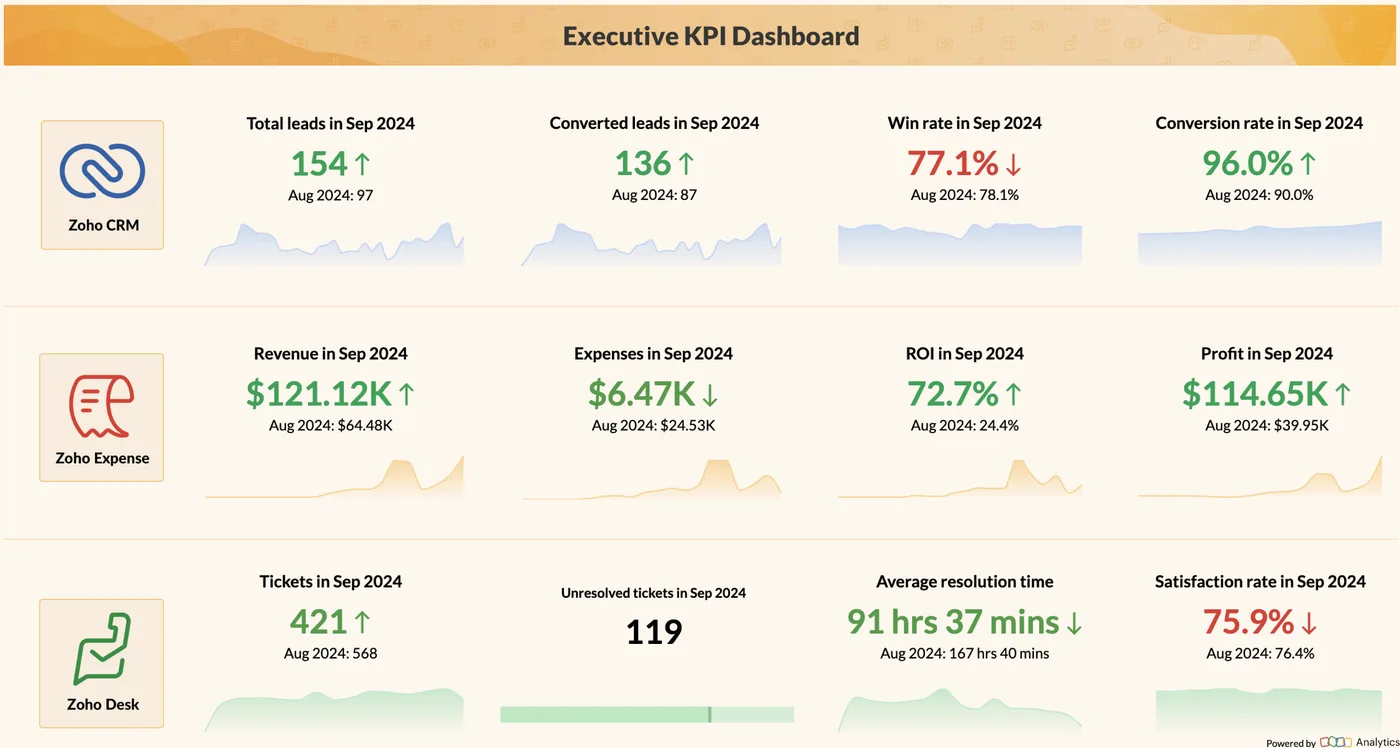
Executive KPI dashboard in Zoho Analytics
Leads, conversions, revenue, expenses, profit, tickets and satisfaction on one board, drawn from Zoho CRM, Expense and Desk. Your software reads from and writes back to screens like this one, so nothing is re-keyed.
- Containers and serverless
- Infrastructure as code
- Autoscaling and resilience
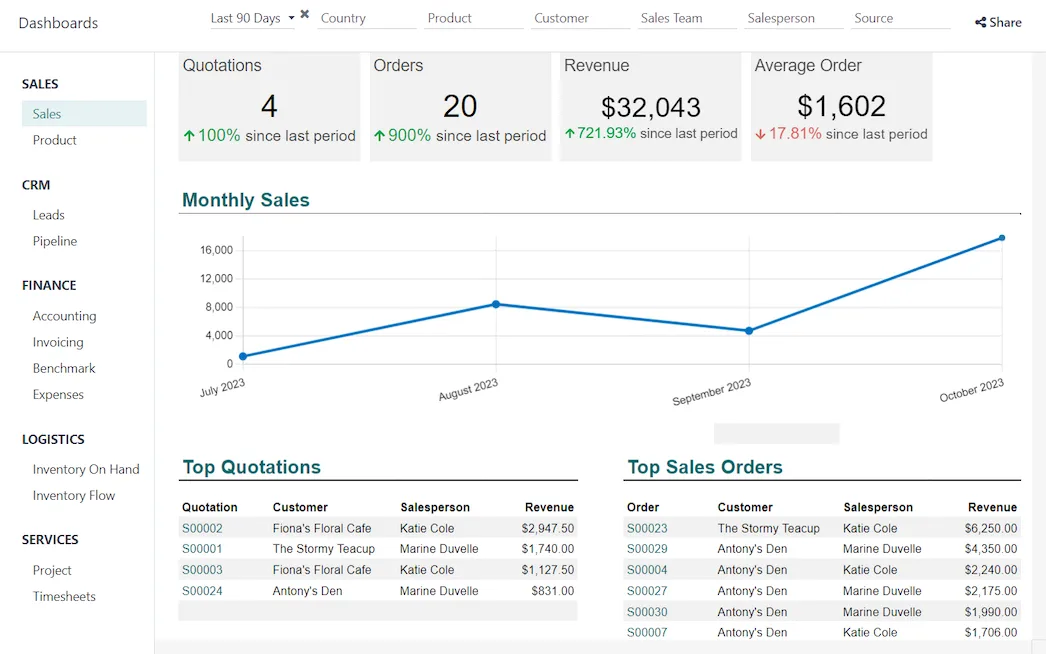
Sales dashboard in Odoo
Quotations, orders, revenue and average order value with the monthly trend, built from live Odoo data. The same software connects to Odoo in exactly the same way.
- Cloud cost control
- UAE cloud regions
- PDPL obligations
What changes in the UAE
The local rules and realities we design for before go-live. Rules change, so we re-check the current position at scoping.
UAE cloud regions
AWS me-central-1 and Azure UAE North let personal and financial data stay in the country, which simplifies PDPL assessments and customer security questionnaires. We deploy there by default unless you choose otherwise.
PDPL obligations
Federal Decree-Law 45 of 2021 sets rules on consent, purpose and cross-border transfer of personal data. We document where each data category lives, who can access it and how long backups are kept.
Seven-emirate delivery
Cloud projects run remotely from our RAK Free Trade Zone office, with on-site workshops in Dubai, Abu Dhabi or Sharjah when architecture decisions need your IT, security and finance teams in one room.
How we deliver cloud application development
Phases, indicative timing and what is delivered in each. Scope is fixed and priced in AED before we start.
Workload discovery
We define users, traffic patterns, data sensitivity and integrations, then decide which UAE cloud region and services fit, with an estimate of monthly running cost.
Architecture and landing zone
We set up accounts, networks, identity, logging and infrastructure as code in Terraform, so every environment can be rebuilt the same way.
Build and automate
Features are built as containers or serverless functions with CI/CD pipelines, automated tests and staging deployments you can review every sprint.
Harden and launch
Load tests, backup and restore drills, security scans and cost alerts come before go-live, with a rollback plan agreed in writing.
Run and optimise
We monitor uptime, errors and cloud spend monthly, right-size resources and apply patches, reporting in plain language rather than raw dashboards.
When cloud application development is the wrong answer
Cloud-native design is overkill for a small internal tool used by ten people during office hours; a single managed server or a low-code platform such as Zoho Creator costs less to build and run. Cloud bills also grow quietly without monitoring. If you have no one to own the account, include a managed support plan or choose a simpler setup.
How we handle it: We implement Zoho, Odoo and Dynamics 365 and build AI and custom software, so our written recommendation can point you to a simpler option, or to doing nothing yet.


A UAE team you can meet in person
That is our team at Zoholics Dubai 2026. We deliver Zoho, Odoo, Dynamics 365 and custom projects from our Ras Al Khaimah office with remote delivery across all seven emirates, in English and Arabic, and we run workshops on site in Dubai, Abu Dhabi and Sharjah when a project needs it.
Cloud Application Development in the UAE: questions we get asked
What is cloud application development?
How is cloud application development different from moving an old system to the cloud?
AWS or Azure: which should we choose?
How much will the cloud hosting cost each month?
Can cloud application development in the UAE keep our data inside the country?
Do you build SaaS products on the cloud?
Why choose Shyphan?

Talk to a consultant about cloud application development
A free 30-minute call, then a written recommendation and a fixed quote in AED, including the honest option that this is not the right fit.
