





















 Saudi Arabia
 UAE
UAE Qatar
Qatar Bahrain
 Kuwait
 Oman
Oman Lebanon
 Egypt
Egypt India
India UK
UK Ireland
 Germany
 USA
USA Australia
 Singapore
 South Africa
 Iraq
Iraq Jordan
 Hungary
 Georgia
 Turkey
 LagosNigeria




 Odoo for traders · Dubai
Odoo for Trading Companies in Dubai
Odoo for trading companies in Dubai fits the city's trading styles: DMCC and JLT commodity traders dealing in USD, Deira family trading houses selling on credit, and Jebel Ali re-exporters shipping across the region. Shyphan, an Official Odoo Partner, configures Odoo Sales, Purchase, Inventory and Accounting for multi-currency deals, landed cost, free-zone and mainland entities and credit control.
Prefer to talk? Call +971 55 145 3265

Book a free Odoo consultation
Tell us what you want to fix. A senior consultant replies within one working day with a written view.
Trusted by businesses across the UAE, Saudi Arabia and beyond












Odoo for Trading Companies in Dubai: the short answer
- What it is
- Odoo ERP configured for Dubai general traders, commodity traders and re-exporters, linking purchase, stock, sales and multi-currency accounting.
- Best suited to
- Dubai traders with a DMCC, JAFZA or mainland licence, or several of them, who buy and sell in more than one currency and need margin per deal.
- Core stack
- Odoo Sales, Odoo Purchase, Odoo Inventory, Odoo Accounting, Odoo Documents, Odoo Spreadsheet
- Typical timeline
- Three to six weeks for a focused single-app rollout; eight to sixteen weeks for a multi-app deployment with data migration and integrations.
- What it costs
- Odoo bills its licence separately, per user. Implementation is quoted as a fixed price in AED after a free 30-minute discovery call, based on apps, data and integrations.
- Local specifics
- DMCC and JLT traders; Deira trading houses; E-invoicing ahead.
- Delivered by
- Shyphan AI Solutions, Official Odoo Partner and Zoho Premium Partner, from its Ras Al Khaimah office with remote delivery across all seven emirates.
- Last reviewed
- 29 September 2026
Odoo for Trading Companies in Dubai: who it is for
Dubai traders with a DMCC, JAFZA or mainland licence, or several of them, who buy and sell in more than one currency and need margin per deal. Odoo ERP configured for Dubai general traders, commodity traders and re-exporters, linking purchase, stock, sales and multi-currency accounting.
- Free-zone and mainland entities
- USD-based commodity deals
- Deira credit and cheques
- Jebel Ali re-export flow
What we use to deliver Odoo for trading companies
Only what the first phase needs is switched on; more follows in later phases.
 Odoo Sales
 Odoo Purchase
 Odoo Inventory
 Odoo Accounting
Odoo for Trading Companies in Dubai: what is included
Odoo for trading companies in Dubai fits the city's trading styles: DMCC and JLT commodity traders dealing in USD, Deira family trading houses selling on credit, and Jebel Ali re-exporters shipping across the region.
Free-zone and mainland entities
Many Dubai traders run a DMCC or JAFZA company alongside a mainland one. Odoo multi-company keeps separate books, VAT registrations and invoices, with intercompany sales posted on both sides automatically.
USD-based commodity deals
Commodity and metals traders in JLT often buy and sell in USD with AED reporting. Odoo keeps deal currency, rates and realised and unrealised exchange differences, and reports margin per deal in both currencies.
Deira credit and cheques
Traditional Deira trading houses sell on credit with post-dated cheques and long relationships. Odoo sets credit limits per customer, blocks orders over limit for approval and tracks cheques to deposit and clearance.
Jebel Ali re-export flow
Goods landed at Jebel Ali and re-exported to GCC, Africa or Central Asia are tracked from purchase to exit, with landed cost, exit references and documents attached, keeping VAT evidence for exports in one place.
Back-to-back and drop-ship
Many Dubai deals never touch your warehouse. Odoo creates the purchase order from the sales order, ships direct from supplier to buyer and matches both invoices, so the deal margin is known before shipment.
Letter of credit tracking
LC and document-based deals record the LC number, bank, expiry, presentation dates and documents required, with reminders before expiry, so a missed presentation date or a discrepancy does not delay payment from the bank.
A foodstuff importer with expiry-driven stock
How Odoo for trading companies in Dubai looks in practice. Illustrative; every project is scoped to the business.
For example, a foodstuff importer in Al Ras, Deira brings rice, spices and canned goods from India, Pakistan and Thailand, storing them in a rented warehouse in Al Qusais. Batch expiry dates are written on cartons, older stock is found at the back of the racks, and supermarkets reject deliveries when remaining shelf life is too short.
- Record lot numbers and expiry dates when each container is received, with first-expiry-first-out removal so pickers are directed to the oldest valid stock.
- Set minimum remaining shelf life per customer group, so orders for supermarkets only allocate lots that meet their acceptance rules and wholesale buyers take shorter-dated stock.
- Build a weekly near-expiry report by product and lot, prompting sales staff to offer discounted clearance to wholesale customers before stock must be written off.
See it in Odoo
Real screens from the platforms we implement. Yours are configured to your entities, processes and KPIs.
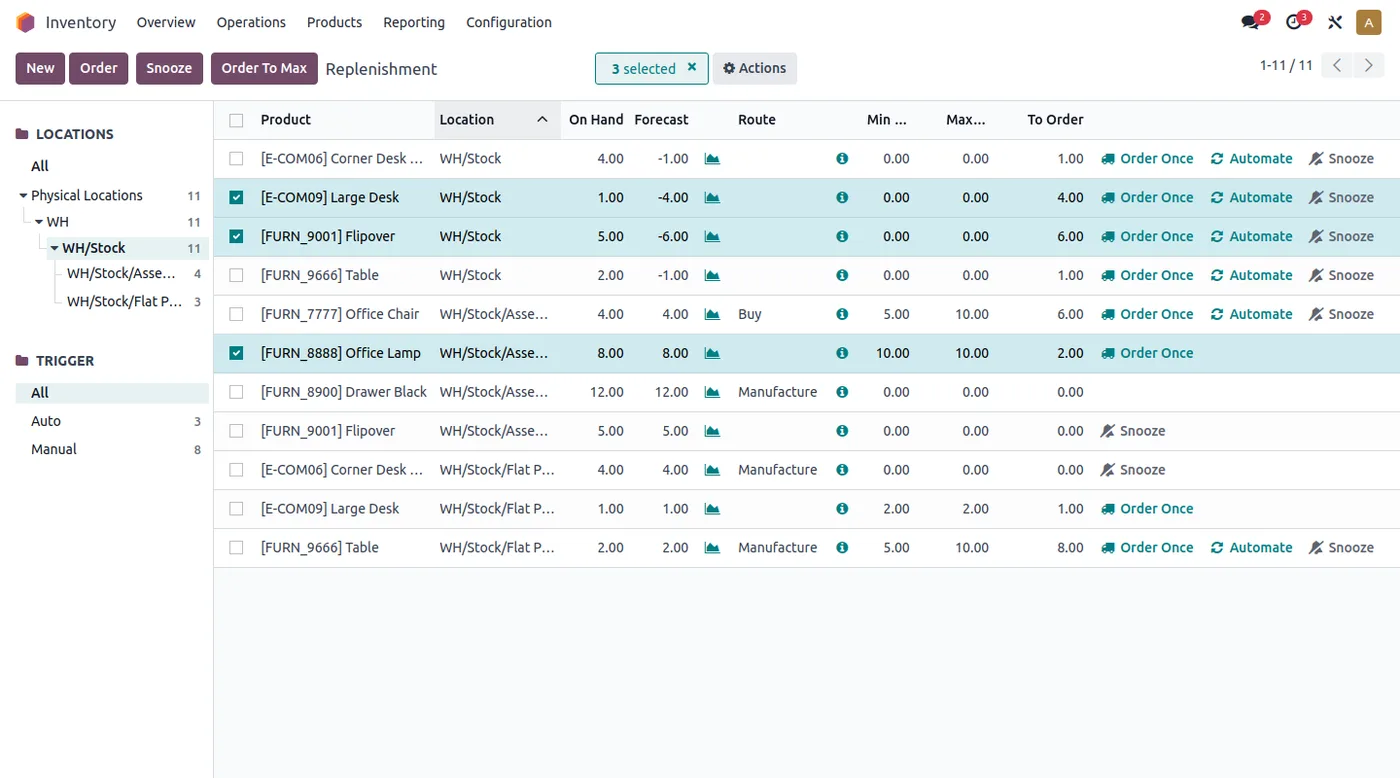
Replenishment in Odoo Inventory
Products below their minimum with the proposed route: buy, manufacture or transfer between warehouses.
- Free-zone and mainland entities
- USD-based commodity deals
- Deira credit and cheques
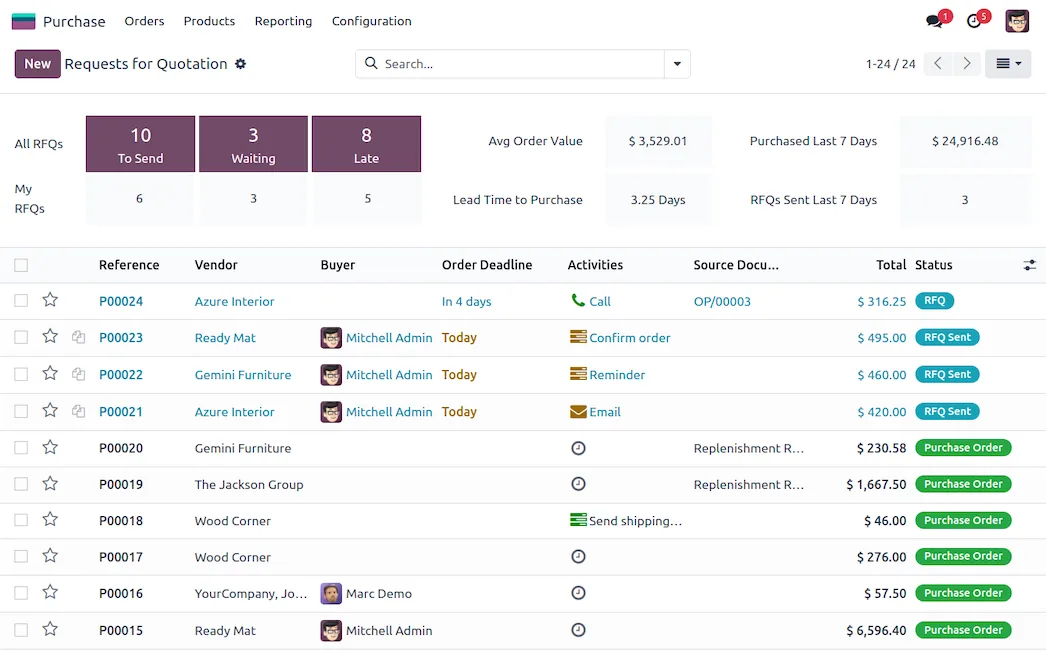
Requests for quotation in Odoo Purchase
RFQs to send, waiting and late at the top with average order value and lead time, and a list of RFQs and purchase orders by vendor, buyer and status.
- Jebel Ali re-export flow
- DMCC and JLT traders
- Deira trading houses
Which platform for Odoo for trading companies in Dubai?
An honest comparison. We implement all of these, so the recommendation follows your processes, team and budget.
| Option | Best when | How it fits this need |
|---|---|---|
| Odoo Inventory, Purchase and Accounting | Lots, expiry, landed cost and credit sales together | Well suited to Dubai food and FMCG traders, since lot tracking, removal strategies, landed cost and customer credit all work in one system with sensible licensing. |
| Zoho Inventory with Zoho Books | Small importer with few products and simple batches | A quicker, lighter setup for small traders. Customer-specific shelf-life rules and complex removal strategies are harder to model than in Odoo for a growing importer. |
| Business Central | Trading group with several entities on Microsoft | Strong on finance and item tracking for groups already on Microsoft. Extra apps and partner localisation add cost compared with Odoo for one trading house. |
| Current accounting package | Commodities without expiry or batch requirements | If goods have no expiry and you sell in bulk, a good accounting package with basic stock may do. Food traders usually need lot and expiry control that basic tools lack. |
What changes in Dubai
The local rules and realities we design for before go-live. Rules change, so we re-check the current position at scoping.
DMCC and JLT traders
DMCC-licensed companies in JLT include commodity, metals, tea and coffee traders who deal internationally in USD. Odoo's multi-currency deal reporting and multi-company setup suit that model.
Deira trading houses
Deira's family-run trading houses in textiles, electronics and general goods depend on customer credit and cheques. Odoo keeps those relationships visible without changing how customers are served.
E-invoicing ahead
UAE e-invoicing through Accredited Service Providers starts with a pilot from July 2026 and mandatory phases from 2027; check the Ministry of Finance for the latest dates. High-volume traders should plan their Odoo connection early.
Working with businesses in Dubai: we support companies across JAFZA, DMCC, Dubai Silicon Oasis, Dubai Internet City, DIFC, Al Quoz and Dubai South, with remote delivery and on-site workshops where the project needs them.
What drives the cost, and what it connects to
No price list: we quote a fixed price in AED after discovery. These are the factors that move the effort up or down.
Lot and expiry discipline
Capturing lots and expiry for every receipt needs labels, scanners and warehouse routines, and counting current stock by lot before go-live takes real effort.
Landed cost allocation
Allocating freight, duty, clearing and insurance across many products per container needs agreed methods by weight, value or quantity, tested against recent shipments.
Customer rule variety
Different shelf-life rules, price lists and credit terms for supermarkets, wholesalers and export buyers add configuration and testing for each customer group.
Warehouse arrangements
Rented or third-party warehouses, several stores or bonded storage need separate locations and may require integrations with the warehouse operator's own systems.
What it connects to
Declaration numbers, duty paid and clearance dates flow into Odoo against each container to complete landed cost.
Purchase orders from retail chains are captured into Odoo; delivery notes and invoices go back in the format each chain requires.
Supplier payments, customer transfers and cheque deposits flow in for reconciliation against invoices and bills.
Receipts, picks and stock counts are scanned with lot and expiry captured, keeping warehouse data accurate each day.
Container ETAs and shipping documents are recorded on incoming shipments so sales staff can promise realistic dates.
How we deliver Odoo for trading companies
Phases, indicative timing and what is delivered in each. Scope is fixed and priced in AED before we start.
Deal review
We trace three real deals, local credit, USD commodity and re-export, through your current process in Dubai.
Entities and currencies
Companies, VAT settings, currencies, chart of accounts and intercompany rules configured in Odoo per licence.
Trade flows
Sales, purchase, landed cost, back-to-back orders, credit limits, cheques and LC records configured and tested.
Opening data
Customers, suppliers, stock and open balances migrated, then reconciled per entity and per currency with finance.
Go-live
Go-live at a month start, users trained at your Dubai office, hyper-care then an AMC.
When Odoo for trading companies is the wrong answer
Odoo does not replace a commodity trading and risk management system for hedging, position limits or futures. Large commodity houses should keep one and use Odoo for accounting and logistics. A small trader on Zoho Books with simple stock may not need Odoo yet.
How we handle it: We implement Zoho, Odoo and Dynamics 365 and build AI and custom software, so our written recommendation can point you to a simpler option, or to doing nothing yet.
Checklist and common mistakes
Buyer's checklist
What to ask for before you choose a provider.
- Ask to see a picking list that directs staff to the earliest valid expiry, not simply the oldest receipt.
- Confirm freight, duty, clearing and insurance can be allocated across a container's products as landed cost.
- Check how customer-specific shelf-life rules are enforced when stock is allocated to an order.
- Ask how recalls by lot are reported, showing every customer who received a given batch.
- Require warehouse scanning tests with your actual labels, pallets and rented warehouse layout.
- Confirm how clearance discounts are approved so salespeople cannot cut prices without a reason recorded.
Common mistakes
What we see go wrong in the UAE, and how to avoid it.
- Loading stock without lot countsImporting totals per product without lots makes expiry control impossible from day one. Count stock by lot and expiry before go-live, even if it takes a weekend.
- Ignoring landed cost timingFreight and duty bills arrive after goods are sold, so early margins look too high. Use estimated landed costs at receipt and adjust when final bills arrive.
- One rule for every customerApplying the same shelf-life rule to all buyers either fails supermarkets or wastes stock. Set rules per customer group based on their acceptance terms.
- Clearance decided too lateNear-expiry stock noticed in the final weeks is hard to sell. Review a near-expiry report weekly and assign clearance actions to named salespeople.


A UAE team you can meet in person
That is our team at Zoholics Dubai 2026. We deliver Odoo projects from our Ras Al Khaimah office with remote delivery across all seven emirates, in English and Arabic, and we run workshops on site in Dubai, Abu Dhabi and Sharjah when a project needs it.
Odoo for Trading Companies in Dubai: questions we get asked
What does Odoo for trading companies in Dubai include?
Can one Odoo database hold our DMCC and mainland companies?
How is this different from Odoo for trading across the UAE?
Does Odoo calculate landed cost?
Can Odoo handle post-dated cheques?
How long does it take and what does it cost?
Can Odoo for trading companies in Dubai manage food products with expiry dates?
Can Odoo work with a rented third-party warehouse?
Can Odoo show profit per container or shipment?
Why choose Shyphan?

Talk to a consultant about Odoo for trading companies
A free 30-minute call, then a written recommendation and a fixed quote in AED, including the honest option that this is not the right fit.
