





















 Saudi Arabia
 UAE
UAE Qatar
Qatar Bahrain
 Kuwait
 Oman
Oman Lebanon
 Egypt
Egypt India
India UK
UK Ireland
 Germany
 USA
USA Australia
 Singapore
 South Africa
 Iraq
Iraq Jordan
 Hungary
 Georgia
 Turkey
 LagosNigeria




 Supply chain AI · UAE
AI Supply Chain Solutions in the UAE
AI supply chain UAE projects help distributors, manufacturers and retailers decide what to buy, when and where to hold it. Shyphan builds forecasting and planning assistants on Odoo, Dynamics 365 Supply Chain Management, Business Central or Zoho Inventory: demand forecasts that respect Ramadan and summer, purchase suggestions, supplier lead-time risk, landed cost estimates and monthly planning notes, with planners approving every order.
Prefer to talk? Call +971 55 145 3265
Book a free AI consultation
Tell us what you want to fix. A senior consultant replies within one working day with a written view.

The first AI Enabled Zoho Partner in the Middle East and Africa. Accredited by Zoho on 14 October 2026 after the Zoho AI Accelerator Series. Read the announcement
AI Enabled Zoho Partner in 21 countriesTrusted by businesses across the UAE, Saudi Arabia and beyond












AI Supply Chain Solutions in the UAE: the short answer
- What it is
- Forecasting and planning models plus AI assistants that turn sales, stock and supplier data into purchase, stock placement and planning decisions for people to approve.
- Best suited to
- UAE distributors, FMCG and pharma importers, manufacturers and multi-branch retailers holding stock in several emirates or across free zone and mainland warehouses.
- Core stack
- Odoo Inventory, Odoo Purchase, Dynamics 365 Supply Chain Management, Zoho Inventory, Azure Machine Learning, Power BI
- Typical timeline
- A measured pilot on one workflow in four to six weeks, then a phased rollout once accuracy is proven.
- What it costs
- We quote a fixed price in AED after a discovery session, broken into phases so you are never committing to the whole build on day one. Model usage is billed at cost.
- Local specifics
- Ramadan and the Hijri calendar; Customs duty and zone VAT; E-invoicing and supplier data.
- Delivered by
- Shyphan AI Solutions, which builds AI agents, document AI and Arabic and English assistants on top of Zoho, Odoo and Dynamics 365.
- Last reviewed
- 29 September 2026
AI Supply Chain Solutions in the UAE: who it is for
UAE distributors, FMCG and pharma importers, manufacturers and multi-branch retailers holding stock in several emirates or across free zone and mainland warehouses. Forecasting and planning models plus AI assistants that turn sales, stock and supplier data into purchase, stock placement and planning decisions for people to approve.
- Demand forecasts by item and site
- Purchase suggestions with reasons
- Supplier lead-time risk
- Landed cost estimates
What we use to deliver AI supply chain solutions
Tools and platforms we typically use, and the systems it connects to. The final choice is made against your systems, budget and team.





 Odoo
Odoo Business Central
 Microsoft 365
 WhatsApp
AI Supply Chain Solutions in the UAE: what is included
AI supply chain UAE projects help distributors, manufacturers and retailers decide what to buy, when and where to hold it.
Demand forecasts by item and site
Forecasts are built per item and warehouse from your sales history, with Ramadan, Eid, summer and school-term effects modelled on the Hijri and school calendars. Planners see the forecast next to last year and can override it with a reason that is kept.
Purchase suggestions with reasons
Suggested purchase orders take forecast, stock on hand, open orders, supplier lead times and minimum order quantities into account. Each line explains why it was suggested, so buyers approve or change it quickly in Odoo, Business Central or Zoho.
Supplier lead-time risk
Actual arrival dates are compared with promised lead times per supplier and route, and the assistant flags suppliers and lanes that are slipping. Safety stock is adjusted for those items and the purchasing team gets a weekly note.
Landed cost estimates
Before an order is placed, the assistant estimates landed cost from supplier price, freight, insurance and the 5% GCC customs duty where it applies, so buyers compare suppliers on cost at the warehouse rather than the ex-works price.
Stock placement across emirates
For companies with stock in Dubai, Abu Dhabi, Sharjah or a free zone, the assistant suggests transfers between sites based on forecast demand and ageing stock, keeping VAT treatment between designated zone and mainland in view.
Monthly planning notes
Ahead of the monthly sales and operations meeting, the assistant writes a plain-language note: forecast changes, items at risk of stock-out or overstock, supplier issues and cash tied up in slow stock, drawn from the same data the planners use.
Pharma importer with two warehouses
How AI supply chain solutions in the UAE looks in practice. Illustrative; every project is scoped to the business.
Picture a pharmaceutical and medical consumables importer with a bonded warehouse in Dubai South and a mainland warehouse in Abu Dhabi, supplying hospitals, clinics and pharmacies. Planners reorder from spreadsheets, short-expiry stock is found too late, and hospital tenders create sudden demand spikes that the purchasing team hears about only after the order arrives.
- Build item-level forecasts in Odoo from sales history, open tenders and seasonal patterns, showing planners the reasons behind each suggested order quantity.
- Flag batches approaching expiry at each warehouse and suggest transfers or customer offers, with the commercial manager approving any discount or return to supplier.
- Read hospital tender awards and framework call-offs from email into expected demand, so purchasing sees upcoming volume before the first purchase order arrives.
See it on the platforms we deliver
Real screens from the platforms we implement. Yours are configured to your entities, processes and KPIs.
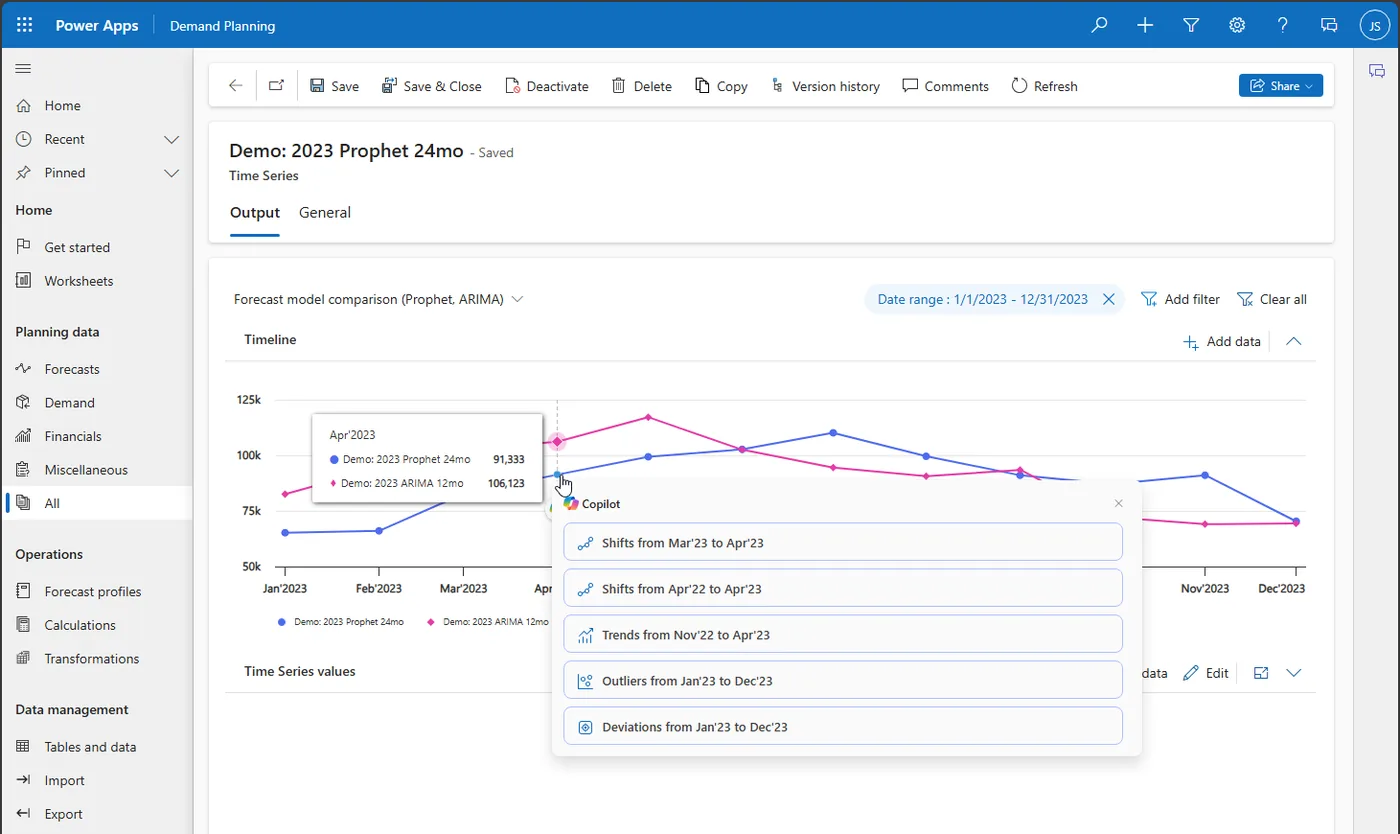
Demand planning with Copilot in Supply Chain Management
A forecast comparison of two models over a year, with Copilot offering to explain shifts, trends, outliers and deviations in the time series.
- Demand forecasts by item and site
- Purchase suggestions with reasons
- Supplier lead-time risk
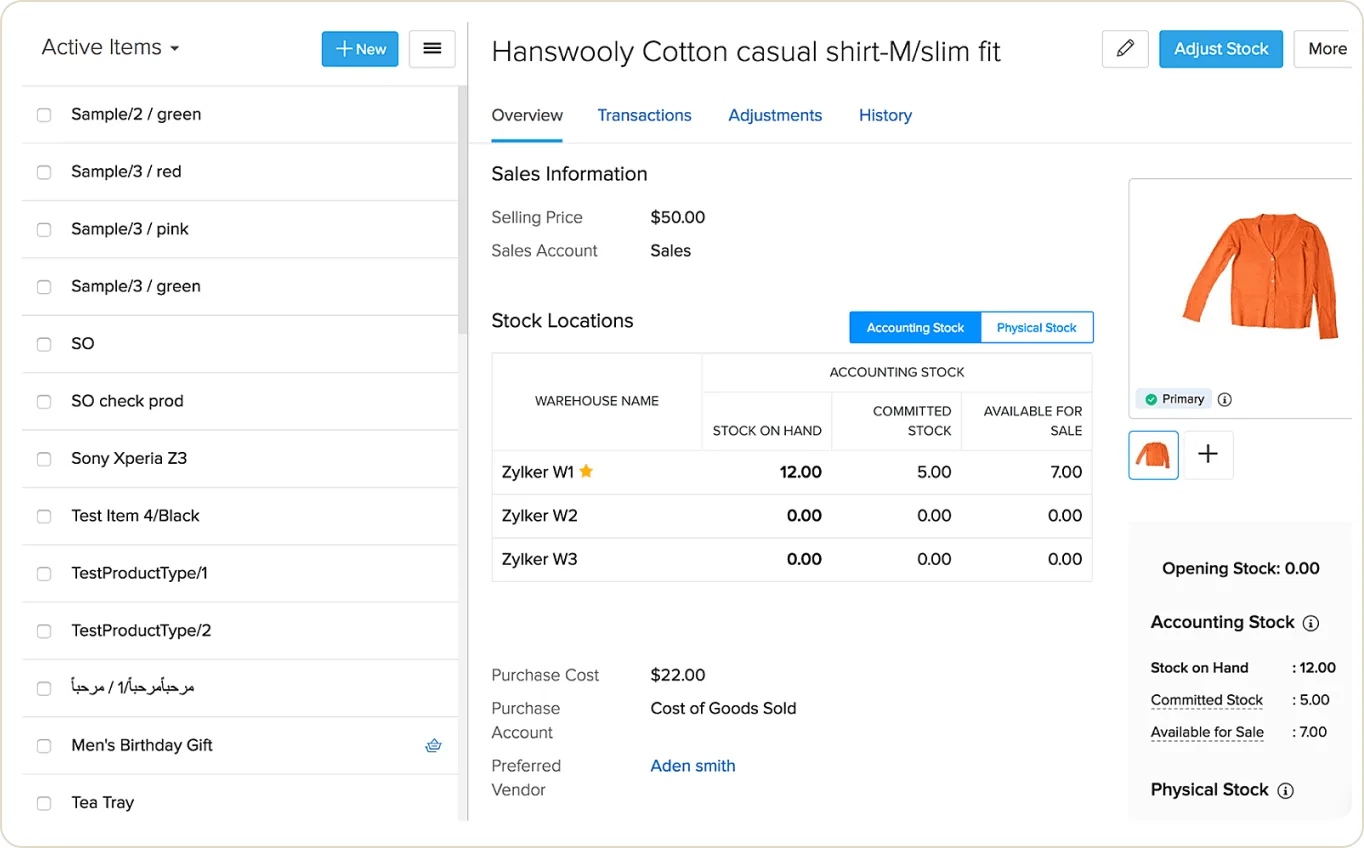
Item stock by warehouse in Zoho Inventory
Stock on hand, committed and available for sale per warehouse, for a single item.
- Landed cost estimates
- Ramadan and the Hijri calendar
- Customs duty and zone VAT
Which platform for AI supply chain solutions in the UAE?
An honest comparison. We implement all of these, so the recommendation follows your processes, team and budget.
| Option | Best when | How it fits this need |
|---|---|---|
| Odoo Inventory and Purchase | Distributors needing lots, expiry and replenishment rules | Strong for UAE importers handling batches, expiry and multi-warehouse routes; AI forecasting and purchase suggestions connect through the API or run as custom modules. |
| Dynamics 365 Supply Chain Management | Large groups with complex manufacturing and distribution | Fits enterprises needing advanced planning, warehouse management and multi-entity supply chains; bigger licence and implementation investment, so best for larger UAE groups. |
| Zoho Inventory | Smaller distributors with simpler stock and fewer items | Suits SMEs with moderate item counts wanting reorder points, batches and multi-warehouse stock at low cost; advanced forecasting needs an external model. |
| Planning spreadsheet with better data | Few items and stable demand | If you hold a small, steady range, clean sales data and a well-built spreadsheet may beat AI forecasting; AI earns its place with many items and volatile demand. |
What changes in the UAE
The local rules and realities we design for before go-live. Rules change, so we re-check the current position at scoping.
Ramadan and the Hijri calendar
Ramadan and Eid move about eleven days earlier each year in the Gregorian calendar, which breaks simple year-on-year forecasts. UAE models need Hijri-aware features, as well as the summer slowdown and school term dates.
Customs duty and zone VAT
Most imports carry the 5% GCC common customs tariff, and moving goods between designated zones and the mainland changes VAT treatment. Landed cost and transfer suggestions account for both; we confirm treatment for your goods at scoping.
E-invoicing and supplier data
UAE e-invoicing through Accredited Service Providers, with the pilot from July 2026 and mandatory phases from 2027, will give cleaner structured supplier invoice data for lead-time and price analysis. Check the Ministry of Finance for the latest dates.
What drives the cost, and what it connects to
No price list: we quote a fixed price in AED after discovery. These are the factors that move the effort up or down.
Number of items and sites
Thousands of items across several warehouses need more data preparation, model training and validation than a small range held in one location.
Quality of sales history
Clean history with stock-outs marked lets forecasts learn real demand. Gaps, returns mixed with sales and renamed items need cleaning first, which takes time.
Supplier data integration
Pulling supplier confirmations, shipping updates and actual receipt dates into the ERP improves lead time estimates but adds integrations with suppliers and forwarders.
Regulatory and batch rules
Pharma, food and chemicals carry batch, expiry and storage rules that planning must respect, adding constraints to design and test with quality teams.
What it connects to
Sales, stock and purchase history flow out to the forecasting model; suggested orders flow back as drafts.
Order confirmations and revised ship dates flow in so lead time risk is updated.
Shipment milestones flow in so expected receipt dates adjust automatically in planning.
Awards and call-off schedules flow in as expected demand for affected items.
Forecast accuracy, stock cover and expiry risk flow out for monthly supply chain reviews.
How we deliver AI supply chain solutions
Phases, indicative timing and what is delivered in each. Scope is fixed and priced in AED before we start.
Data health check
We test two or three years of sales, stock and purchase data for gaps, item code changes and one-off events.
Forecast baseline
We build and back-test forecasts on a product family and agree accuracy measures with planners.
Purchase logic
Suggestions, lead-time risk and landed cost are built and connected to your ERP as drafts, never auto-posted.
Planner trial
Planners use the suggestions for one or two buying cycles while we compare results with their own decisions.
Widen and review
We extend to more families and sites and review forecast accuracy monthly with your team.
When AI supply chain solutions is the wrong answer
If you have less than a year of reliable sales history, many new items or frequent code changes, statistical forecasts will not beat an experienced buyer. In that case we set up clean reorder rules in Odoo or Zoho Inventory first. For one warehouse with a few hundred items, standard min-max rules are often enough without AI.
How we handle it: We implement Zoho, Odoo and Dynamics 365 and build AI and custom software, so our written recommendation can point you to a simpler option, or to doing nothing yet.
Checklist and common mistakes
Buyer's checklist
What to ask for before you choose a provider.
- Ask how the forecast explains each suggestion, so planners understand and trust the numbers.
- Require that purchase orders are always approved by a planner, with AI suggestions only as drafts.
- Check how the model handles Ramadan, summer and tender-driven spikes specific to your business.
- Ask how batch, expiry and serial data are used, especially for regulated or perishable goods.
- Confirm how supplier lead times are measured from actual receipts rather than quoted times.
- Ask what data history is needed and what happens for new items with no sales history.
Common mistakes
What we see go wrong in the UAE, and how to avoid it.
- Forecasting from sales, not demandWhen stock-outs hide true demand, forecasts learn the wrong pattern. Record lost sales or stock-out days so the model sees what customers actually wanted.
- Auto-ordering without planner reviewLetting AI raise purchase orders directly can overstock slow items or miss tender context. Keep planners approving suggestions and recording why they changed them.
- Ignoring expiry in replenishmentOrdering the right quantity with the wrong shelf life still loses money. Include expiry and FEFO rules in planning, especially for pharma and food.
- Using quoted lead timesSuppliers' quoted times rarely match reality. Measure actual order-to-receipt times per supplier and route, and let the model use those. Review them quarterly as routes and suppliers change.


A UAE team you can meet in person
That is our team at Zoholics Dubai 2026. We deliver AI projects from our Ras Al Khaimah office with remote delivery across all seven emirates, in English and Arabic, and we run workshops on site in Dubai, Abu Dhabi and Sharjah when a project needs it.
AI Supply Chain Solutions in the UAE: questions we get asked
What does an AI supply chain UAE project actually deliver?
How is this different from AI for logistics companies?
Which ERP do we need?
How accurate will the forecasts be?
Does it handle Ramadan and summer seasonality in the UAE?
What does an AI supply chain project cost in the UAE?
How much sales history does AI supply chain planning need?
Can AI planning cover both free zone and mainland warehouses?
Will the forecast replace our planners?
Why choose Shyphan?

Talk to a consultant about AI supply chain solutions
A free 30-minute call, then a written recommendation and a fixed quote in AED, including the honest option that this is not the right fit.
