





















 Saudi Arabia
 UAE
UAE Qatar
Qatar Bahrain
 Kuwait
 Oman
Oman Lebanon
 Egypt
Egypt India
India UK
UK Ireland
 Germany
 USA
USA Australia
 Singapore
 South Africa
 Iraq
Iraq Jordan
 Hungary
 Georgia
 Turkey
 LagosNigeria




 AI for bookkeeping · UAE
AI Accounting in the UAE
AI accounting in the UAE puts a trained assistant inside your ledger work: it codes transactions to the right account and VAT treatment, suggests reconciliation matches, prepares accrual and prepayment entries and drafts month-end variance notes. Shyphan builds it on Zoho Books, Odoo Accounting or Business Central for in-house accounting teams, with every journal still posted by an accountant.
Prefer to talk? Call +971 55 145 3265
Book a free AI consultation
Tell us what you want to fix. A senior consultant replies within one working day with a written view.

The first AI Enabled Zoho Partner in the Middle East and Africa. Accredited by Zoho on 14 October 2026 after the Zoho AI Accelerator Series. Read the announcement
AI Enabled Zoho Partner in 21 countriesTrusted by businesses across the UAE, Saudi Arabia and beyond












AI Accounting in the UAE: the short answer
- What it is
- AI accounting is the use of machine learning and language models to propose account codes, VAT treatments, matches and journal entries from your own ledger history, which a qualified accountant then reviews and posts.
- Best suited to
- UAE companies with an in-house accounting team of two to fifteen people who spend most of the month coding, reconciling and closing rather than analysing.
- Core stack
- Zoho Books, Odoo Accounting, Business Central, Azure OpenAI Service, Zoho Analytics, Power Automate
- Typical timeline
- A measured pilot on one workflow in four to six weeks, then a phased rollout once accuracy is proven.
- What it costs
- We quote a fixed price in AED after a discovery session, broken into phases so you are never committing to the whole build on day one. Model usage is billed at cost.
- Local specifics
- Built around the VAT 201 return; Ready for Corporate Tax; E-invoicing data quality.
- Delivered by
- Shyphan AI Solutions, which builds AI agents, document AI and Arabic and English assistants on top of Zoho, Odoo and Dynamics 365.
- Last reviewed
- 29 September 2026
AI Accounting in the UAE: who it is for
UAE companies with an in-house accounting team of two to fifteen people who spend most of the month coding, reconciling and closing rather than analysing. AI accounting is the use of machine learning and language models to propose account codes, VAT treatments, matches and journal entries from your own ledger history, which a qualified accountant then reviews and posts.
- Account and cost centre suggestions
- VAT treatment checks
- Reconciliation match proposals
- Accruals and prepayments
What we use to deliver AI accounting
Tools and platforms we typically use, and the systems it connects to. The final choice is made against your systems, budget and team.





 Odoo
Odoo Business Central
 Microsoft 365
 WhatsApp
AI Accounting in the UAE: what is included
AI accounting in the UAE puts a trained assistant inside your ledger work: it codes transactions to the right account and VAT treatment, suggests reconciliation matches, prepares accrual and prepayment entries and drafts month-end variance notes.
Account and cost centre suggestions
The model learns from your past postings which supplier, description and amount patterns go to which account, cost centre and project, and proposes the coding on new bills and bank lines. Accountants accept in bulk or correct, and corrections feed the next suggestion.
VAT treatment checks
Each line is checked for the likely VAT treatment: standard 5%, zero-rated, exempt, out of scope or reverse charge on imported services. Mismatches against the supplier's history or TRN status are flagged before the VAT 201 period closes.
Reconciliation match proposals
For bank, card and intercompany accounts the assistant proposes one-to-one and one-to-many matches, including partial payments and bank charges, with a confidence note. Low-confidence lines stay in the manual queue.
Accruals and prepayments
Recurring costs without invoices, annual licences and rent paid in advance are detected and draft accrual or amortisation journals are prepared for review, cutting the checklist work of month-end close.
Variance commentary drafts
After close, the assistant compares the month with budget and prior periods and drafts short explanations for the largest movements, pulling the transactions behind each one, so the finance manager edits rather than writes.
Corporate Tax adjustment log
Entertainment, fines, related-party charges and other items that may need adjustment for UAE Corporate Tax are tagged during the year, so the year-end computation starts from a list instead of a ledger search.
A distributor closing three entities monthly
How AI accounting in the UAE looks in practice. Illustrative; every project is scoped to the business.
For example, a Dubai mainland FMCG distributor with a JAFZA re-export entity and a small Abu Dhabi branch runs three ledgers in Zoho Books. Its four-person accounts team spends the first ten days of every month coding card spend, matching supplier statements and chasing why intercompany balances do not agree before anyone looks at margins.
- Train account and tax-code suggestions on each entity's own posted history, so the JAFZA ledger learns designated-zone treatments separately from the mainland ledger.
- Build an intercompany check that pairs recharges between the three entities, flags one-sided postings and drafts the matching journal for the accountant to review and post.
- Add a month-end pack step that drafts variance notes per entity from Zoho Analytics, marking any line the model could not explain for a human to write.
See it on the platforms we deliver
Real screens from the platforms we implement. Yours are configured to your entities, processes and KPIs.
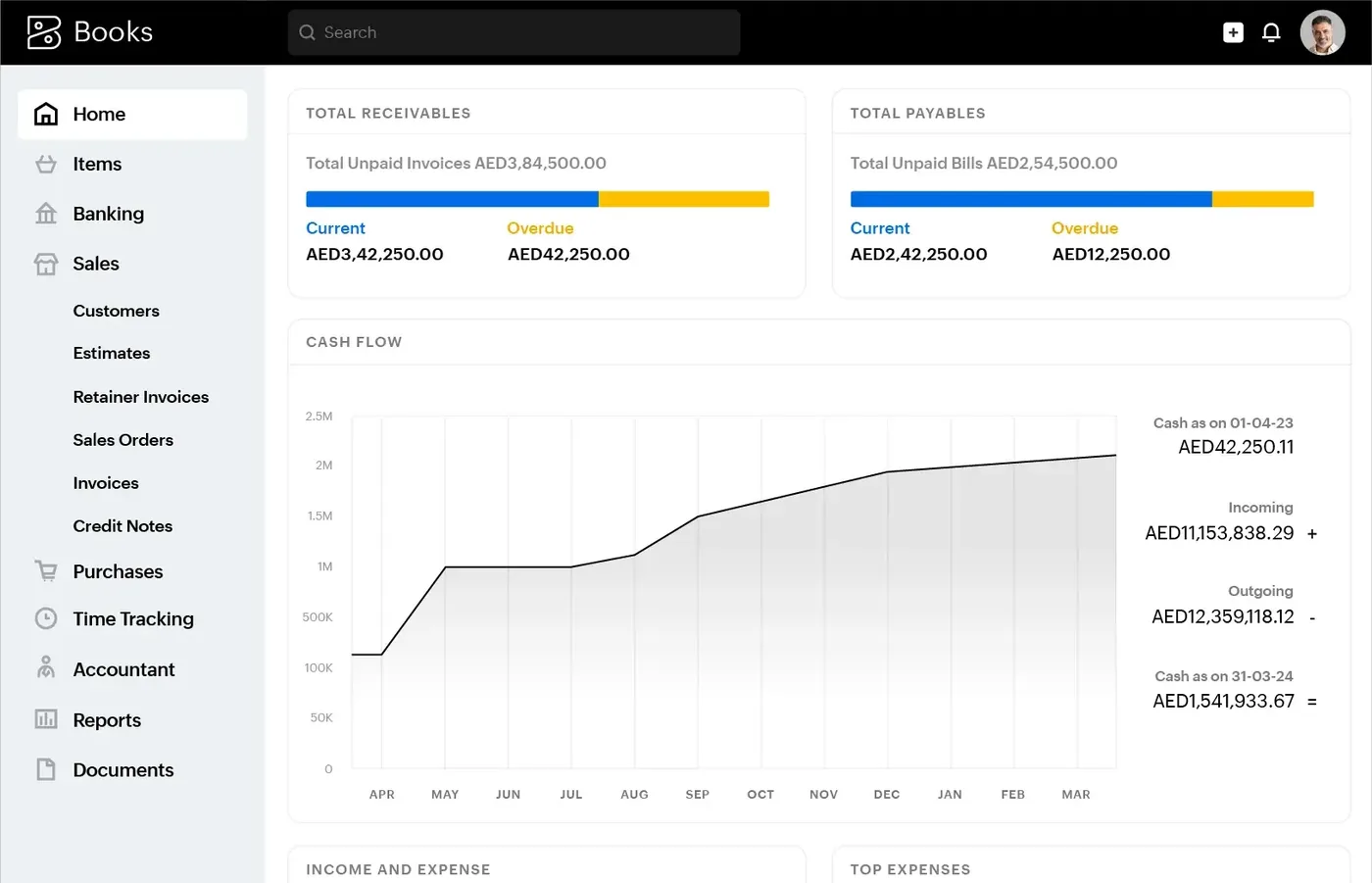
The Zoho Books dashboard in AED
Total receivables and payables split into current and overdue, and a twelve-month cash flow chart with incoming, outgoing and closing cash, all in UAE dirhams.
- Account and cost centre suggestions
- VAT treatment checks
- Reconciliation match proposals
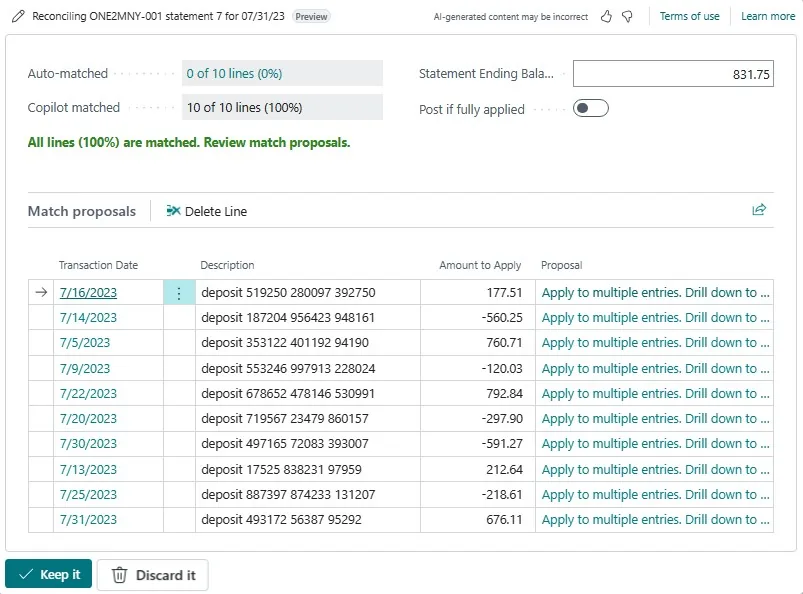
Bank reconciliation with Copilot in Business Central
Copilot proposing matches for a bank statement: ten of ten lines matched, each deposit with its date, amount and suggested entry, with keep or discard buttons.
- Accruals and prepayments
- Built around the VAT 201 return
- Ready for Corporate Tax
Which platform for AI accounting in the UAE?
An honest comparison. We implement all of these, so the recommendation follows your processes, team and budget.
| Option | Best when | How it fits this need |
|---|---|---|
| Zoho Books with Zia and a custom AI layer | Your ledgers already live in Zoho Books and volumes are moderate | Good for SMEs and mid-sized groups on Zoho. Built-in rules cover simple coding; the added AI layer handles supplier-specific patterns, intercompany pairing and variance notes that native rules do not. |
| Odoo Accounting with AI add-on | You also run Odoo inventory or sales in the same database | Strong when stock, purchasing and accounting share one database, because the AI can read goods receipts and landed costs when proposing accruals. Less attractive if accounting is the only Odoo module. |
| Business Central with Copilot plus extensions | You are a Microsoft 365 group with several legal entities | Suits multi-entity groups that want consolidation and Microsoft identity. Remember UAE localisation comes from a partner app, and Copilot features vary by release wave, so we check what is available before scoping. |
| Stay on rules and spreadsheets | Under a few hundred transactions a month, one entity | If bank rules and a clean chart of accounts already handle most coding, an AI layer adds cost without much saving. Tidy the rules first and revisit AI when volumes or entities grow. |
What changes in the UAE
The local rules and realities we design for before go-live. Rules change, so we re-check the current position at scoping.
Built around the VAT 201 return
Checks are grouped by the VAT 201 boxes, including reverse charge and designated zone treatment, so the quarterly return review is a short exception list rather than a full ledger scan.
Ready for Corporate Tax
With 9% Corporate Tax above AED 375,000 and returns due within 9 months of year end via EmaraTax, tagging adjustments monthly avoids a year-end scramble. We confirm treatments with your tax adviser.
E-invoicing data quality
From the pilot starting 1 July 2026, structured e-invoices through Accredited Service Providers need clean master data. Coding checks catch missing TRNs and wrong tax categories early. Check the Ministry of Finance for the latest dates.
What drives the cost, and what it connects to
No price list: we quote a fixed price in AED after discovery. These are the factors that move the effort up or down.
Number of entities
Each legal entity has its own chart of accounts, VAT registration and posting history, so suggestion models and checks are configured and tested per entity, which adds effort.
Intercompany complexity
Groups with frequent recharges, shared staff costs and management fees need matching logic between ledgers, and that logic takes longer to design and test than single-entity coding.
State of historical data
If past transactions were coded inconsistently, the model learns the inconsistency. Cleaning or relabelling a representative period before training is often the largest hidden task.
Close pack requirements
Drafting variance commentary for a board pack with fixed layouts and thresholds takes more design than a simple list of unusual movements for the finance manager.
What it connects to
Posted history flows out to train suggestions; proposed codes and draft journals flow back as unposted entries for review.
Bank lines flow in for match proposals against open invoices, bills and expected transfers, with the accountant confirming each match.
Card transactions and receipts flow in so the AI can propose account, cost centre and recoverable VAT per line.
Closed period figures flow in for variance analysis; draft commentary flows back into the month-end pack for editing.
Tagged Corporate Tax adjustments are exported as a schedule for your tax adviser; nothing is filed automatically from the system.
How we deliver AI accounting
Phases, indicative timing and what is delivered in each. Scope is fixed and priced in AED before we start.
Ledger health check
We review your chart of accounts, tax codes and historical coding quality, since the model learns from how you have posted before.
Clean and map
We fix inconsistent tax codes and merge duplicate accounts where needed, then define which suggestions the pilot will cover.
Pilot on one entity
Coding and reconciliation suggestions run on one company for one full month-end, alongside the normal process.
Review accuracy
We compare suggestions with final postings, set confidence thresholds and agree what can be accepted in bulk.
Extend and document
We add accruals, variance notes and further entities, with an audit trail and user guide for your auditors.
When AI accounting is the wrong answer
AI accounting is not a replacement for an accountant or an auditor, and it does not decide tax positions. If your ledger history is short or badly coded, suggestions will be weak for the first months. For very small volumes, good bank rules in Zoho Books or Odoo may be enough without AI.
How we handle it: We implement Zoho, Odoo and Dynamics 365 and build AI and custom software, so our written recommendation can point you to a simpler option, or to doing nothing yet.
Checklist and common mistakes
Buyer's checklist
What to ask for before you choose a provider.
- Ask whether suggestions are trained on your own posted history per entity, not a generic chart of accounts shared across clients.
- Require that no journal, bill or payment is posted by the AI; the accountant approves and posts every entry.
- Ask how the system handles designated-zone, reverse-charge and out-of-scope VAT treatments rather than defaulting everything to standard rated 5%.
- Request an accuracy report on a sample of your last closed month before go-live, reviewed by your own finance lead.
- Confirm where ledger data is processed, which model provider is used, and that your data is not used to train public models.
- Check who maintains prompts and rules after the chart of accounts, cost centres or entity structure changes.
Common mistakes
What we see go wrong in the UAE, and how to avoid it.
- Training on a messy chart of accountsTeams switch on AI suggestions before merging duplicate accounts and cost centres, so the model spreads the confusion. Rationalise the chart and mapping rules first, then train on a clean period.
- Ignoring designated-zone VAT treatmentFree zone groups let the AI default to standard rated VAT for movements that need different treatment. Give the model explicit tax-code rules per entity and review a sample of zone transactions each quarter.
- Measuring nothing before go-liveWithout a baseline of hours and error rates for the old process, nobody can judge whether the AI helps. Record how long the close takes and what auditors raise before starting.
- Letting confidence scores replace reviewAccepting high-confidence suggestions in bulk without spot checks lets a systematic error run for months. Keep sample reviews of accepted suggestions in every close, even when accuracy looks good.


A UAE team you can meet in person
That is our team at Zoholics Dubai 2026. We deliver AI projects from our Ras Al Khaimah office with remote delivery across all seven emirates, in English and Arabic, and we run workshops on site in Dubai, Abu Dhabi and Sharjah when a project needs it.
AI Accounting in the UAE: questions we get asked
What is AI accounting in the UAE and who is it for?
How is AI accounting different from AI finance automation?
Will the AI post journals without approval?
Can it handle Arabic supplier invoices?
Does AI accounting help with the UAE e-invoicing rollout?
What does it cost?
Can AI accounting handle intercompany transactions between a free zone entity and a mainland company?
Will our external auditors accept entries suggested by AI?
How long does it take before suggestions become reliable for our ledger?
Why choose Shyphan?

Talk to a consultant about AI accounting
A free 30-minute call, then a written recommendation and a fixed quote in AED, including the honest option that this is not the right fit.
