





















 Saudi Arabia
 UAE
UAE Qatar
Qatar Bahrain
 Kuwait
 Oman
Oman Lebanon
 Egypt
Egypt India
India UK
UK Ireland
 Germany
 USA
USA Australia
 Singapore
 South Africa
 Iraq
Iraq Jordan
 Hungary
 Georgia
 Turkey
 LagosNigeria




 BI and reporting · Dubai
Zoho Analytics Implementation in Dubai
Zoho Analytics implementation in Dubai gives management one set of numbers across the systems and companies they run: a DMCC trading entity, a mainland distributor, a few retail stores and an online shop. We connect the data sources, build a clean data model, and deliver dashboards for margin, cash, stock and sales that directors trust enough to use in meetings.
Prefer to talk? Call +971 55 145 3265
Book a free Zoho consultation
Tell us what you want to fix. A senior consultant replies within one working day with a written view.

The first AI Enabled Zoho Partner in the Middle East and Africa. Accredited by Zoho on 14 October 2026 after the Zoho AI Accelerator Series. Read the announcement
AI Enabled Zoho Partner in the UAETrusted by businesses across the UAE, Saudi Arabia and beyond












Zoho Analytics Implementation in Dubai: the short answer
- What it is
- A Zoho Analytics implementation is the setup of Zoho Analytics: data connections, data modelling, calculated metrics, dashboards, sharing permissions and scheduled reports.
- Best suited to
- Dubai groups and mid-size companies whose monthly reporting is built by hand in Excel from several systems or entities.
- Core stack
- Zoho Analytics, Zoho Books, Zoho CRM, Zoho Inventory, Zoho DataPrep, SQL databases
- Typical timeline
- Two to six weeks for a focused first phase such as one or two Zoho apps; a wider Zoho One rollout runs in further phases.
- What it costs
- Zoho bills its licences directly, per user or per organisation depending on the edition. Implementation is a fixed price in AED after a free 30-minute discovery call.
- Local specifics
- DMCC and mainland group structures; Corporate Tax and VAT visibility; Hospitality and retail volume.
- Delivered by
- Shyphan AI Solutions, Zoho Premium Partner and Zoho Top Partner MEA Q3 2026, from its Ras Al Khaimah office with remote delivery across all seven emirates.
- Last reviewed
- 29 September 2026
Zoho Analytics Implementation in Dubai: who it is for
Dubai groups and mid-size companies whose monthly reporting is built by hand in Excel from several systems or entities. A Zoho Analytics implementation is the setup of Zoho Analytics: data connections, data modelling, calculated metrics, dashboards, sharing permissions and scheduled reports.
- Free zone and mainland group view
- Qualifying income tracking for Corporate Tax
- Trading margin after FX and freight
- Store and mall performance
What we use to deliver Zoho Analytics implementation
Only what the first phase needs is switched on; more follows in later phases.




Zoho Analytics Implementation in Dubai: what is included
Zoho Analytics implementation in Dubai gives management one set of numbers across the systems and companies they run: a DMCC trading entity, a mainland distributor, a few retail stores and an online shop.
Free zone and mainland group view
Dubai groups often run a DMCC or JAFZA entity alongside a mainland company. We combine their ledgers with entity tags and intercompany eliminations defined by your finance team, so group revenue and margin are not double counted.
Qualifying income tracking for Corporate Tax
Free zone entities that may be Qualifying Free Zone Persons need to see qualifying and non-qualifying income separately. Tagged revenue analysis gives finance an ongoing view; your tax adviser decides the classification.
Trading margin after FX and freight
For Dubai traders buying in USD or CNY and selling in AED, dashboards show margin after landed cost and exchange differences by product, supplier and customer, rather than gross invoice margin.
Store and mall performance
Retailers with stores across Dubai malls get daily sales, average basket, stock cover and sell-through by store, combining POS exports with Zoho Inventory or ERP data. Store managers see only their own store.
Non-Zoho data sources
Zoho Analytics connects to SQL databases, spreadsheets, cloud storage and many business apps. Where a Dubai client runs Tally, a legacy ERP or a POS, we set up scheduled imports and document each source.
Role-based sharing
Directors see the group, entity managers see their company, and sales managers see their team, with row-level filters so one workspace serves everyone without leaking figures. Access changes are managed from one place.
A DMCC commodities group's month-end pack
How Zoho Analytics implementation in Dubai looks in practice. Illustrative; every project is scoped to the business.
Picture a coffee and spices trading group with a DMCC entity handling international trades, a mainland distribution company supplying Dubai cafes and hotels, and a roastery in Al Quoz. Each company keeps its own books, stock and CRM, and the group finance manager spends the first week of each month building a management pack in Excel for the directors' meeting.
- Connect each entity's Zoho Books, the roastery's inventory data and the CRM to Zoho Analytics, with a shared chart of accounts mapping and intercompany eliminations.
- Model landed cost per shipment, including freight, duty and exchange differences, so trading margin by origin and customer reflects actual cost rather than invoice price.
- Publish a group dashboard for directors and entity-level views for managers, refreshed daily, with the monthly pack generated automatically after the books close.
See it in Zoho Analytics
Real screens from the platforms we implement. Yours are configured to your entities, processes and KPIs.
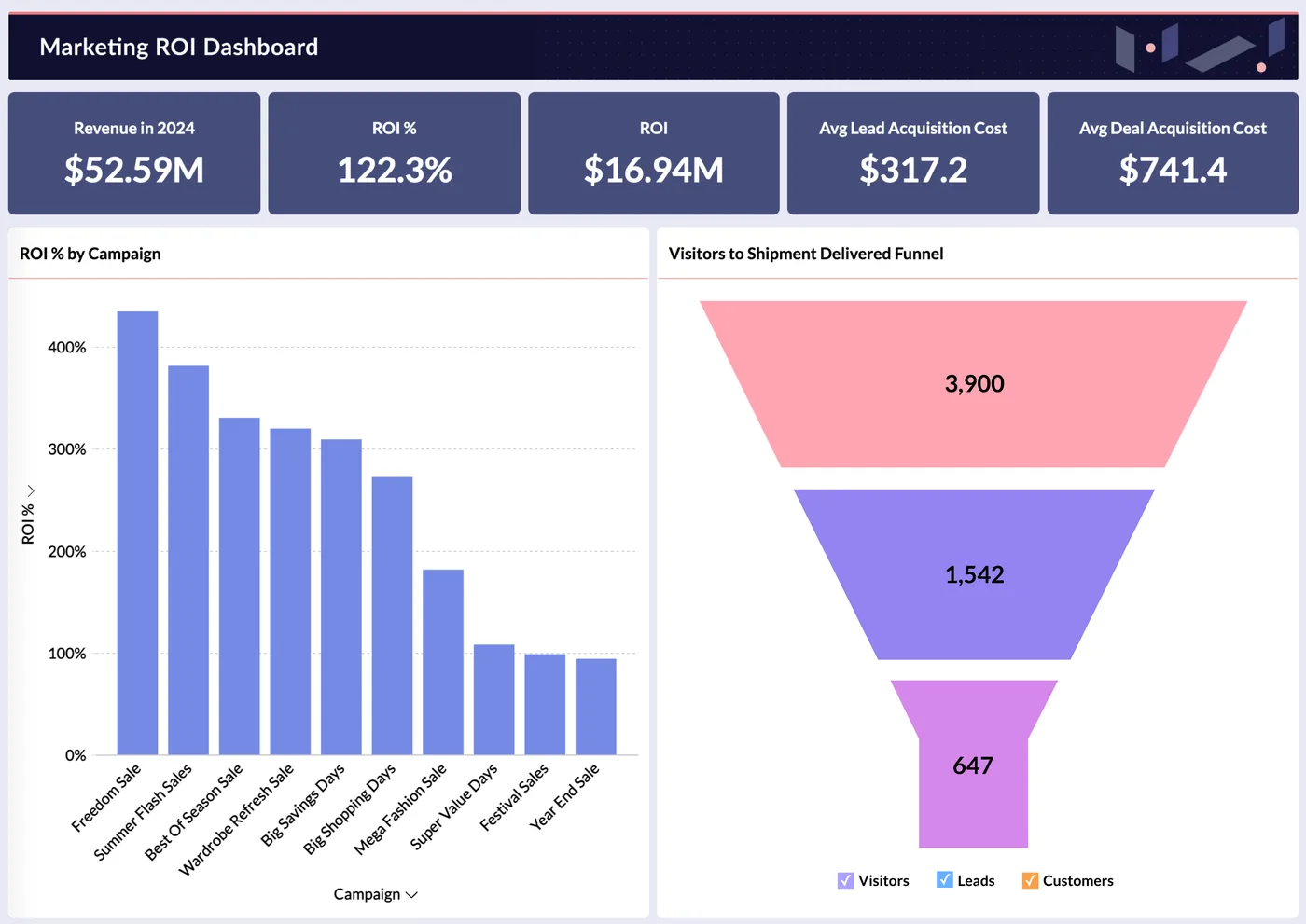
A marketing ROI dashboard in Zoho Analytics
Revenue, ROI and acquisition costs as headline tiles, ROI by campaign as a bar chart and a visitors-to-customers funnel.
- Free zone and mainland group view
- Qualifying income tracking for Corporate Tax
- Trading margin after FX and freight
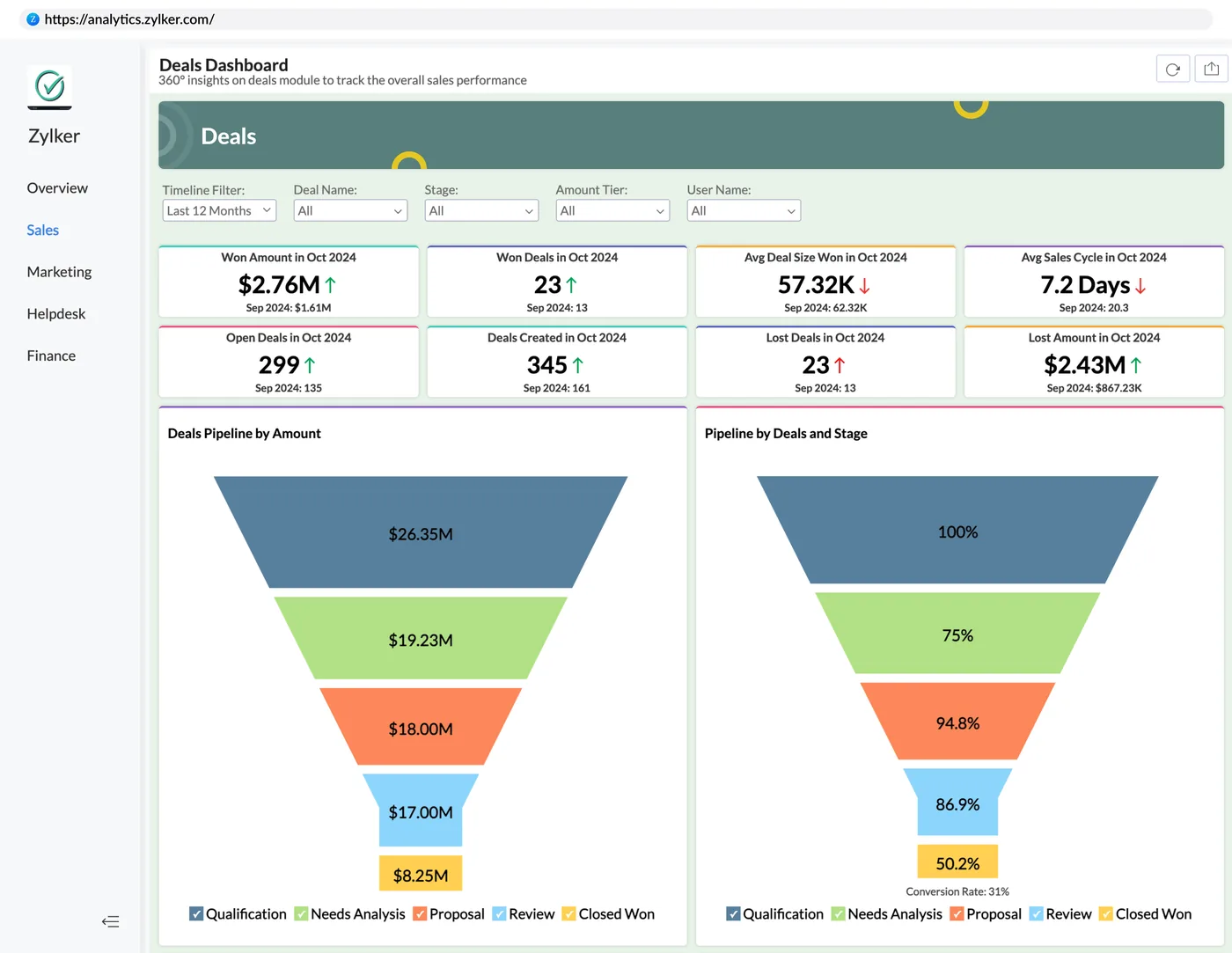
A deals dashboard in Zoho Analytics
Won, open and lost deal values and counts with month-on-month change, and funnels of the pipeline by amount and by stage conversion.
- Store and mall performance
- DMCC and mainland group structures
- Corporate Tax and VAT visibility
Which platform for Zoho Analytics implementation in Dubai?
An honest comparison. We implement all of these, so the recommendation follows your processes, team and budget.
| Option | Best when | How it fits this need |
|---|---|---|
| Zoho Analytics | Groups running Zoho Books, CRM and Inventory alongside other sources | The most direct option for Dubai groups on Zoho apps, with native connectors, data blending and role-based sharing. Large on-premise data volumes may need DataPrep or a staging database. |
| Power BI | Dynamics 365 or Business Central is the main system of record | Often the better choice for groups built on Microsoft finance and CRM, where Power BI connectors and skills are already in place. Zoho sources connect through APIs or exports. |
| Odoo Spreadsheet dashboards | All entities run on one Odoo database | Sensible when every company already sits in Odoo and needs operational dashboards. Less suited to combining several outside systems or consolidating entities on different platforms. |
| Keep the Excel pack | One entity and a monthly pack that already works | Honest option if one entity and a stable pack take a day to produce. Implementation pays off when several entities or systems make the pack slow and error-prone. |
What changes in Dubai
The local rules and realities we design for before go-live. Rules change, so we re-check the current position at scoping.
DMCC and mainland group structures
Many Dubai businesses split trading, holding and operating activities across free zone and mainland licences. Reporting by entity and in total is usually the first thing directors ask for, so we design for it from day one.
Corporate Tax and VAT visibility
With 9% Corporate Tax above AED 375,000 and 5% VAT, finance teams want tax-relevant figures visible monthly. Dashboards show VAT by period and taxable profit trends, while filings stay in your accounting system.
Hospitality and retail volume
Dubai hotels, restaurants and retailers generate high daily transaction volumes. We use aggregated tables and scheduled syncs so dashboards stay fast during busy seasons. Heavy calculations run overnight.
Working with businesses in Dubai: we support companies across JAFZA, DMCC, Dubai Silicon Oasis, Dubai Internet City, DIFC, Al Quoz and Dubai South, with remote delivery and on-site workshops where the project needs them.
What drives the cost, and what it connects to
No price list: we quote a fixed price in AED after discovery. These are the factors that move the effort up or down.
Entities and consolidation
One entity is quick to model. Several entities with different charts of accounts, currencies and intercompany transactions need mapping tables, elimination logic and reconciliation against audited figures.
Non-Zoho data sources
Zoho apps connect natively. On-premise SQL databases, legacy ERP exports, POS systems or cloud warehouses need connectors, scheduling and sometimes a staging layer.
Cost and margin logic
Simple revenue reporting is quick. Landed cost, FX differences, rebates and allocated overheads need agreed business rules with finance and careful testing against known figures.
Audiences and security
Directors, entity managers, sales and operations each need tailored views and permissions. More audiences mean more dashboards, security rules and user acceptance sessions.
What it connects to
Ledgers, invoices, bills and receivables sync daily from each company for consolidated and entity-level reporting.
Pipeline, customer and salesperson data blend with invoiced sales to show conversion and margin by account.
Legacy ERP or warehouse data imports on a schedule through Zoho Analytics connectors or a secure local agent.
Online orders and customer data sync so e-commerce sales appear alongside stores and trade channels.
Messy source data is cleaned and standardised before loading, keeping the analytics model consistent across entities.
How we deliver Zoho Analytics implementation
Phases, indicative timing and what is delivered in each. Scope is fixed and priced in AED before we start.
Question list
We collect the ten questions management asks every month and trace where each number comes from today.
Source setup
Data connections, sync schedules and data cleansing rules are set up for each system and entity.
Data model
Tables are joined, metrics defined in writing and figures reconciled to your management accounts. Differences are explained before dashboards are built.
Dashboards
Dashboards and scheduled reports are built and reviewed with each user group. Each group signs off that the numbers match their own records.
Handover
Your team is trained to edit reports, with a metric dictionary so definitions do not drift.
When Zoho Analytics implementation is the wrong answer
Zoho Analytics is not a data warehouse for very large data volumes or heavy data science. If you process millions of rows a day from many systems, a warehouse such as Azure Synapse or BigQuery with Power BI may fit better. If you only use Zoho Books, its built-in reports may be enough.
How we handle it: We implement Zoho, Odoo and Dynamics 365 and build AI and custom software, so our written recommendation can point you to a simpler option, or to doing nothing yet.
Checklist and common mistakes
Buyer's checklist
What to ask for before you choose a provider.
- Ask the implementer to rebuild one page of your current management pack first, so you can compare figures before wider rollout.
- Confirm how intercompany sales, loans and recharges between free zone and mainland entities will be eliminated in group views.
- Check the data model documentation you will receive, so another analyst can maintain it if staff change.
- Require row-level security so entity managers see only their own company while directors see the group.
- Ask how exchange rates are applied to USD, EUR and AED transactions for consistent reporting across entities.
- Confirm refresh schedules and what happens when a source connection fails, including who is notified.
Common mistakes
What we see go wrong in the UAE, and how to avoid it.
- Skipping the data model designBuilding dashboards directly on raw tables produces conflicting numbers. Agree a data model with finance first, then build every report on top of it.
- Not reconciling to the booksDirectors lose trust the first time a dashboard disagrees with the accounts. Reconcile key figures to closed months before launch and document any intentional differences.
- Forgetting intercompany eliminationsGroup revenue inflated by intercompany sales misleads directors. Tag intercompany customers and suppliers in each entity so eliminations happen automatically in group views.
- No owner after go-liveDashboards decay when sources and definitions change. Assign an internal owner and agree a support arrangement so the model is maintained as the business grows.


A UAE team you can meet in person
That is our team at Zoholics Dubai 2026. We deliver Zoho projects from our Ras Al Khaimah office with remote delivery across all seven emirates, in English and Arabic, and we run workshops on site in Dubai, Abu Dhabi and Sharjah when a project needs it.
Zoho Analytics Implementation in Dubai: questions we get asked
How long does a Zoho Analytics implementation in Dubai take?
Can Zoho Analytics report across our DMCC and mainland companies?
Can Zoho Analytics help track qualifying free zone income?
Does Zoho Analytics work with non-Zoho systems?
How does implementation differ from ongoing Zoho Analytics consulting?
Who owns the dashboards afterwards?
Can a Zoho Analytics implementation in Dubai replace our monthly management pack?
Can we report in AED when entities trade in USD and EUR?
What training do our analysts receive?
Why choose Shyphan?

Talk to a consultant about Zoho Analytics implementation
A free 30-minute call, then a written recommendation and a fixed quote in AED, including the honest option that this is not the right fit.
