





















 Saudi Arabia
 UAE
UAE Qatar
Qatar Bahrain
 Kuwait
 Oman
Oman Lebanon
 Egypt
Egypt India
India UK
UK Ireland
 Germany
 USA
USA Australia
 Singapore
 South Africa
 Iraq
Iraq Jordan
 Hungary
 Georgia
 Turkey
 LagosNigeria




 CRM integration · Dubai
CRM Integration in Dubai
CRM integration in Dubai often means connecting to systems outside the UAE or outside your control: property portal lead feeds, a parent company's ERP in Europe or Asia, marketplace and ecommerce stores, and regional marketing platforms. Shyphan builds and monitors these links for Zoho CRM, Odoo CRM and Dynamics 365 Sales, with clear ownership of each field and alerts when a feed stops.
Prefer to talk? Call +971 55 145 3265
Get a free recommendation
Tell us what you want to fix. A senior consultant replies within one working day with a written view.

The first AI Enabled Zoho Partner in the Middle East and Africa. Accredited by Zoho on 14 October 2026 after the Zoho AI Accelerator Series. Read the announcement
AI Enabled Zoho Partner in the UAETrusted by businesses across the UAE, Saudi Arabia and beyond












CRM Integration in Dubai: the short answer
- What it is
- CRM integration links the CRM to external lead sources, group systems and sales channels so data moves automatically and consistently.
- Best suited to
- Dubai brokerages, regional offices of international groups, ecommerce and D2C brands, and free zone companies whose finance runs on a parent company's system.
- Core stack
- Zoho CRM, Dynamics 365 Sales, Odoo CRM, Power Automate, Zoho Flow, Azure Logic Apps
- Typical timeline
- Four to sixteen weeks depending on the platform, modules, data migration and integrations; we phase larger programmes.
- What it costs
- A fixed price in AED after a free discovery call, phased so you are never committing to the whole programme on day one. Platform licences are billed by the vendor.
- Local specifics
- Group IT approvals take time; DIFC and cross-border data; Dubai free zone and mainland entities.
- Delivered by
- Shyphan AI Solutions: Zoho Premium Partner, Official Odoo Partner, independent Dynamics 365 consultancy and custom software house, so the platform is chosen by fit.
- Last reviewed
- 29 September 2026
CRM Integration in Dubai: who it is for
Dubai brokerages, regional offices of international groups, ecommerce and D2C brands, and free zone companies whose finance runs on a parent company's system. CRM integration links the CRM to external lead sources, group systems and sales channels so data moves automatically and consistently.
- Property portal lead feeds
- Parent company ERP abroad
- Ecommerce and marketplace orders
- Marketing platform attribution
What we use to deliver CRM integration
Tools and platforms we typically use, and the systems it connects to. The final choice is made against your systems, budget and team.





 Odoo
Odoo Business Central
 Microsoft 365
 WhatsApp
CRM Integration in Dubai: what is included
CRM integration in Dubai often means connecting to systems outside the UAE or outside your control: property portal lead feeds, a parent company's ERP in Europe or Asia, marketplace and ecommerce stores, and regional marketing platforms.
Property portal lead feeds
Listing portal enquiries arrive by email parsing, webhook or API depending on the portal, and are created as leads with listing reference, source and campaign. Duplicate checks stop the same buyer being assigned to three agents.
Parent company ERP abroad
Many Dubai regional offices sell locally but invoice through a group ERP such as SAP or Dynamics in another country. We sync customers, orders and invoice status between the Dubai CRM and the group system through agreed interfaces.
Ecommerce and marketplace orders
Online store orders and customers sync into the CRM so B2C and B2B history sits in one profile. Useful for Dubai brands selling online and through distributors at the same time.
Marketing platform attribution
Ad platforms and email tools send campaign data to the CRM and receive conversion events back, so Dubai marketing teams can see cost per qualified lead and revenue per campaign.
Viewing and meeting scheduling
Booking tools are linked to the CRM so a viewing, demo or consultation booked online creates an activity with the right agent, sends reminders to both sides and adds a follow-up task after the meeting ends.
Currency and entity mapping
When CRM and ERP use different entity or currency setups, we map legal entity, currency and tax treatment explicitly, including designated zone cases, so orders land in the right company books.
D2C brand selling across marketplaces
How CRM integration in Dubai looks in practice. Illustrative; every project is scoped to the business.
Picture a Dubai-based beauty and personal care brand selling through its own online store, two regional marketplaces and a WhatsApp catalogue. Customer data is spread across each platform, the European parent company's ERP holds stock and invoices, and marketing cannot tell which customers bought twice or which campaign brought them.
- Connect the online store and marketplace order feeds to Zoho CRM through Zoho Flow and APIs, matching customers by phone and email to avoid duplicate records.
- Build a nightly sync with the parent company's ERP abroad for stock availability and invoice status, agreed with group IT, logging every failed record.
- Pass ad and campaign identifiers from website forms and store checkouts into the CRM, so repeat purchase and campaign reports use one customer record.
See it on the platforms we deliver
Real screens from the platforms we implement. Yours are configured to your entities, processes and KPIs.
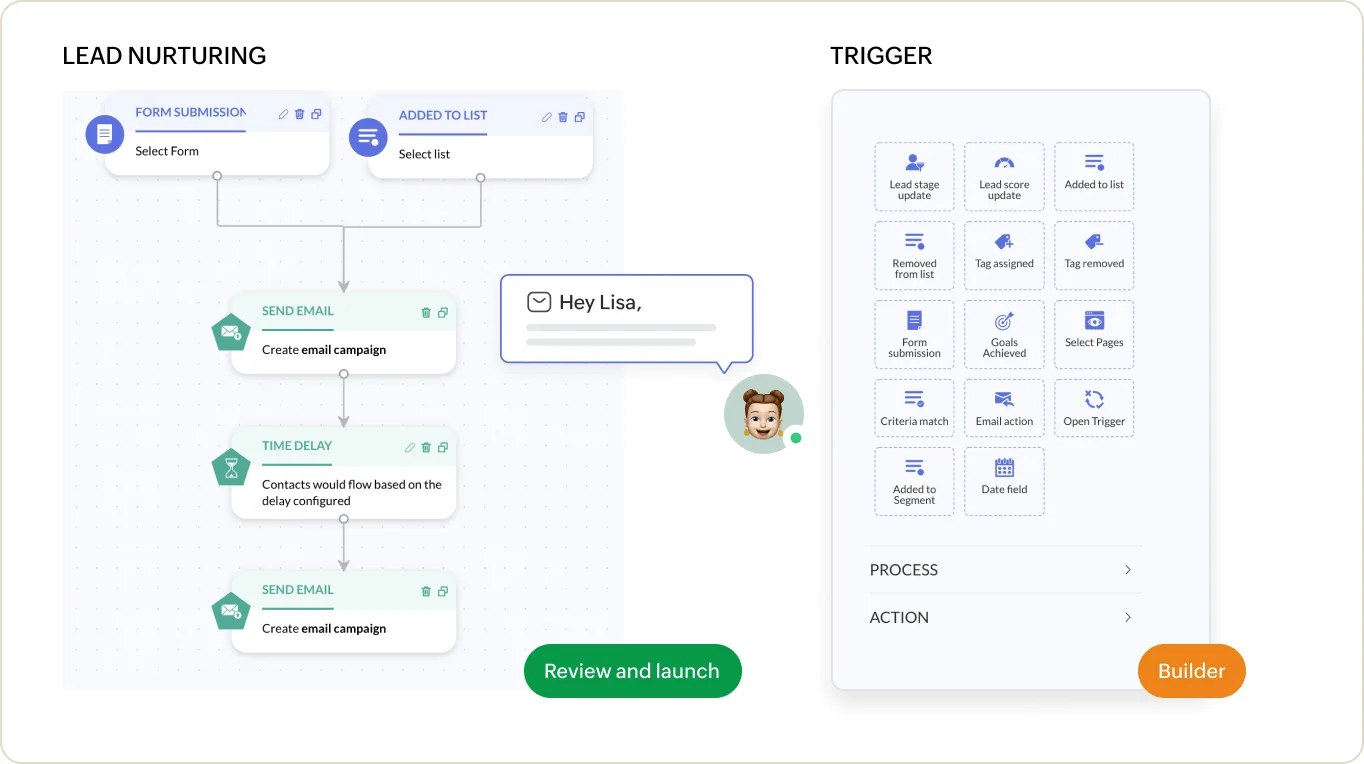
A lead nurturing journey in Zoho Marketing Automation
Form sign-ups flowing into timed email steps and triggers, built in a visual journey editor.
- Property portal lead feeds
- Parent company ERP abroad
- Ecommerce and marketplace orders
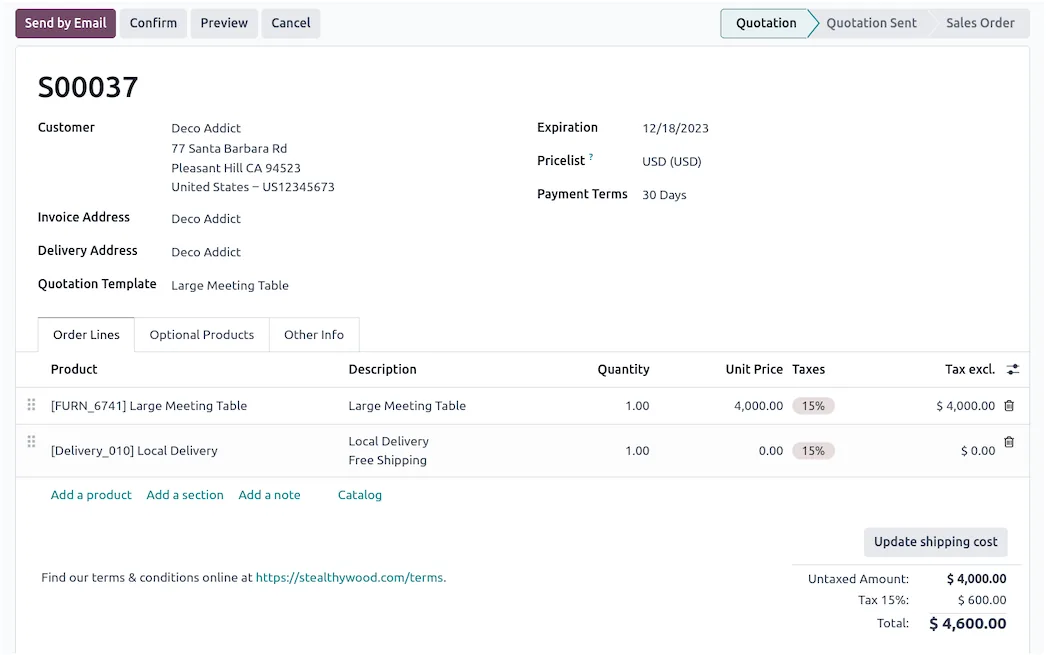
A sales quotation in Odoo Sales
A quotation with customer, expiry, pricelist and payment terms, order lines with 15% tax and totals, ready to send by email or confirm.
- Marketing platform attribution
- Group IT approvals take time
- DIFC and cross-border data
Which platform for CRM integration in Dubai?
An honest comparison. We implement all of these, so the recommendation follows your processes, team and budget.
| Option | Best when | How it fits this need |
|---|---|---|
| Zoho Flow | Zoho-centred stacks with common apps and moderate data volumes. | Quick to build and cheap to run for store, marketing and WhatsApp links. Complex transformations or high-volume ERP syncs may outgrow it and need custom code. |
| Power Automate or Azure Logic Apps | Dynamics 365 or group IT on Microsoft Azure. | Suits Dubai regional offices where group IT requires Microsoft tooling, audit and monitoring. Premium connectors and Azure usage add running costs to plan for. |
| Custom API integration | Parent company ERP abroad with strict formats and volume. | Best for high-volume or complex syncs with foreign ERPs. More build effort, but full control over mapping, retries and logging that group IT often demands. |
| Scheduled file exchange | Parent system has no API and daily updates are enough. | An honest fallback when head office systems cannot expose APIs. Less timely but reliable if files are validated and failures alert someone in Dubai. |
What changes in Dubai
The local rules and realities we design for before go-live. Rules change, so we re-check the current position at scoping.
Group IT approvals take time
Dubai regional offices often need approval from head-office IT abroad for API access. We prepare the security and data flow documents they ask for, so approvals do not stall the project.
DIFC and cross-border data
Moving customer data to a parent system outside the UAE raises data protection questions under the PDPL or, for DIFC firms, the DIFC data protection law. We flag transfers in the design; we confirm the current requirement at scoping.
Dubai free zone and mainland entities
A group may run a DMCC or JAFZA entity and a mainland company. Integrations route each order to the correct entity so VAT and Corporate Tax records stay clean.
Working with businesses in Dubai: we support companies across JAFZA, DMCC, Dubai Silicon Oasis, Dubai Internet City, DIFC, Al Quoz and Dubai South, with remote delivery and on-site workshops where the project needs them.
What drives the cost, and what it connects to
No price list: we quote a fixed price in AED after discovery. These are the factors that move the effort up or down.
Systems outside your control
Integrations with a parent company ERP abroad or third-party platforms depend on their API access, approvals and change schedules, which often extends timelines beyond local work.
Data mapping complexity
Different currencies, entities, product codes and customer identifiers between Dubai and head office systems require mapping tables and transformation logic that take time to agree.
Volume and timing
Real-time sync for high order volumes costs more to build and run than nightly batches. Choose timing based on what the business actually needs to see.
Monitoring and alerts
Logging, retries and alerting when feeds stop add build effort but prevent silent data loss, which matters most when leads come from paid portals and ads.
What it connects to
Portal enquiries flow into the CRM with listing references, assigned to agents by listing or area.
Stock, pricing and invoice status flow from head office systems; approved orders flow back where allowed.
Orders and customer details flow into the CRM, matched to existing contacts to track repeat buyers.
Lead form submissions and campaign identifiers flow into the CRM; conversions can be sent back for ad optimisation.
Viewings and meetings booked online create CRM activities and notify the assigned agent or salesperson.
How we deliver CRM integration
Phases, indicative timing and what is delivered in each. Scope is fixed and priced in AED before we start.
Feed and system audit
Every lead source and downstream system listed with owners, API access and current manual steps.
Field ownership map
Decide which system owns each field and how conflicts are resolved; agreed with IT and sales.
Connector build
Feeds, APIs and middleware built, including access arranged with group IT or portal providers where needed.
Live test
Real leads and orders processed through both old and new paths, and reconciled daily until they match.
Monitor and hand over
Alerts, dashboards showing feed health and a runbook handed over to your Dubai team for daily use.
When CRM integration is the wrong answer
If your portal or group ERP offers no API and head-office IT will not open one, a daily file exchange may be the realistic option; we will not promise live sync we cannot support. And if lead volume is low, forwarding portal emails into the CRM may be enough.
How we handle it: We implement Zoho, Odoo and Dynamics 365 and build AI and custom software, so our written recommendation can point you to a simpler option, or to doing nothing yet.
Checklist and common mistakes
Buyer's checklist
What to ask for before you choose a provider.
- Ask how the provider will get approval and access from group IT or the parent company abroad, and who leads those talks.
- Require field-level ownership rules stating which system is the master for each shared piece of data.
- Check what alerts are sent when a portal, store or ERP feed stops, and who receives them.
- Confirm how customer matching works across channels to prevent duplicates in the CRM.
- Ask where data will be processed and stored, especially for DIFC entities or cross-border transfers.
- Get documentation of each integration's flows, credentials handling and error handling handed over at the end.
Common mistakes
What we see go wrong in the UAE, and how to avoid it.
- Starting before group IT agreesBuilding integrations before head office approves access leads to rework. Get group IT to sign off scope, security and credentials before development starts.
- Two systems editing one fieldWhen both CRM and ERP can change the same field, data flips back and forth. Decide which system owns each field and make the other read-only.
- No alert when feeds stopPortal and ad feeds break silently when passwords or APIs change. Set alerts for failed runs and for unusually low lead counts.
- Ignoring cross-border data rulesSending customer data to systems abroad without checking PDPL or DIFC rules creates risk. Review data transfer requirements with your legal adviser early.


A UAE team you can meet in person
That is our team at Zoholics Dubai 2026. We deliver Zoho, Odoo, Dynamics 365 and custom projects from our Ras Al Khaimah office with remote delivery across all seven emirates, in English and Arabic, and we run workshops on site in Dubai, Abu Dhabi and Sharjah when a project needs it.
CRM Integration in Dubai: questions we get asked
Can you integrate property portal leads into our Dubai CRM?
How does CRM integration in Dubai differ from the UAE-wide service?
Can the CRM sync with our head office ERP outside the UAE?
Which middleware do you use for Dubai CRM integrations?
How do we know if a lead feed stops working?
What does CRM integration in Dubai cost?
Can a Dubai CRM integrate with marketplaces like Amazon or Noon?
How long does a CRM integration in Dubai take?
Can the CRM show head office stock to our Dubai sales team?
Why choose Shyphan?

Talk to a consultant about CRM integration
A free 30-minute call, then a written recommendation and a fixed quote in AED, including the honest option that this is not the right fit.
