





















 Saudi Arabia
 UAE
UAE Qatar
Qatar Bahrain
 Kuwait
 Oman
Oman Lebanon
 Egypt
Egypt India
India UK
UK Ireland
 Germany
 USA
USA Australia
 Singapore
 South Africa
 Iraq
Iraq Jordan
 Hungary
 Georgia
 Turkey
 LagosNigeria




 Odoo Inventory · Sharjah
Odoo Inventory and Warehouse Management in Sharjah
Odoo Inventory in Sharjah is for the warehouses that keep the Northern Emirates supplied: yards in the industrial areas, bonded stock in SAIF Zone and Hamriyah, and showrooms selling from both. Shyphan, an Official Odoo Partner, configures locations, routes, barcode picking and landed costs so stock figures match the shelf and every container is costed correctly.
Prefer to talk? Call +971 55 145 3265

Book a free Odoo consultation
Tell us what you want to fix. A senior consultant replies within one working day with a written view.
Trusted by businesses across the UAE, Saudi Arabia and beyond












Odoo Inventory and Warehouse Management in Sharjah: the short answer
- What it is
- Odoo Inventory is Odoo's stock and warehouse app, handling locations, receipts, picking, transfers, lots and serials, valuation and replenishment.
- Best suited to
- Sharjah importers, distributors and manufacturers running one or more warehouses, especially where free zone and mainland stock must be kept separate.
- Core stack
- Odoo Inventory, Odoo Barcode, Odoo Purchase, Odoo Accounting, Android scanners or phones
- Typical timeline
- Three to six weeks for a focused single-app rollout; eight to sixteen weeks for a multi-app deployment with data migration and integrations.
- What it costs
- Odoo bills its licence separately, per user. Implementation is quoted as a fixed price in AED after a free 30-minute discovery call, based on apps, data and integrations.
- Local specifics
- Hamriyah and Khalid port flows; Northern Emirates distribution; Customs and VAT records.
- Delivered by
- Shyphan AI Solutions, Official Odoo Partner and Zoho Premium Partner, from its Ras Al Khaimah office with remote delivery across all seven emirates.
- Last reviewed
- 29 September 2026
Odoo Inventory and Warehouse Management in Sharjah: who it is for
Sharjah importers, distributors and manufacturers running one or more warehouses, especially where free zone and mainland stock must be kept separate. Odoo Inventory is Odoo's stock and warehouse app, handling locations, receipts, picking, transfers, lots and serials, valuation and replenishment.
- Free zone to mainland transfers
- Landed cost per container
- Barcode picking in the yard
- Lots, serials and expiry
What we use to deliver Odoo Inventory and warehouse management
Only what the first phase needs is switched on; more follows in later phases.
 Odoo Inventory
 Odoo Purchase
 Odoo Accounting
Odoo Inventory and Warehouse Management in Sharjah: what is included
Odoo Inventory in Sharjah is for the warehouses that keep the Northern Emirates supplied: yards in the industrial areas, bonded stock in SAIF Zone and Hamriyah, and showrooms selling from both.
Free zone to mainland transfers
Stock held in a SAIF Zone or Hamriyah warehouse and a mainland warehouse sits in separate locations. Transfers between them generate the documents your clearing agent needs, and valuation follows each move so finance sees where value sits.
Landed cost per container
Freight, 5% customs duty, clearing and port charges are spread across the products in each container by weight, volume or value, so your margin reflects what goods actually cost to land in Sharjah.
Barcode picking in the yard
Pickers scan location and product on a rugged Android device or a phone. Wrong item or wrong quantity is flagged before the truck is loaded, which cuts returns from customers across Sharjah and Ajman.
Lots, serials and expiry
Food and chemical traders track lots with expiry; equipment dealers track serial numbers from receipt to sale and warranty. Removal strategies pick the oldest or earliest-expiring stock first. Recalls can be traced to the customers who received an affected lot within minutes.
Bin locations for large yards
Large warehouses in the industrial areas get zones, aisles and bins, with putaway rules so incoming pallets go to the right place without a supervisor directing every forklift. Cycle counts can then run bin by bin without stopping dispatch.
Replenishment rules
Minimum and maximum levels per product and warehouse create draft purchase orders or internal transfers automatically, so fast movers are reordered before the showroom runs out. Buyers review and confirm the drafts, so nothing is ordered without a person checking it first.
Food importer with cold and dry stores
How Odoo Inventory and warehouse management in Sharjah looks in practice. Illustrative; every project is scoped to the business.
Picture a Sharjah food importer with a warehouse in the industrial areas holding frozen, chilled and dry goods for supermarkets, restaurants and grocery shops in Sharjah, Ajman and Umm Al Quwain. Expiry dates are tracked on paper, chilled items occasionally expire unnoticed, and supermarket buyers reject deliveries with less shelf life than agreed.
- Set up separate frozen, chilled and dry zones with lot and expiry tracking, so every receipt records expiry dates and stock is put away into the correct temperature zone.
- Configure FEFO picking and a minimum remaining shelf life rule per supermarket customer, blocking allocation of lots that would breach their agreed shelf-life terms.
- Schedule a weekly near-expiry report by zone, so the sales team offers short-dated stock to restaurants or promotions before it becomes a write-off.
See it in Odoo
Real screens from the platforms we implement. Yours are configured to your entities, processes and KPIs.
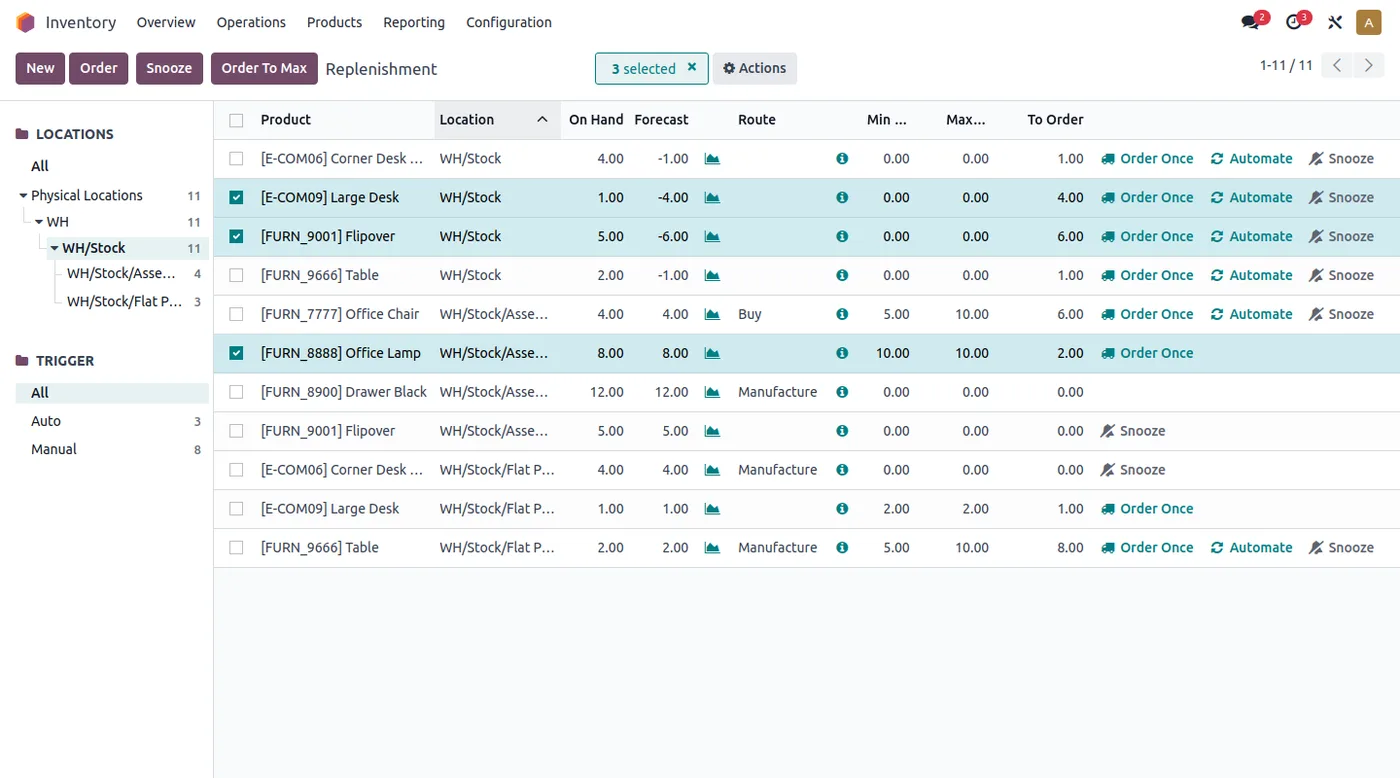
Replenishment in Odoo Inventory
Products below their minimum with the proposed route: buy, manufacture or transfer between warehouses.
- Free zone to mainland transfers
- Landed cost per container
- Barcode picking in the yard
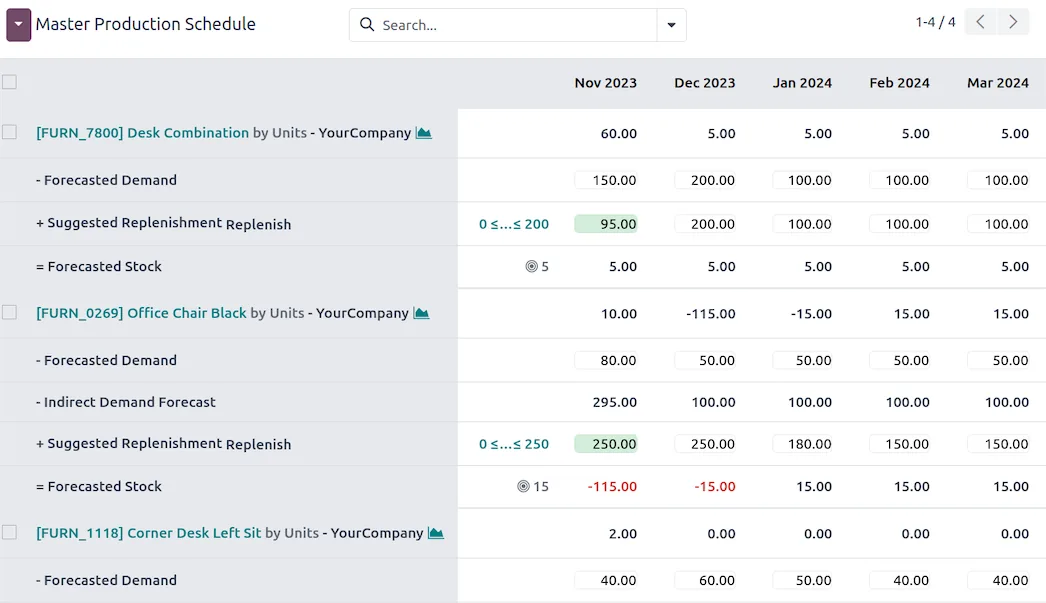
The master production schedule in Odoo
Forecasted demand, indirect demand, suggested replenishment and forecasted stock per product, month by month, for planning what to make or buy.
- Lots, serials and expiry
- Hamriyah and Khalid port flows
- Northern Emirates distribution
Which platform for Odoo Inventory and warehouse management in Sharjah?
An honest comparison. We implement all of these, so the recommendation follows your processes, team and budget.
| Option | Best when | How it fits this need |
|---|---|---|
| Odoo Inventory with lots and expiry | Expiry control, FEFO and customer rules matter together | Suits Sharjah food importers needing lot-level expiry tracking, FEFO picking and customer shelf-life rules, linked to sales, purchasing and accounting in a single Odoo database. |
| Zoho Inventory | Small range of food products on Zoho Books | Batch and expiry tracking are available for smaller Zoho-based food traders. Customer-specific shelf-life rules and zone-based put-away are more limited than in Odoo. |
| Dynamics 365 Business Central | Regional food group standardised on Microsoft | Suits larger groups needing Microsoft integration and Power BI. For a single Sharjah importer, partner-built localisation and licences add cost compared with Odoo. |
| Spreadsheet expiry tracking | Very small range with slow-moving products | Can work for a handful of items with long shelf life. With chilled goods and many customers, spreadsheet expiry tracking quickly leads to write-offs and rejected deliveries. |
What changes in Sharjah
The local rules and realities we design for before go-live. Rules change, so we re-check the current position at scoping.
Hamriyah and Khalid port flows
Many Sharjah importers receive containers through local ports and free zones. We configure receipt steps that separate arrival, inspection and putaway so partial or damaged deliveries are recorded properly.
Northern Emirates distribution
Sharjah warehouses often serve customers from Dubai to Fujairah. Delivery routes and dispatch waves can be grouped by area so drivers leave with a sensible load.
Customs and VAT records
Keeping free zone and mainland stock in separate locations with traceable movements supports correct VAT and customs records. We confirm the documentation your clearing agent and auditor need at scoping.
Working with businesses in Sharjah: we support companies across SAIF Zone, Hamriyah Free Zone and the Sharjah industrial areas, with remote delivery and on-site workshops where the project needs them.
What drives the cost, and what it connects to
No price list: we quote a fixed price in AED after discovery. These are the factors that move the effort up or down.
Temperature zones
Separate frozen, chilled and dry locations with put-away rules add warehouse design and testing, particularly where one warehouse mixes several temperature zones.
Expiry and shelf-life rules
Customer-specific shelf-life requirements and FEFO picking may need configuration or light customisation, depending on how many supermarket customers have their own rules.
Receiving process changes
Capturing lots and expiry dates at receipt adds steps for storekeepers. Training, labelling and scanner setup affect how smoothly this change lands.
Catch weight products
Meat, cheese or fish sold by actual weight need catch weight handling, which is not standard in Odoo and may require a module or process workaround.
What it connects to
Storekeepers scan GS1 barcodes to capture product, lot and expiry at receipt, reducing manual date entry.
Cold room temperature logs can be referenced or attached per zone, supporting food safety audits.
Orders from large retailers are imported as sales orders, and delivery confirmations return to their systems.
Actual weights of variable-weight items feed picking and invoicing where catch weight handling is configured.
Write-offs, stock valuation and landed costs on imported containers post automatically with approval records.
How we deliver Odoo Inventory and warehouse management
Phases, indicative timing and what is delivered in each. Scope is fixed and priced in AED before we start.
Warehouse walk-through
On-site or video walk-through of each Sharjah warehouse to map locations, flows and pain points.
Location and route design
Warehouses, bins, routes and removal strategies designed and signed off with the warehouse manager. One-step or multi-step receipts and deliveries are chosen per warehouse.
Configuration and devices
Odoo configured, barcode labels printed and scanners tested on real receipts and picks. Pickers test the devices on their own aisles before go-live.
Stock count and load
Full or cycle count loaded as opening stock, valued and reconciled with finance. Differences are investigated before the opening value is posted.
Go-live on the floor
Consultant support during the first week of live receipts and dispatches. We stay close to the dock for the first busy days.
When Odoo Inventory and warehouse management is the wrong answer
Odoo Inventory is not a full warehouse control system for high-bay automated warehouses with conveyor or robot integration; those need a specialist WMS. For a very small stockroom with a few hundred SKUs and no lots, Odoo may be heavier than needed and a simpler stock module will do.
How we handle it: We implement Zoho, Odoo and Dynamics 365 and build AI and custom software, so our written recommendation can point you to a simpler option, or to doing nothing yet.
Checklist and common mistakes
Buyer's checklist
What to ask for before you choose a provider.
- Ask how expiry dates are captured at receipt and whether scanners can read them from supplier labels.
- Check how FEFO picking works and whether minimum shelf-life rules can be set per customer.
- Confirm how temperature zones are modelled as locations and how put-away rules direct stock to them.
- Require near-expiry reports and alerts by zone, category and customer to guide sales action.
- Ask how Dubai Municipality or Sharjah Municipality food documentation will be stored against lots if required.
- Agree how write-offs and destruction of expired stock are approved and recorded for accounting.
Common mistakes
What we see go wrong in the UAE, and how to avoid it.
- Tracking expiry only on paperPaper expiry logs are not checked at picking. Record expiry in Odoo at receipt so FEFO and customer shelf-life rules work automatically at picking.
- Ignoring customer shelf-life termsSupermarkets reject deliveries below their minimum shelf life, and returns cost transport and goodwill. Configure rules per customer so pickers never allocate unacceptable lots.
- Mixing temperature zones in one locationA single location for all stock hides where chilled goods sit. Model each temperature zone separately so put-away and counts are accurate.
- Not acting on near-expiry reportsReports only help if someone acts. Assign near-expiry stock review to a named sales person each week and track the discounts or promotions used.


A UAE team you can meet in person
That is our team at Zoholics Dubai 2026. We deliver Odoo projects from our Ras Al Khaimah office with remote delivery across all seven emirates, in English and Arabic, and we run workshops on site in Dubai, Abu Dhabi and Sharjah when a project needs it.
Odoo Inventory and Warehouse Management in Sharjah: questions we get asked
Can Odoo Inventory in Sharjah separate free zone and mainland stock?
What does an Odoo Inventory Sharjah project cost?
Do we need special scanners?
How is Odoo Inventory different from Odoo Purchase for a Sharjah importer?
How long does Odoo Inventory take for a Sharjah warehouse?
What does it cost?
Can Odoo Inventory in Sharjah enforce minimum shelf life for each supermarket customer?
Can Odoo read expiry dates from GS1 barcodes on supplier cartons?
Can we see write-off costs by product and reason in Odoo?
Why choose Shyphan?

Talk to a consultant about Odoo Inventory and warehouse management
A free 30-minute call, then a written recommendation and a fixed quote in AED, including the honest option that this is not the right fit.
