





















 Saudi Arabia
 UAE
UAE Qatar
Qatar Bahrain
 Kuwait
 Oman
Oman Lebanon
 Egypt
Egypt India
India UK
UK Ireland
 Germany
 USA
USA Australia
 Singapore
 South Africa
 Iraq
Iraq Jordan
 Hungary
 Georgia
 Turkey
 LagosNigeria




 Forecasting and prediction · UAE
AI Predictive Analytics in the UAE
AI predictive analytics in the UAE builds forecasting and prediction models on your own ERP, CRM and sales data: demand by item and branch, cash flow, customer churn, late payment risk and equipment failure. Shyphan tests each model on past data you can see before anyone uses it, and puts predictions into the screens where decisions are made.
Prefer to talk? Call +971 55 145 3265
Book a free AI consultation
Tell us what you want to fix. A senior consultant replies within one working day with a written view.

The first AI Enabled Zoho Partner in the Middle East and Africa. Accredited by Zoho on 14 October 2026 after the Zoho AI Accelerator Series. Read the announcement
AI Enabled Zoho Partner in 21 countriesTrusted by businesses across the UAE, Saudi Arabia and beyond












AI Predictive Analytics in the UAE: the short answer
- What it is
- Statistical and machine learning models trained on your historical data that estimate future values or the likelihood of events, with their accuracy measured.
- Best suited to
- UAE distributors, retailers, F&B groups, FMCG suppliers and service firms with at least two years of clean transaction history and a specific decision to improve.
- Core stack
- Python, Azure Machine Learning, Power BI, Zoho Analytics, Odoo, Microsoft Fabric
- Typical timeline
- A measured pilot on one workflow in four to six weeks, then a phased rollout once accuracy is proven.
- What it costs
- We quote a fixed price in AED after a discovery session, broken into phases so you are never committing to the whole build on day one. Model usage is billed at cost.
- Local specifics
- Ramadan and Eid move each year; Tourist and event seasons; Population movement.
- Delivered by
- Shyphan AI Solutions, which builds AI agents, document AI and Arabic and English assistants on top of Zoho, Odoo and Dynamics 365.
- Last reviewed
- 29 September 2026
AI Predictive Analytics in the UAE: who it is for
UAE distributors, retailers, F&B groups, FMCG suppliers and service firms with at least two years of clean transaction history and a specific decision to improve. Statistical and machine learning models trained on your historical data that estimate future values or the likelihood of events, with their accuracy measured.
- Demand forecasting by item
- Cash flow projection
- Churn and reorder prediction
- Late payment risk
What we use to deliver AI predictive analytics
Tools and platforms we typically use, and the systems it connects to. The final choice is made against your systems, budget and team.





 Odoo
Odoo Business Central
 Microsoft 365
 WhatsApp
AI Predictive Analytics in the UAE: what is included
AI predictive analytics in the UAE builds forecasting and prediction models on your own ERP, CRM and sales data: demand by item and branch, cash flow, customer churn, late payment risk and equipment failure.
Demand forecasting by item
Forecasts per item, branch and week from sales history, promotions and seasonality, fed into Odoo or Zoho Inventory reorder levels. Slow and intermittent items get methods suited to sparse data rather than one model for all.
Cash flow projection
Receipts are projected from each customer's actual payment behaviour rather than invoice due dates, and payments from bills and payroll, giving finance a weekly cash view with a range, not one number.
Churn and reorder prediction
For B2B distributors and subscription businesses, the model flags customers whose ordering frequency or basket size is slipping, so sales can call and find out why before the account is quietly lost to a competitor.
Late payment risk
Each open invoice gets a probability of paying late, based on the customer's payment history, invoice amount and terms. Collections teams work the riskiest invoices first instead of simply the oldest ones.
Backtesting you can see
Every model is tested on past periods it did not train on, and the error is reported in plain terms. If a simple baseline performs as well, we tell you and use the baseline.
Monitoring and retraining
Accuracy is tracked each month against what actually happened. When patterns shift, for example a new branch, product range or major customer, the model is retrained or flagged for review with the business owner.
FMCG distributor forecasting through Ramadan
How AI predictive analytics in the UAE looks in practice. Illustrative; every project is scoped to the business.
Picture a food and beverage distributor supplying supermarkets and groceries across the UAE from a warehouse in Sharjah. Buyers order stock based on last year's figures and gut feel, so dates, juices and rice run short before Ramadan while slow-moving lines tie up cash after Eid. The company has several years of invoice data in Odoo.
- Clean and prepare several years of Odoo sales and stock data by item, customer channel and emirate, marking Ramadan, Eid, school holidays and promotion periods each year.
- Build item-level demand forecasts with Azure Machine Learning that shift with the moving Islamic calendar, and backtest them against past seasons alongside the buyers' own estimates.
- Publish forecasts and suggested order quantities in a Power BI report and back into Odoo purchase planning, with buyers able to adjust and record reasons.
See it on the platforms we deliver
Real screens from the platforms we implement. Yours are configured to your entities, processes and KPIs.
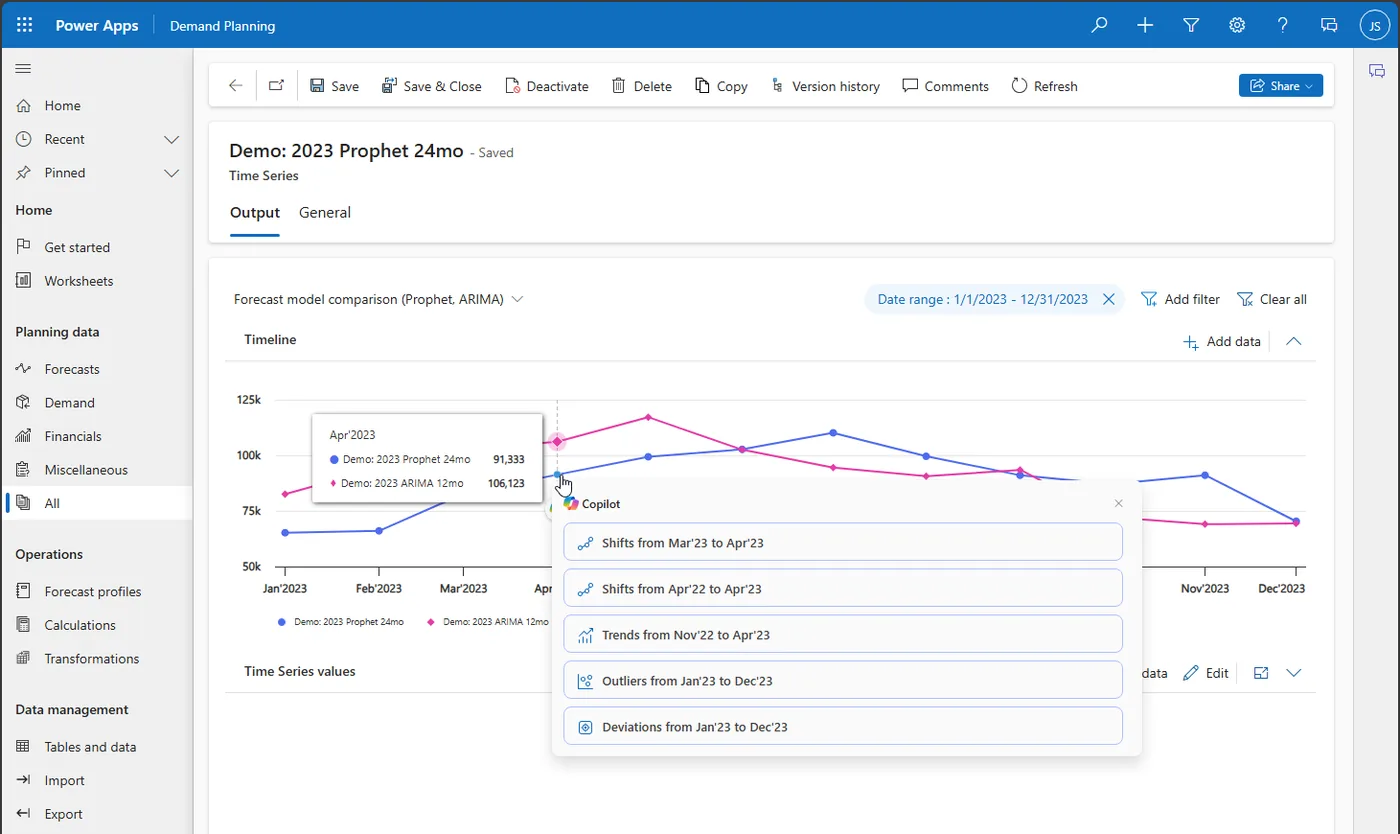
Demand planning with Copilot in Supply Chain Management
A forecast comparison of two models over a year, with Copilot offering to explain shifts, trends, outliers and deviations in the time series.
- Demand forecasting by item
- Cash flow projection
- Churn and reorder prediction
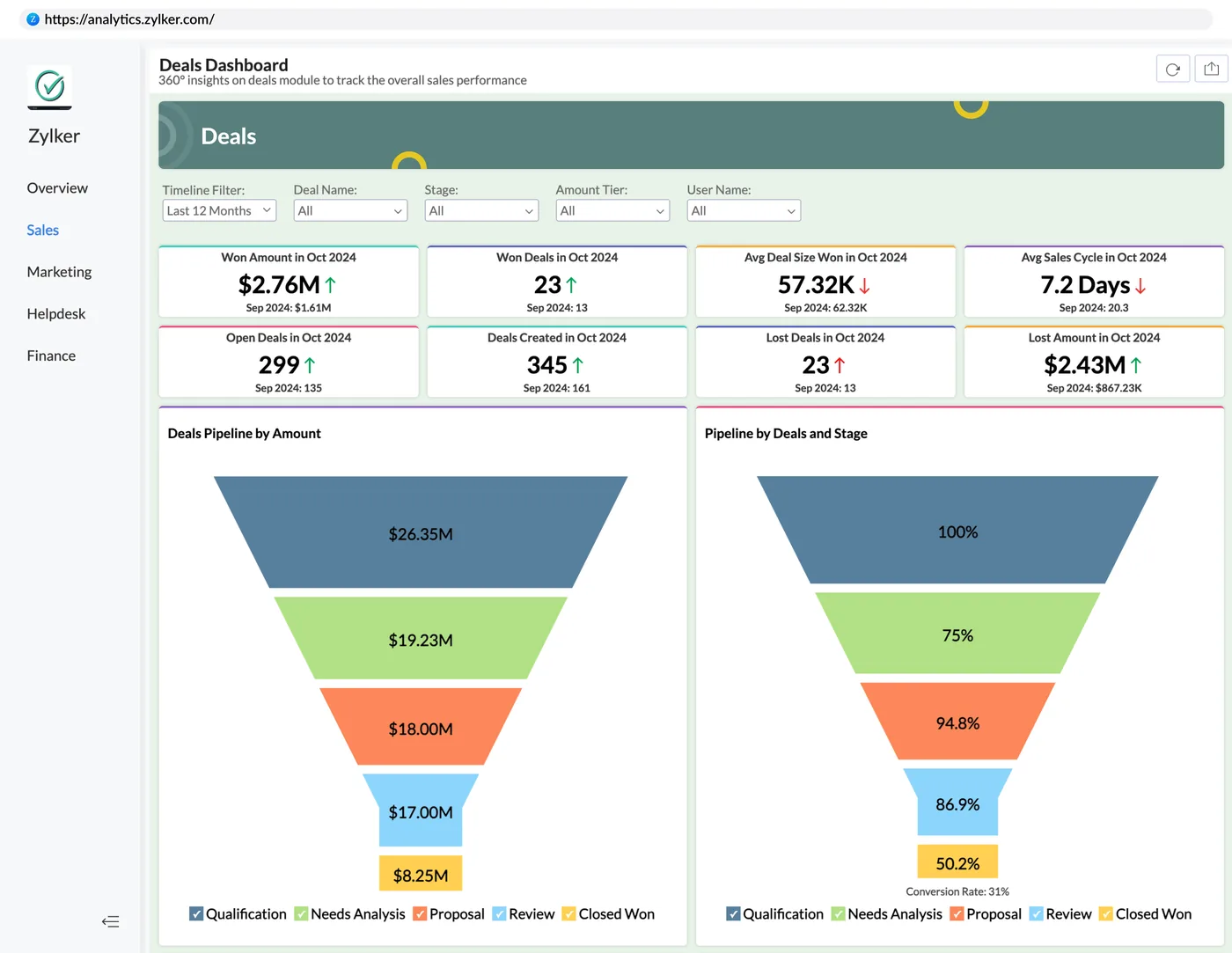
A deals dashboard in Zoho Analytics
Won, open and lost deal values and counts with month-on-month change, and funnels of the pipeline by amount and by stage conversion.
- Late payment risk
- Ramadan and Eid move each year
- Tourist and event seasons
Which platform for AI predictive analytics in the UAE?
An honest comparison. We implement all of these, so the recommendation follows your processes, team and budget.
| Option | Best when | How it fits this need |
|---|---|---|
| Custom models in Azure Machine Learning | Specific decisions with enough clean history and seasonal complexity | Suits distributors and retailers whose demand shifts with Ramadan, Eid and tourist seasons. Gives full control over features, backtesting and retraining, with results shown in Power BI or your ERP. |
| Built-in forecasting in Zoho Analytics or Power BI | Simple trends on a few key numbers | Built-in forecasting works for high-level trends such as monthly revenue. It struggles with thousands of items and moving holiday effects, but is quick and cheap to try. |
| Odoo or Business Central planning features | Reorder rules based on stable demand | Standard reorder points and replenishment reports cover steady items well. Predictive models add value for seasonal or promotional items where fixed rules keep failing. |
| Better reporting before prediction | Data is inconsistent or less than two years deep | If sales data is incomplete or item codes changed often, predictive models will mislead. Clean reporting and data discipline for a year may be the right first step. |
What changes in the UAE
The local rules and realities we design for before go-live. Rules change, so we re-check the current position at scoping.
Ramadan and Eid move each year
Ramadan and Eid follow the lunar calendar and shift about eleven days a year, so demand patterns cannot be read from the Gregorian date. Models use the actual holiday dates for each year.
Tourist and event seasons
Retail and F&B demand in the UAE rises with the winter season, school holidays, shopping festivals and major events. These are added as model inputs where your data shows the effect.
Population movement
Summer departures of residents and expatriate turnover change demand by area of each city. Branch-level models pick this up better than a single national forecast built from total UAE sales.
What drives the cost, and what it connects to
No price list: we quote a fixed price in AED after discovery. These are the factors that move the effort up or down.
Data preparation effort
Merging item codes that changed, fixing returns and missing periods, and labelling promotions often takes more time than building the model itself, especially across several systems.
Number of items and locations
Forecasting a few hundred key items for one warehouse is simpler than thousands of items by customer channel and emirate, which needs more modelling and monitoring.
Seasonal and event effects
Moving Islamic holidays, school terms, tourist seasons and major events each need to be modelled and tested, adding feature engineering compared with steady demand.
Operational integration
Writing forecasts back into ERP purchase planning and setting up automated retraining adds work beyond a one-off analysis delivered as a report.
What it connects to
Sales, stock and purchase history flow out for modelling; approved forecasts and suggested quantities flow back to planning.
Holds cleaned history and features from several systems so models train on one consistent dataset.
Shows forecasts, ranges, backtest accuracy and planner overrides by item, channel and emirate.
For Zoho-based businesses, forecasts and accuracy tracking appear alongside existing sales and inventory reports.
Planned promotions and price changes are fed in so forecasts account for expected uplifts rather than treating them as surprises.
How we deliver AI predictive analytics
Phases, indicative timing and what is delivered in each. Scope is fixed and priced in AED before we start.
Decision and data check
Pick the decision to improve and check whether your history is long and clean enough.
Data preparation
Extract from ERP and CRM, fix gaps, and add calendar events such as Ramadan and Eid.
Model and backtest
Build candidate models, compare them with a simple baseline on past periods, and review the results with the users.
Deploy to screens
Write predictions back to your ERP or CRM and into Power BI or Zoho Analytics dashboards where people decide.
Monitor
Monthly accuracy reporting, retraining when needed and a model review with the business owner who uses it.
When AI predictive analytics is the wrong answer
Predictive models need history. With under two years of consistent data, frequent product changes or messy ERP records, forecasts will not beat an experienced planner, and we will say so. If you mainly need to see what happened, start with dashboards on our AI analytics page before predictions.
How we handle it: We implement Zoho, Odoo and Dynamics 365 and build AI and custom software, so our written recommendation can point you to a simpler option, or to doing nothing yet.
Checklist and common mistakes
Buyer's checklist
What to ask for before you choose a provider.
- Ask the provider to backtest on past periods you choose, including a Ramadan season, and compare against your current method.
- Require forecasts to show uncertainty ranges so planners understand where predictions are less reliable.
- Confirm how moving holidays such as Ramadan and Eid are represented, rather than fixed calendar months.
- Check how often models will be retrained and who monitors accuracy once they are in production.
- Ask where predictions will appear in daily work, such as ERP purchase screens, not only in a separate dashboard.
- Make sure planners can override forecasts and record why, so overrides improve future models.
Common mistakes
What we see go wrong in the UAE, and how to avoid it.
- Using Gregorian months for seasonalityRamadan moves roughly eleven days earlier each year, so monthly averages blur its effect. Model holiday periods directly to capture how demand really shifts each year.
- No baseline to beatWithout comparing to current planner estimates, nobody knows whether the model helps. Always backtest against your existing method and share the comparison openly.
- Dashboards nobody acts onForecasts left in a separate report are ignored during busy weeks. Put predictions where planners already work, such as purchase screens and order proposals.
- Forgetting population and tourist swingsUAE demand changes when residents travel in summer and tourists arrive in winter. Include these patterns, or forecasts will be consistently wrong in the same months.


A UAE team you can meet in person
That is our team at Zoholics Dubai 2026. We deliver AI projects from our Ras Al Khaimah office with remote delivery across all seven emirates, in English and Arabic, and we run workshops on site in Dubai, Abu Dhabi and Sharjah when a project needs it.
AI Predictive Analytics in the UAE: questions we get asked
How is AI predictive analytics different from your AI analytics solutions page?
How much data does AI predictive analytics in the UAE need?
How accurate will the forecasts be?
Do we need a data warehouse first?
Where do the predictions appear?
What does it cost?
Can AI predictive analytics in the UAE forecast demand around Ramadan accurately?
What decisions besides stock ordering can predictive analytics support?
Do we need a data scientist on staff to use AI predictive analytics?
Why choose Shyphan?

Talk to a consultant about AI predictive analytics
A free 30-minute call, then a written recommendation and a fixed quote in AED, including the honest option that this is not the right fit.
