





















 Saudi Arabia
 UAE
UAE Qatar
Qatar Bahrain
 Kuwait
 Oman
Oman Lebanon
 Egypt
Egypt India
India UK
UK Ireland
 Germany
 USA
USA Australia
 Singapore
 South Africa
 Iraq
Iraq Jordan
 Hungary
 Georgia
 Turkey
 LagosNigeria



 Warehouse automation · UAE
Warehouse Automation in the UAE
Warehouse automation in the UAE, focused on the software layer: automatic replenishment and allocation, labels that print themselves, scales and dimensioners feeding the system, and integrations with conveyors, sorters or robots you already run. We build it on Odoo, Zoho Inventory, Business Central or a custom service, so fewer decisions depend on a supervisor with a spreadsheet.
Prefer to talk? Call +971 55 145 3265
Get a free recommendation
Tell us what you want to fix. A senior consultant replies within one working day with a written view.
Trusted by businesses across the UAE, Saudi Arabia and beyond












Warehouse Automation in the UAE: the short answer
- What it is
- Warehouse automation replaces manual decisions and data entry on the floor with rules, device integrations and system-triggered tasks.
- Best suited to
- UAE warehouses where supervisors spend hours planning replenishment, typing weights or labels, or re-keying data between the WMS, ERP and carriers.
- Core stack
- Odoo Inventory, Zoho Flow, Power Automate, Python/Node integration services, Zebra printers and scanners
- Typical timeline
- Four to sixteen weeks depending on the platform, modules, data migration and integrations; we phase larger programmes.
- What it costs
- A fixed price in AED after a free discovery call, phased so you are never committing to the whole programme on day one. Platform licences are billed by the vendor.
- Local specifics
- Heat and staffing reality; Re-export paperwork; WhatsApp alerts done properly.
- Delivered by
- Shyphan AI Solutions: Zoho Premium Partner, Official Odoo Partner, independent Dynamics 365 consultancy and custom software house, so the platform is chosen by fit.
- Last reviewed
- 29 September 2026
Warehouse Automation in the UAE: who it is for
UAE warehouses where supervisors spend hours planning replenishment, typing weights or labels, or re-keying data between the WMS, ERP and carriers. Warehouse automation replaces manual decisions and data entry on the floor with rules, device integrations and system-triggered tasks.
- Automatic replenishment
- Rule-based order allocation
- Scales and dimensioners
- Conveyor, sorter and AMR hooks
What we use to deliver warehouse automation
Tools and platforms we typically use, and the systems it connects to. The final choice is made against your systems, budget and team.





 Odoo
Odoo Business Central
 Microsoft 365
 WhatsApp
Warehouse Automation in the UAE: what is included
Warehouse automation in the UAE, focused on the software layer: automatic replenishment and allocation, labels that print themselves, scales and dimensioners feeding the system, and integrations with conveyors, sorters or robots you already run.
Automatic replenishment
Pick faces refill from reserve when they drop below a minimum, and purchase or transfer suggestions are raised from reorder rules and lead times, so the morning replenishment list builds itself instead of being walked and written up.
Rule-based order allocation
Orders are allocated to a warehouse, zone or wave by rules on region, carrier, cut-off and stock position. Exceptions such as partial stock or credit hold go to a queue rather than stopping the whole release.
Scales and dimensioners
Pack stations read weight and dimensions straight from connected scales or cubing devices, check them against expected values, and pass them to the carrier API, removing a common source of courier surcharges.
Conveyor, sorter and AMR hooks
If you run conveyors, sorters or autonomous mobile robots, we connect them through the vendor's API or middleware so tasks and confirmations flow between machine and WMS. We integrate equipment; we do not sell or install it.
Document AI for paperwork
Supplier packing lists, commercial invoices and delivery notes arriving by email are read by document AI, matched to purchase orders and pre-filled into receipts, with a person approving anything that does not match.
Event alerts and escalations
Stock-outs on fast movers, stuck waves, expired lots, failed courier bookings and late inbound containers raise alerts by email, Teams or WhatsApp templates to the person who can act. Each alert has an owner.
The platforms we deliver it on
Real screens from the platforms we implement. Yours are configured to your entities, processes and KPIs.
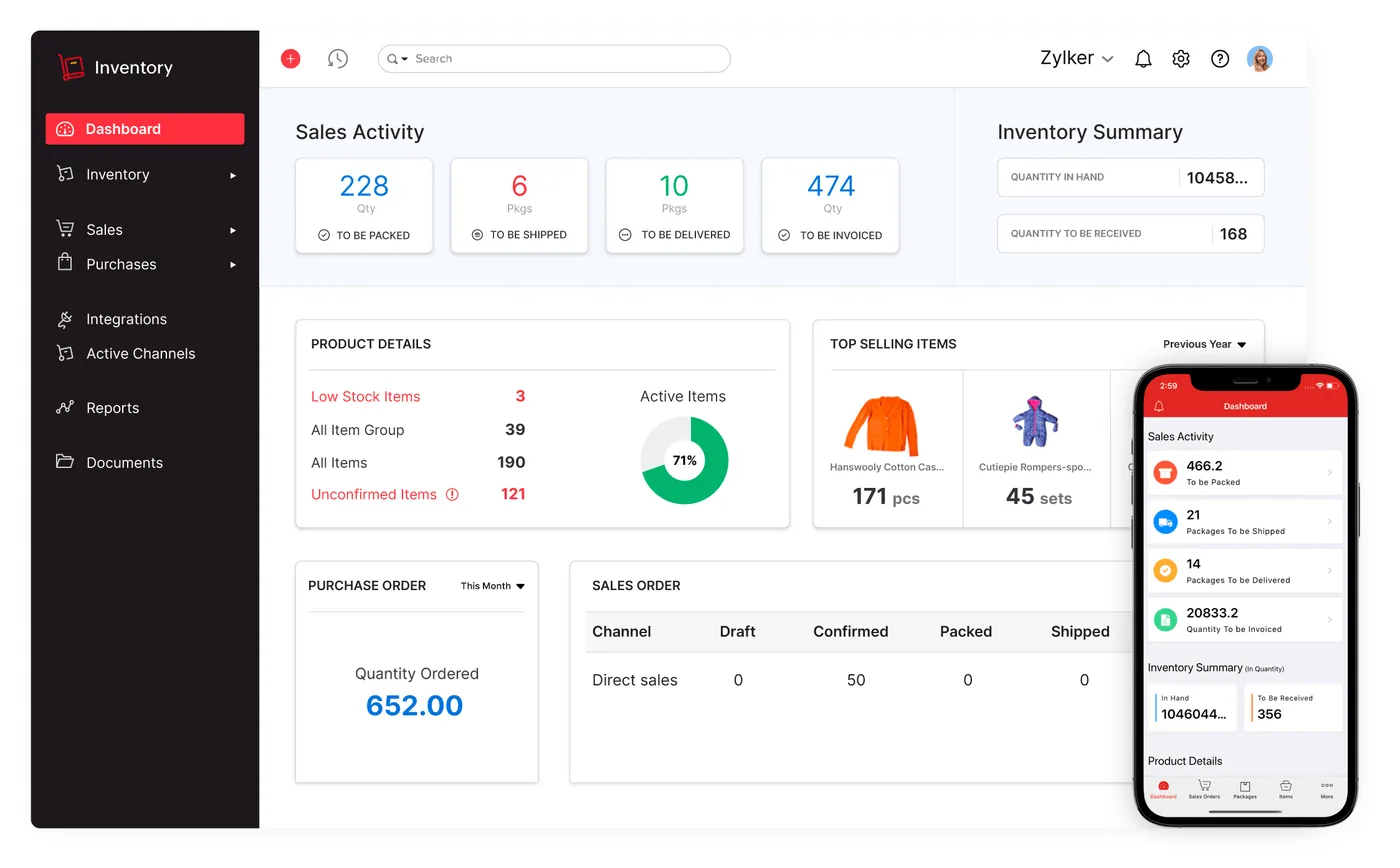
The Zoho Inventory dashboard
Sales activity, inventory summary, low-stock and top-selling items, and order status, on web and mobile.
- Zoho: fastest and lowest cost per user for SMEs and growing teams.
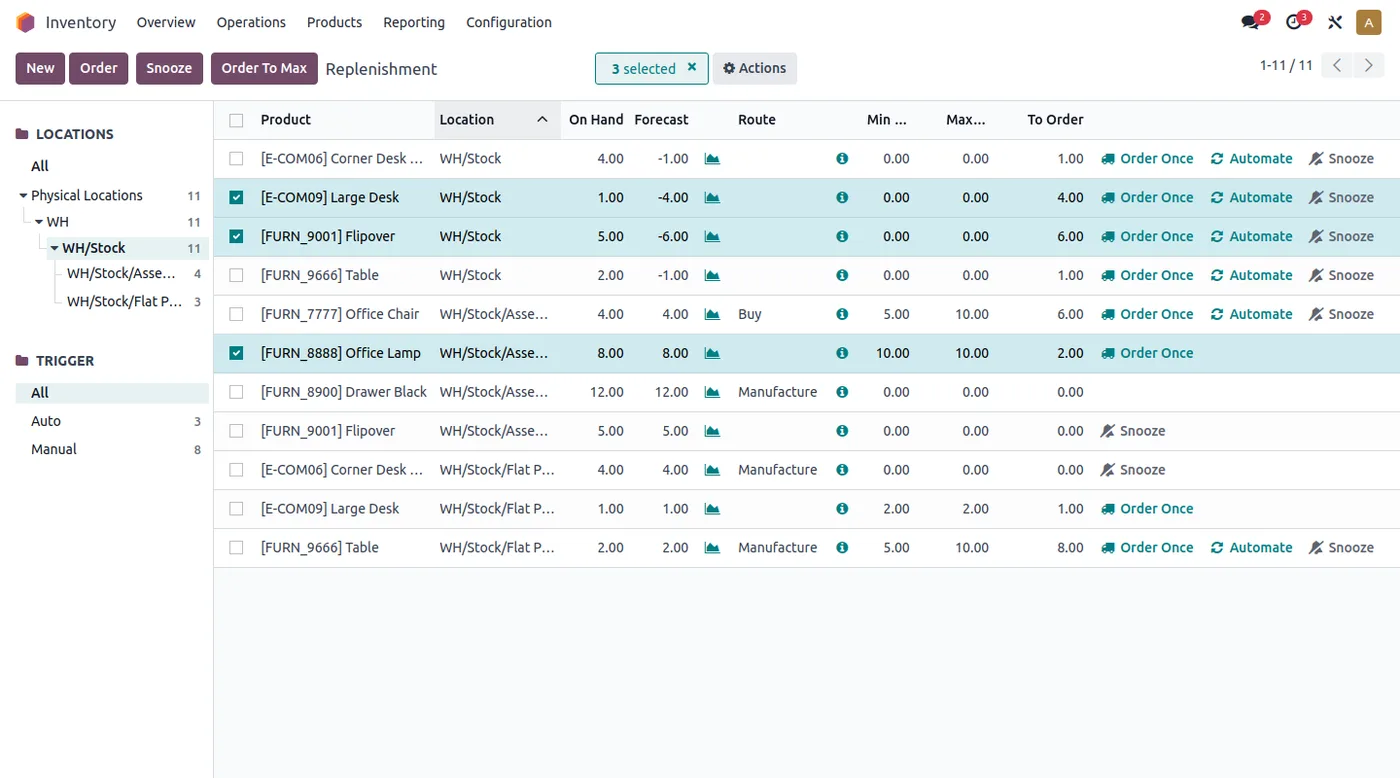
Replenishment in Odoo Inventory
Products below their minimum with the proposed route: buy, manufacture or transfer between warehouses.
- Odoo: strongest where stock, manufacturing and operations lead.
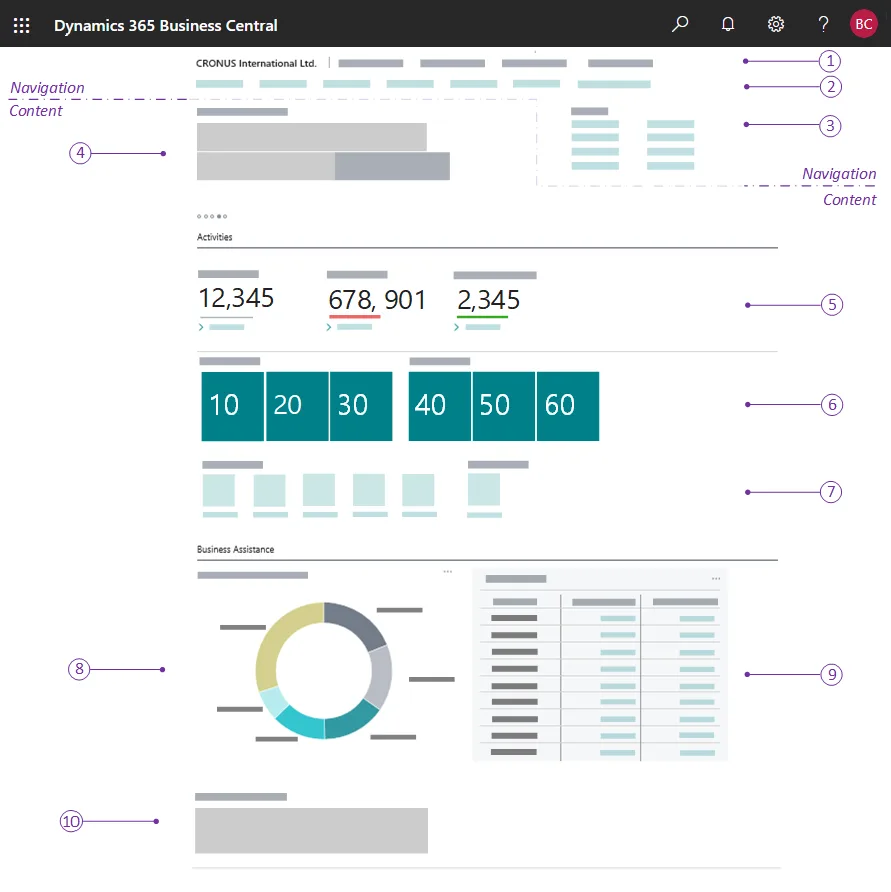
A Business Central role centre
The home page each user gets for their role: headlines, activity cues, KPI tiles, charts and actions. The numbered callouts come from Microsoft's documentation.
- Dynamics 365: best for Microsoft-centric companies and larger groups.
What changes in the UAE
The local rules and realities we design for before go-live. Rules change, so we re-check the current position at scoping.
Heat and staffing reality
Summer heat limits time on loading bays and in mezzanines. Automating replenishment and task sequencing cuts walking and repeated trips, which matters more in UAE conditions than in a mild-climate warehouse.
Re-export paperwork
Traders re-exporting to GCC markets produce commercial invoices and packing lists per shipment. We generate them from the pick and pack data so documents match exactly what was loaded.
WhatsApp alerts done properly
Alerts to drivers and supervisors on WhatsApp use the WhatsApp Business Platform with approved templates and opt-in, not personal numbers, so messages are reliable and records are kept.
How we deliver warehouse automation
Phases, indicative timing and what is delivered in each. Scope is fixed and priced in AED before we start.
Time and motion review
We observe the floor, log manual steps and re-keying, and rank automation candidates by hours saved and risk, with a fixed AED quote.
Rules and interfaces
Replenishment, allocation and alert rules written up; device and equipment interfaces documented with vendors. Each rule has an owner.
Build
Rules configured, integrations and document AI built, with logging for every automated action. Every rule can be switched off individually if needed.
Supervised run
Automation runs with a person approving outputs until results match what supervisors would have done.
Hand over and tune
Approvals removed where safe, thresholds tuned, and a runbook given to your team for exceptions.
When warehouse automation is the wrong answer
Automation amplifies whatever process you have. If receiving is unreliable, bins are not labelled or stock accuracy is poor, automating replenishment or allocation will just make wrong decisions faster. In that case we would fix scanning discipline and data first, then automate a few months later.
How we handle it: We implement Zoho, Odoo and Dynamics 365 and build AI and custom software, so our written recommendation can point you to a simpler option, or to doing nothing yet.


A UAE team you can meet in person
That is our team at Zoholics Dubai 2026. We deliver Zoho, Odoo, Dynamics 365 and custom projects from our Ras Al Khaimah office with remote delivery across all seven emirates, in English and Arabic, and we run workshops on site in Dubai, Abu Dhabi and Sharjah when a project needs it.
Warehouse Automation in the UAE: questions we get asked
What does warehouse automation in the UAE usually cover?
Do you install robots or conveyors?
Can supplier documents be captured automatically?
Which platform is best for warehouse automation?
How do you prove automation is working?
How much does warehouse automation cost?
Why choose Shyphan?

Talk to a consultant about warehouse automation
A free 30-minute call, then a written recommendation and a fixed quote in AED, including the honest option that this is not the right fit.
